
Now Reading: Dark matter, not a black hole, could power Milky Way’s heart
-
01
Dark matter, not a black hole, could power Milky Way’s heart



EarthSky’s 2026 lunar calendar shows the moon phase for every day of the year. Get yours today!
- The Milky Way’s center might contain a dense core of dark matter and not a supermassive black hole, as astronomers have long believed. That’s the new result of a study released on February 5, 2026.
- The new model links the orbits of stars near the galaxy’s center with that of stars at the outer edges of the galaxy.
- The results of the new study are based on the latest data from the European Space Agency’s GAIA DR3 mission. Future studies with the Very Large Telescope will help test this new theory.
The Royal Astronomical Society published this original story on February 5, 2026. Edits by EarthSky.
Dark matter, not a black hole, could power Milky Way’s heart
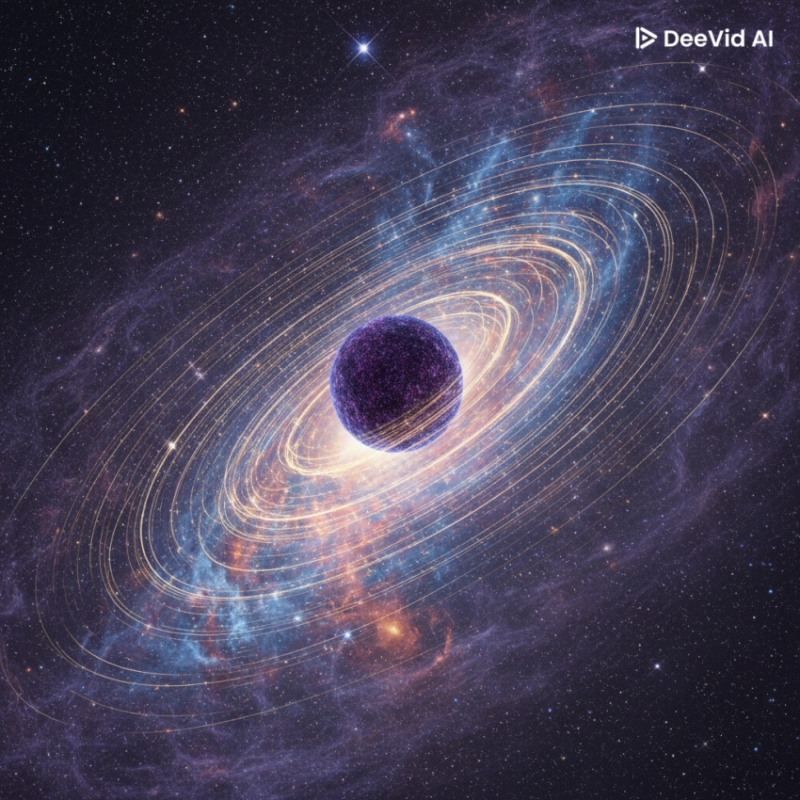
Our Milky Way galaxy might not have a supermassive black hole at its center, after all. Instead, the galaxy’s heart might contain an enormous clump of mysterious dark matter. If it’s true, this dark matter would exert the same gravitational influence as a black hole, astronomers said on February 5, 2026.
They said they believe dark matter at the Milky Way’s core can explain both the blistering speeds of stars just light-hours from the core. Plus dark matter can explain the large-scale rotation of the galaxy as a whole.
The peer-reviewed Monthly Notices of the Royal Astronomical Society published the new study on February 5, 2026.
No supermassive black hole at the heart of our galaxy?
The new study challenges the leading theory that Sagittarius A* – a proposed black hole at the heart of our galaxy – is responsible for the observed orbits of a group of stars, known as the S-stars. These stars whip around at tremendous speeds of up to a few thousand kilometers per second.
The international team of researchers have instead put forward an alternative idea: that a specific type of dark matter made up of fermions, or light subatomic particles, can create a unique cosmic structure that also fits with what we know about the Milky Way’s core.
It would in theory produce a super-dense, compact core surrounded by a vast, diffuse halo. These, together, would act as a single, unified entity.
The inner core would be so compact and massive that it could mimic the gravitational pull of a black hole. It would also explain the orbits of S-stars that have been observed in previous studies, as well as the orbits of the dust-shrouded objects known as G-sources, which also exist nearby.
Data from GAIA
Of particular importance to the new research are the latest data from the European Space Agency’s GAIA DR3 mission. This mission has meticulously mapped the rotation curve of the Milky Way’s outer halo, showing how stars and gas orbit far from the center.
It observed a slowdown of our galaxy’s rotation curve, known as the Keplerian decline. Researchers say this can be explained by their dark matter model’s outer halo when combined with the traditional disk and bulge mass components of ordinary matter.
This, they add, strengthens the ‘fermionic’ model by highlighting a key structural difference. While traditional Cold Dark Matter halos spread out following an extended ‘power law’ tail, the fermionic model predicts a tighter structure, leading to more compact halo tails.
The research has been carried out by an international collaboration involving the Institute of Astrophysics La Plata in Argentina, International Centre for Relativistic Astrophysics Network and National Institute for Astrophysics in Italy, Relativity and Gravitation Research Group in Colombia and Institute of Physics University of Cologne in Germany.
A dense core of dark matter plus halo
Co-author Carlos Argüelles, of the Institute of Astrophysics La Plata, said:
This is the first time a dark matter model has successfully bridged these vastly different scales and various object orbits, including modern rotation curve and central stars data.
We are not just replacing the black hole with a dark object; we are proposing that the supermassive central object and the galaxy’s dark matter halo are two manifestations of the same, continuous substance.
New model fits with the famous ‘black hole’ image
Crucially, this fermionic dark matter model had already passed a significant test. A previous study by Pelle et al. (2024), also published in MNRAS, showed that when an accretion disk illuminates these dense dark matter cores, they cast a shadow-like feature strikingly similar to the one imaged by the Event Horizon Telescope collaboration for Sagittarius A*.
Lead author Valentina Crespi, of the Institute of Astrophysics La Plata, said:
This is a pivotal point. Our model not only explains the orbits of stars and the galaxy’s rotation but is also consistent with the famous ‘black hole shadow’ image. The dense dark matter core can mimic the shadow because it bends light so strongly, creating a central darkness surrounded by a bright ring.
The researchers statistically compared their fermionic dark matter model to the traditional black hole model.
They found that while current data for the inner stars cannot yet decisively distinguish between the two scenarios, the dark matter model provides a unified framework that explains the galactic center (central stars and shadow), and the galaxy at large.
What’s next for the dark matter core model?
The new study paves the way for future observations. More precise data from instruments such as the GRAVITY interferometer, on the Very Large Telescope in Chile, and the search for the unique signature of photon rings – a key feature of black holes and absent in the dark matter core scenario – will be crucial to test the predictions of this new model, the authors say.
The outcome of these findings could potentially reshape our understanding of the fundamental nature of the cosmic behemoth at the heart of the Milky Way.
Bottom line: A new study suggests a dark matter core, and not a supermassive black hole, lies at the center of our Milky Way galaxy. The new theory also helps explain the galaxy’s dark matter halo.
Via Royal Astronomical Society
The post Dark matter, not a black hole, could power Milky Way’s heart first appeared on EarthSky.










Related Posts
Stay Informed With the Latest & Most Important News
Previous Post
Next Post



Advertisement
-
 01Two Black Holes Observed Circling Each Other for the First Time
 -
 02From Polymerization-Enabled Folding and Assembly to Chemical Evolution: Key Processes for Emergence of Functional Polymers in the Origin of Life
 -
 03Astronomy 101: From the Sun and Moon to Wormholes and Warp Drive, Key Theories, Discoveries, and Facts about the Universe (The Adams 101 Series)
 -
 04True Anomaly hires former York Space executive as chief operating officer
 -
 05Φsat-2 begins science phase for AI Earth images
 -
 06Hurricane forecasters are losing 3 key satellites ahead of peak storm season − a meteorologist explains why it matters
 -
 07Binary star systems are complex astronomical objects − a new AI approach could pin down their properties quickly