
Now Reading: Space Force awards $54.5 million contract to Starfish Space for GEO servicing vehicle
-
01
Space Force awards $54.5 million contract to Starfish Space for GEO servicing vehicle

Space Force awards $54.5 million contract to Starfish Space for GEO servicing vehicle

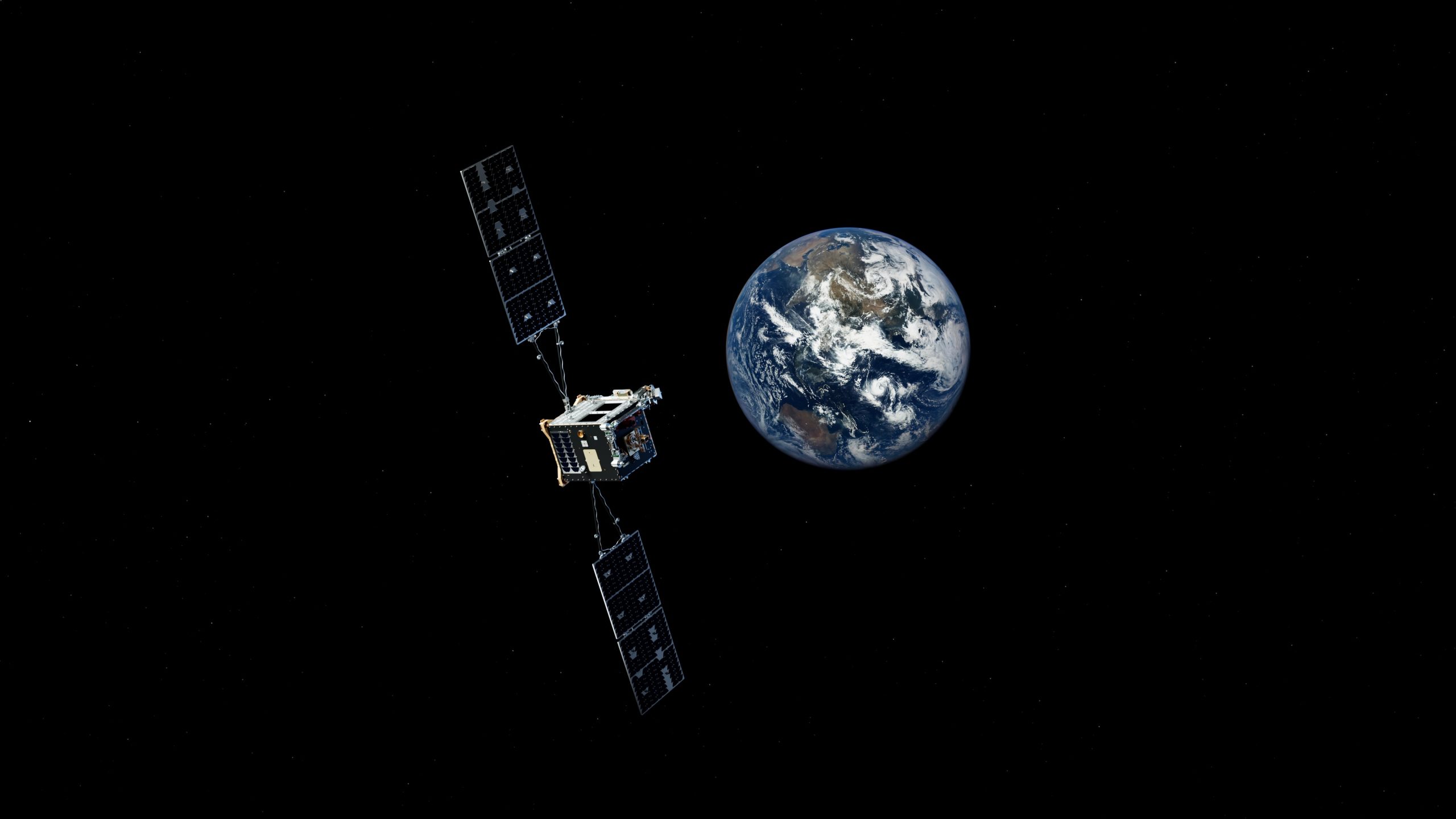

WASHINGTON — The U.S. Space Force has awarded a $54.5 million contract to Starfish Space to build and operate a spacecraft designed to support military satellites in geostationary Earth orbit.
The contract, awarded on Feb. 2, covers the manufacture and operation of an Otter servicing vehicle — the name of Starfish’s spacecraft — for at least five years.
Otter is a class of spacecraft known as space tugs, which are designed to move, reposition or sustain other satellites once they are already in orbit. In military operations, these vehicles are intended to give commanders more flexibility over how satellites are operated and defended.
“The Otter vehicle will provide the United States Space Force with mobility solutions through relocation, including to disposal orbits, and life extension services through station keeping for fuel-limited national security space assets in GEO,” a spokesperson for the Space Systems Command said in a statement to SpaceNews Feb. 6.
According to a Pentagon contract announcement, the $54.5 million agreement covers the manufacturing of an Otter vehicle and includes two option years for operational support. While Otter is a commercial spacecraft, the version covered by this contract would be specifically for military use.
The contract was funded by a Pentagon initiative known as APFIT — Accelerate the Procurement and Fielding of Innovative Technologies — which in the 2026 budget included $48.5 million for an “augmented maneuver vehicle for satellites.”
Austin Link, co-founder of Starfish Space, said the APFIT funding supports “transitioning platforms like Otter from development to deployed capability.”
This will be the second Otter acquired by the Space Systems Command. It follows a 2024 contract worth $37.5 million awarded to Starfish for a demonstration vehicle projected to launch in 2026.
“This effort transitions the augmented maneuver demonstration awarded to Starfish Space in 2024 to an operational capability,” the spokesperson said. “Specifically, it provides for manufacture, test, manifest, launch and on-orbit commissioning of a DoD configured Otter vehicle in GEO, posturing the United States Space Force to present up to 60 months of on-orbit capability to the warfighter.”
Starfish said the second contract “reflects confidence in Starfish to deliver a near-term, deployable capability, with the Otter scheduled for delivery in 2028.” The agreement includes options to operate the vehicle through 2030.
‘Augmented maneuver’
In military space planning, augmented maneuver refers to the ability to move satellites more frequently, farther or less predictably than their onboard propulsion systems alone would allow. Most national security satellites are constrained by limited fuel reserves, which restrict how often they can change orbits without shortening their operational lives. A space tug, typically equipped with high-efficiency electric propulsion and designed to dock with or attach to another spacecraft, can provide propulsion on behalf of the satellite, preserving its fuel. From a military standpoint, that added mobility can complicate adversary tracking and targeting.
Relocation involves shifting satellites between orbits or orbital planes to meet changing mission demands. This could include moving a sensor or communications satellite to support operations in a new region, filling coverage gaps caused by satellite failures or dispersing assets during a crisis. Using tugs to reposition satellites already on orbit can reduce reliance on rapid replacement launches and shorten response times.
Station keeping, the routine task of maintaining a satellite’s precise orbital position, is another use case. Space tugs act as external propulsion or life-extension systems. For high-value satellites in geostationary orbit, this can stretch operational life and defer replacement costs.
Starfish says Otter is engineered to rendezvous with, dock to and interact with other satellites without requiring prior hardware modifications on the client spacecraft, a design choice meant to broaden the range of satellites it can service.
Founded in 2019, the Seattle-based company has steadily expanded its defense portfolio. It recently announced a $52.5 million deal with the Space Development Agency to provide deorbit-as-a-service for satellites in the Proliferated Warfighter Space Architecture constellation being built for the Defense Department.
Starfish launched its first test spacecraft, Otter Pup 1, in 2023. Otter Pup 2 launched in 2025 and is intended to attempt a docking with a D-Orbit spacecraft. The company says its next three Otter missions are planned for NASA, the U.S. Space Force and Intelsat. Otter Pup spacecraft are roughly the size of a microwave oven.










Related Posts

Stay Informed With the Latest & Most Important News



Advertisement
-
 01Two Black Holes Observed Circling Each Other for the First Time
 -
 02From Polymerization-Enabled Folding and Assembly to Chemical Evolution: Key Processes for Emergence of Functional Polymers in the Origin of Life
 -
 03Astronomy 101: From the Sun and Moon to Wormholes and Warp Drive, Key Theories, Discoveries, and Facts about the Universe (The Adams 101 Series)
 -
 04True Anomaly hires former York Space executive as chief operating officer
 -
 05Φsat-2 begins science phase for AI Earth images
 -
 06Hurricane forecasters are losing 3 key satellites ahead of peak storm season − a meteorologist explains why it matters
 -
 07Binary star systems are complex astronomical objects − a new AI approach could pin down their properties quickly