
Now Reading: A Chemistry-First Centered Icy Chemical Inventory of Protostellar Sources with JWST
-
01
A Chemistry-First Centered Icy Chemical Inventory of Protostellar Sources with JWST

A Chemistry-First Centered Icy Chemical Inventory of Protostellar Sources with JWST

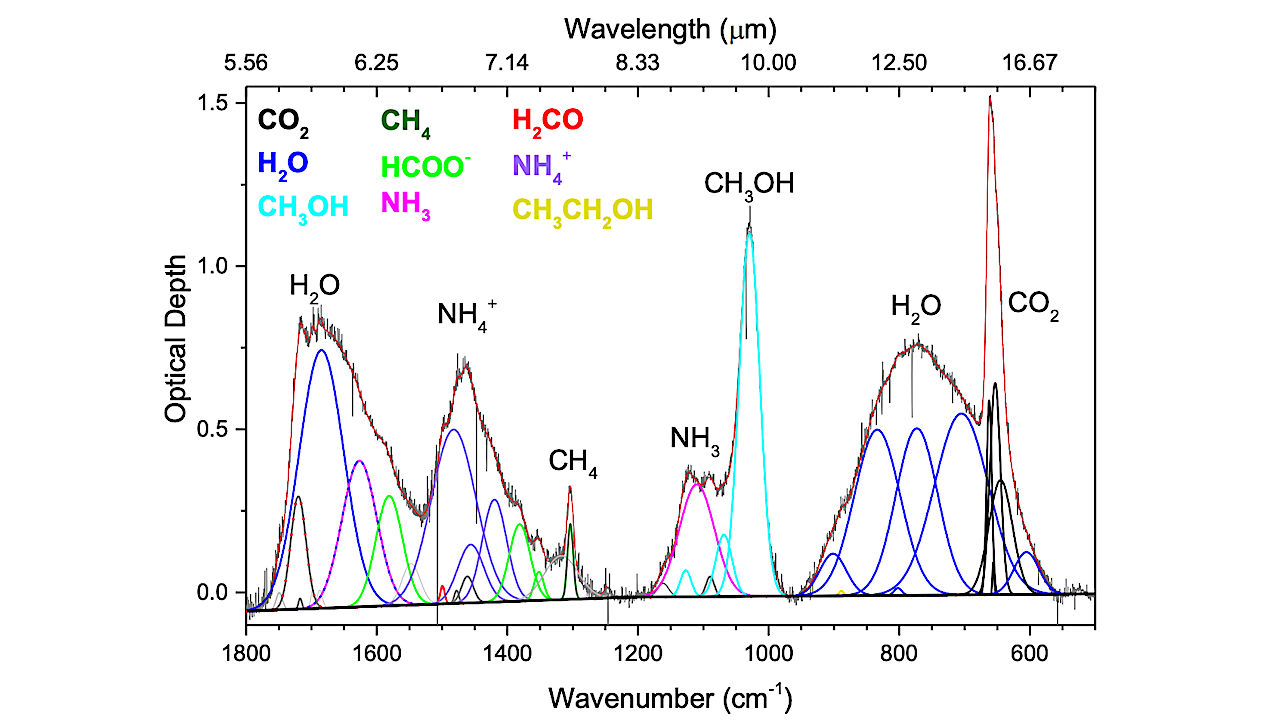
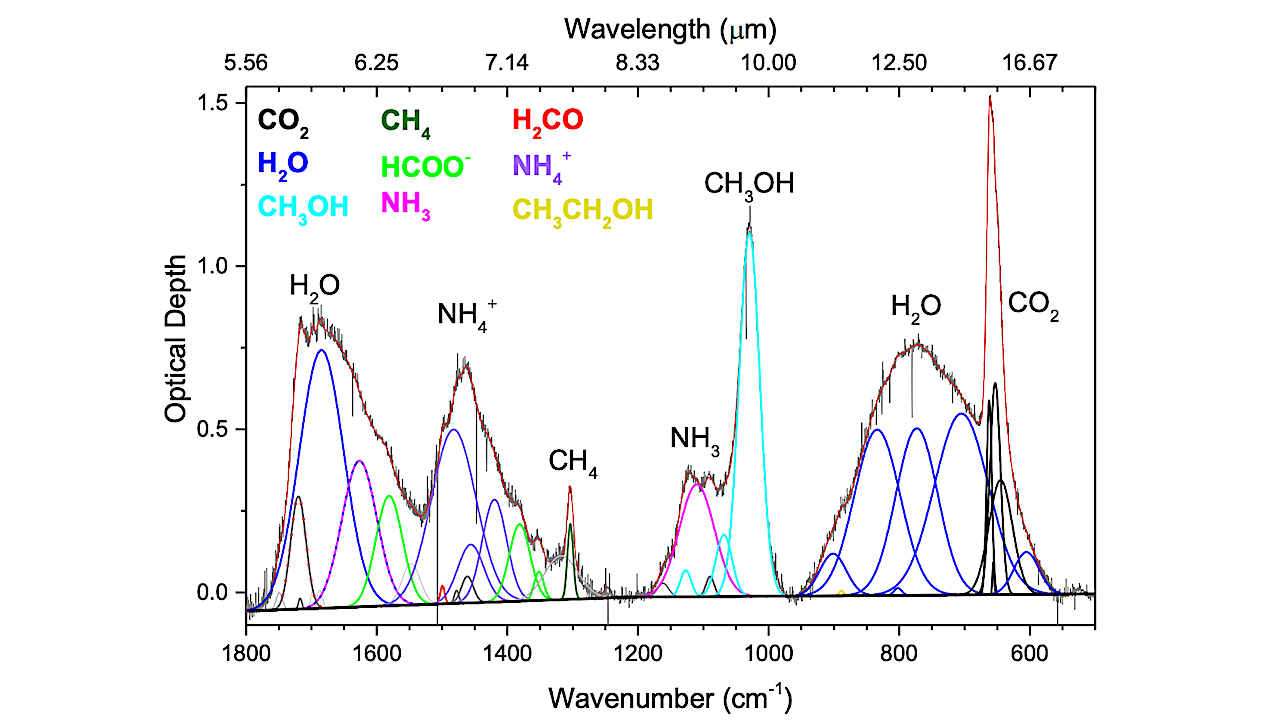
Infrared spectrum of Ser-emb7 after continuum removal and peak fitting. The original spectrum (dark gray) is fit with color-coded peaks, which are identified in the legend, that sum to an overall fit (red). Light gray peaks are not assigned to one molecule and are explained in Table 2, and the locally-fitted baseline is black. — astro-ph.GA
The chemical evolution in star forming regions is driven by the interplay between gas and ice mantles. Identifying the ice compositions at the early stage of star formation thus provides constraints on the chemical processes inaccessible from gas-phase characterizations.
As part of the CORINOS program, spectra from the James Webb Space Telescope (JWST) MIRI MRS were taken toward four Class 0 protostars: IRAS 15398-3359, Ser-emb7, L483, and B335. The spectra were processed with simultaneous fitting of a continuum and silicate absorption to produce optical depth mid-infrared spectra of the ices at 5-28 μm (360-2000 cm−1) toward these four sources.
Simple molecules such as water (H2O), carbon dioxide (CO2), methanol (CH3OH), formic acid/formate (HCOOH/HCOO−), ammonia/ammonium (NH3/NH4+), and formaldehyde (H2CO) are the most abundant features in these ices, while complex organic molecules (COMs) represent a smaller contribution.
Likely COMs include hydroxylamine (NH2OH), methylamine (CH3NH2), and ethanol (CH3CH2OH). Absorption features belonging to functional groups such as -CH3 and -OH suggest that additional COMs are present, but these cannot be unambiguously assigned due to overlapping bands. Formation pathways toward these COMs utilizing radical-radical combination reactions based on laboratory simulation experiments is presented.
By extension, COMs predicted by these reactions, but absent from the spectra, are discussed. The results provide insight into the chemical environment of these ices and also highlight the critical need for caution and sufficient evidence in order to confidently identify COMs in ice.
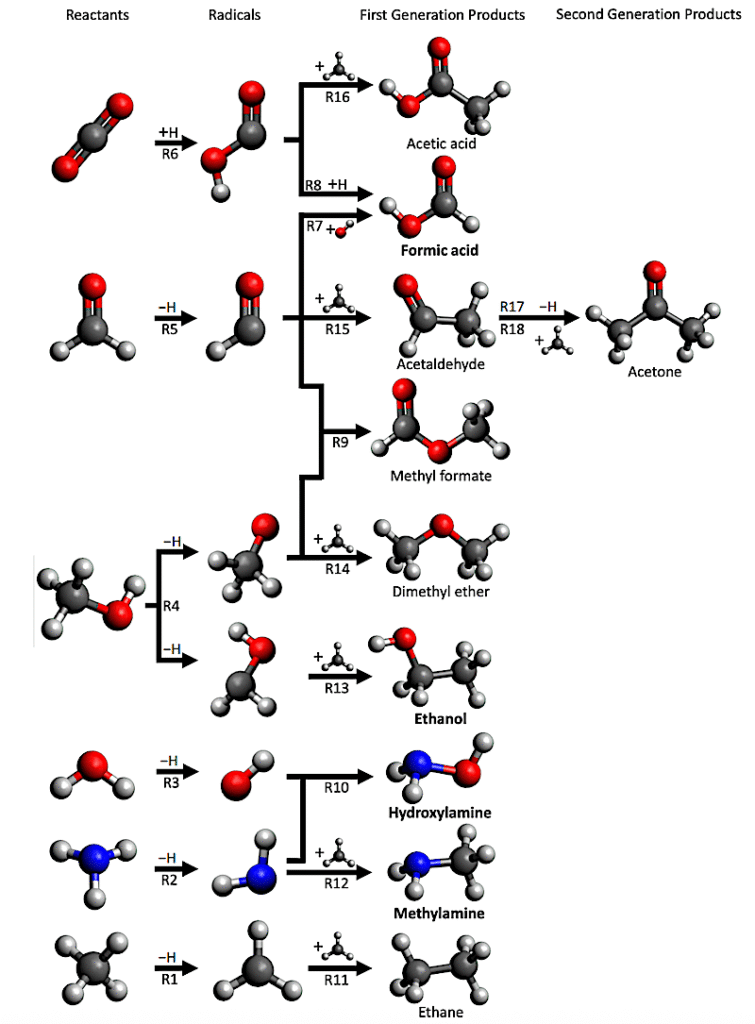
Reaction scheme demonstrating the formation of complex organic molecules in the JWST spectra via radical-radical recombination reactions starting from simple reactants such as carbon dioxide (CO2), formaldehyde (H2CO), methanol (CH3OH), water (H2O), ammonia (NH3), and methane (CH4). Each of these pathways have been identified identified in laboratory ice analogue experiments. Chemical names in bold were identified in the JWST spectra with greater confidence. — astro-ph.GA
Andrew M. Turner, Yao-Lun Yang, Rachel Gross, Nami Sakai, Ralf I. Kaiser
Comments: Accepted to The Astrophysical Journal
Subjects: Astrophysics of Galaxies (astro-ph.GA); Solar and Stellar Astrophysics (astro-ph.SR)
Cite as: arXiv:2602.05383 [astro-ph.GA] (or arXiv:2602.05383v1 [astro-ph.GA] for this version)
https://doi.org/10.48550/arXiv.2602.05383
Focus to learn more
Submission history
From: Yao-Lun Yang
[v1] Thu, 5 Feb 2026 07:08:33 UTC (8,710 KB)
https://arxiv.org/abs/2602.05383
Astrobiology, AStrochemistry,










Related Posts
Stay Informed With the Latest & Most Important News
Previous Post
Next Post


Advertisement
-
 01Two Black Holes Observed Circling Each Other for the First Time
 -
 02From Polymerization-Enabled Folding and Assembly to Chemical Evolution: Key Processes for Emergence of Functional Polymers in the Origin of Life
 -
 03Astronomy 101: From the Sun and Moon to Wormholes and Warp Drive, Key Theories, Discoveries, and Facts about the Universe (The Adams 101 Series)
 -
 04True Anomaly hires former York Space executive as chief operating officer
 -
 05Φsat-2 begins science phase for AI Earth images
 -
 06Hurricane forecasters are losing 3 key satellites ahead of peak storm season − a meteorologist explains why it matters
 -
 07Binary star systems are complex astronomical objects − a new AI approach could pin down their properties quickly