
Now Reading: The Phylogenetic Context For The Origin Of A Unique Purple-green Photosymbiosis
-
01
The Phylogenetic Context For The Origin Of A Unique Purple-green Photosymbiosis


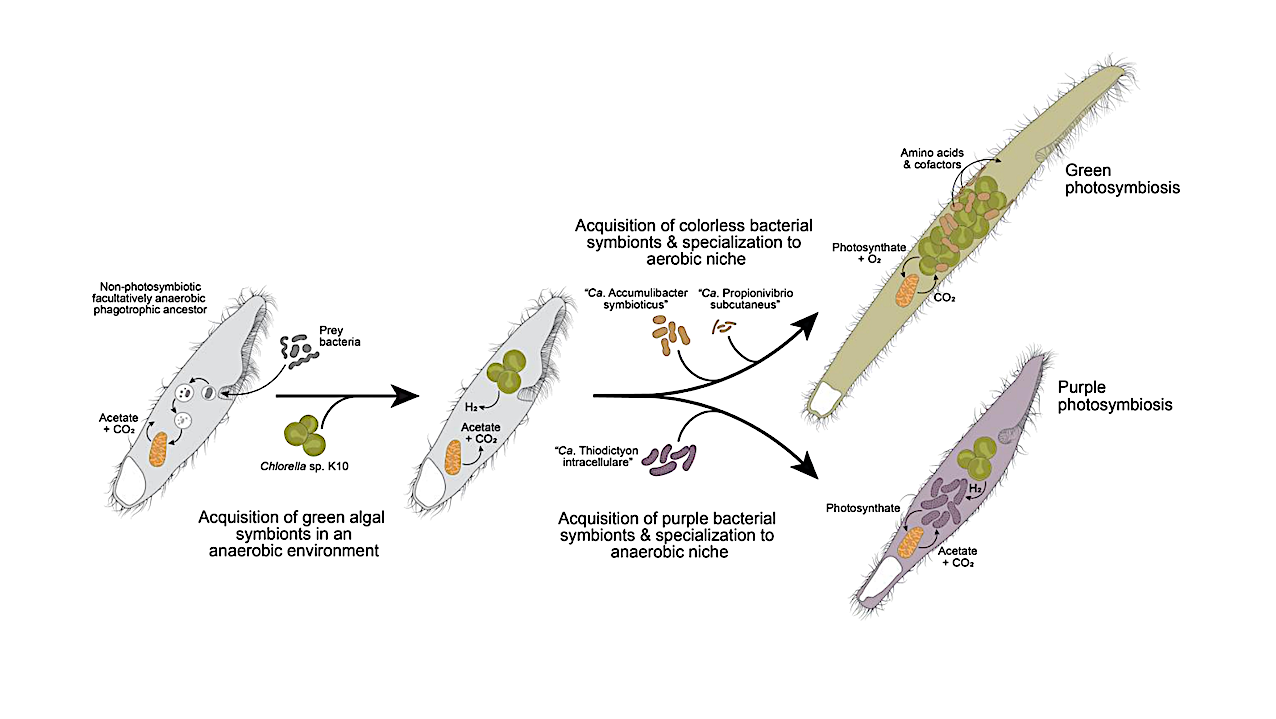
Hypothetical sequence of events that led to the origin of the purple-green photosymbiosis of P. tenue. See main text for details. Note that all ancestors and extant species remain phagotrophic (or mixotrophic in the case of photosymbiosis). This study has revealed the order of endosymbiont acquisition in P. tenue and potential pre adaptations that facilitated the symbiosis. These insights have, in turn, shed light on the question of how two contrasting photosynthetic symbionts came to exist within the same host. Moreover, we have expanded the known diversity of the genus Pseudoblepharisma by discovering new non photosymbiotic species and confidently establishing the sister relationship between the genera Pseudoblepharisma and Spirostomum in the family Spirostomidae. Our genome-based predictions on the physiology of photosymbiotic Pseudoblepharisma species represent the basis for future experimental work on the identity of the metabolites that are exchanged among symbiotic partners. — biorxiv.org
Symbioses are widespread in nature and have been the source of much evolutionary innovation. While some types of symbioses evolved multiple times across space and time (e.g., oxygenic photosymbioses or chemosymbioses), others are extremely rare. Purple photosymbioses are an example of such rare associations.
Only two purple photosymbioses between heterotrophic eukaryotes and intracellular purple bacteria have been documented. This is in stark contrast to very common oxygenic photosymbioses and poses the question of what factors prevent the more frequent establishment of purple photosymbioses. To shed light on this question, we investigated the evolutionary history of the purple-green ciliate Pseudoblepharisma tenue (Spirostomidae) using a phylogenetic and comparative approach.
We sampled about 30 new isolates of spirostomid ciliates, inferred a comprehensive and well-supported phylogenomic tree, and resolved the sister relationship between Pseudoblepharisma and Spirostomum. Furthermore, we characterized P. tenue’s sister species, here renamed Pseudoblepharisma chlorelligera, and revealed that it constitutes a quadripartite symbiosis between a ciliate, a green alga, and two different non-photosynthetic bacteria.
In addition, we discovered three colorless, non-photosymbiotic Pseudoblepharisma species, which branch as sister to the photosymbiotic P. tenue and P. chlorelligera.
Our phylogenetic and comparative genomic analyses suggest that the green algal symbionts of P. tenue predated the acquisition of purple bacterial symbionts, and that the ancestor of the extant Pseudoblepharisma species was non-photosymbiotic and facultatively anaerobic.
These data allowed us to hypothesize on the evolutionary steps that led to the origin of P. tenue and thus bring us closer to explaining the conditions that led to the evolutionary emergence of a unique purple-green symbiosis.
The phylogenetic context for the origin of a unique purple-green photosymbiosis, biorxiv.org
Astrobiology,











Related Posts

Stay Informed With the Latest & Most Important News
Previous Post
Next Post




Advertisement
-
 01Two Black Holes Observed Circling Each Other for the First Time
 -
 02From Polymerization-Enabled Folding and Assembly to Chemical Evolution: Key Processes for Emergence of Functional Polymers in the Origin of Life
 -
 03Astronomy 101: From the Sun and Moon to Wormholes and Warp Drive, Key Theories, Discoveries, and Facts about the Universe (The Adams 101 Series)
 -
 04True Anomaly hires former York Space executive as chief operating officer
 -
 05Φsat-2 begins science phase for AI Earth images
 -
 06Hurricane forecasters are losing 3 key satellites ahead of peak storm season − a meteorologist explains why it matters
 -
 07Binary star systems are complex astronomical objects − a new AI approach could pin down their properties quickly