
Now Reading: Microbial Communities Of Selected Regions Of The Deep Springs Lake Aquifer System
-
01
Microbial Communities Of Selected Regions Of The Deep Springs Lake Aquifer System


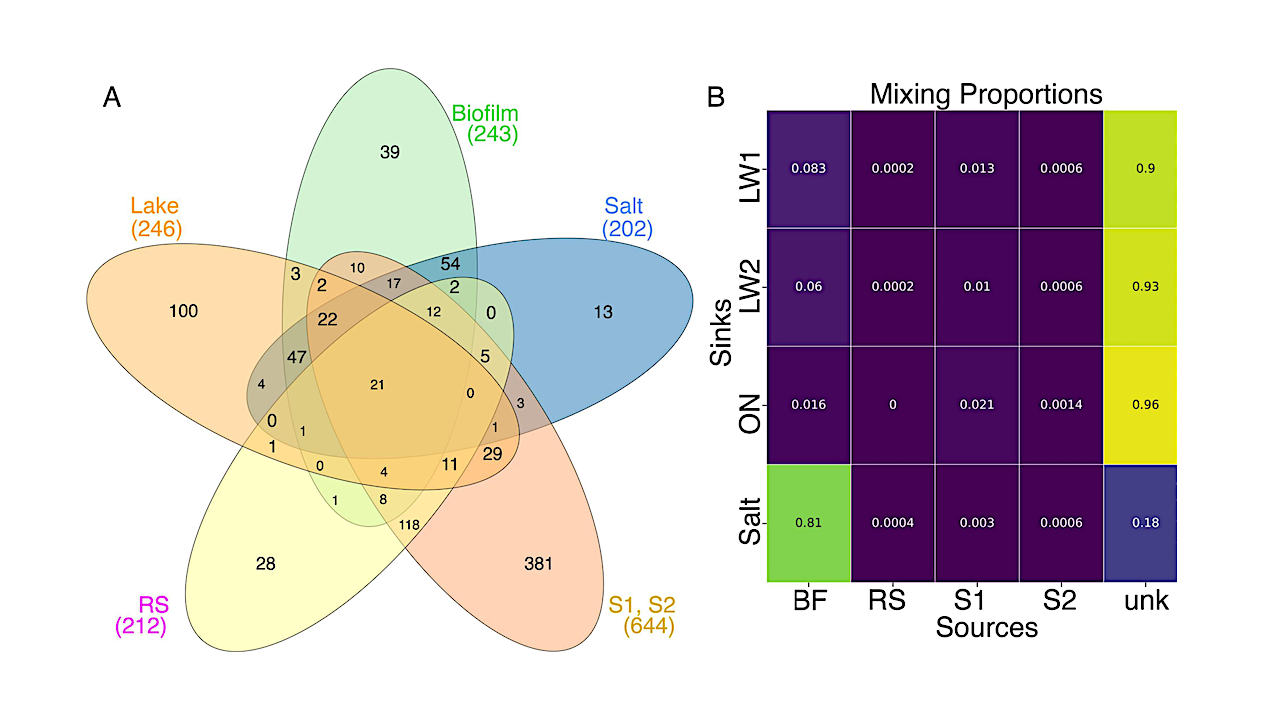
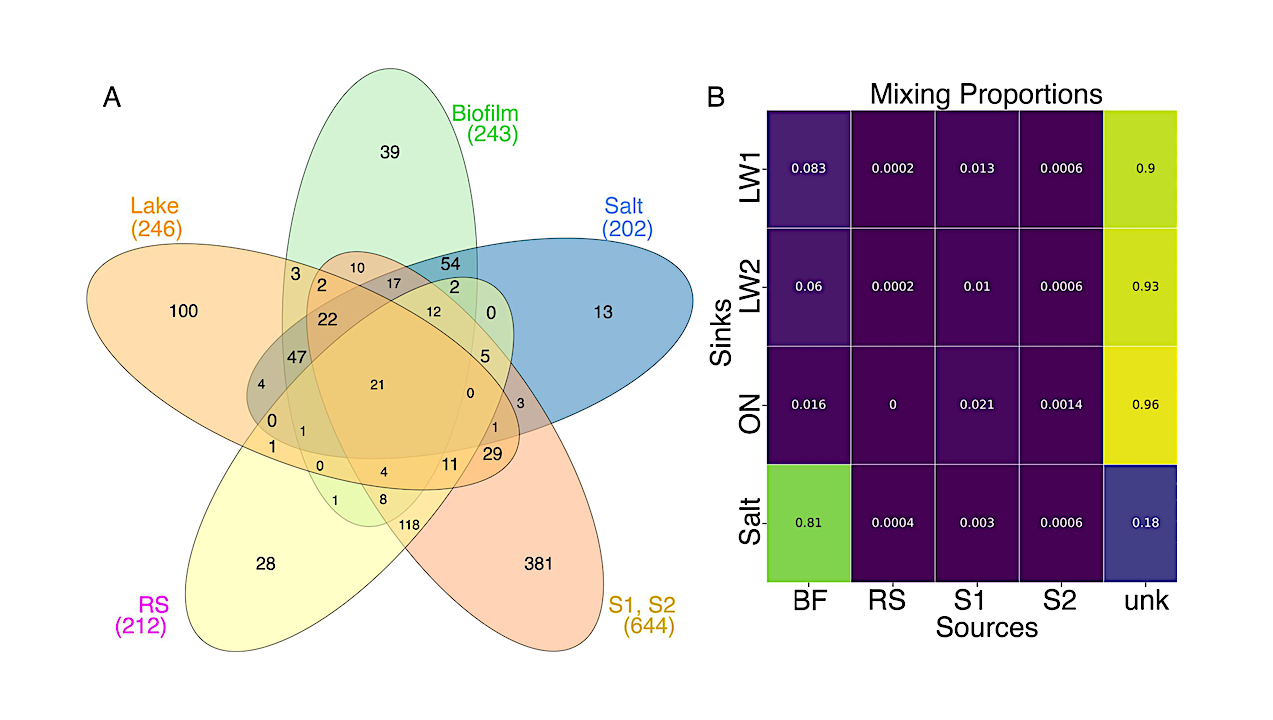
Contribution of springs to the lake. (A) Venn diagram of genera found in the Corral Springs biofilm, salt crust, Springs 1 and 2 (S1, S2 combined), Roberts Ranch/Wyman Creek (RS), and the lake water. (B) Mixing proportions calculated using SourceTracker using the lake water samples (LW1, LW2, and overnight incubated [ON]) and the salt crust as sinks, and the biofilm, RS, S1 and S2 as sources. “Unk” indicates “unknown source.” The Gibbs sampler was run for 10,000 iterations. — Frontiers
Deep Springs Lake is a small, isolated, highly alkaline soda lake in Inyo County of Eastern California, USA. It is a seasonally filled salt lake or playa, and is part of a closed aquifer system.
Such closed systems are globally rare, occurring only in arid zones where annual evaporation is greater than annual rainfall. Deep Springs Lake’s hydrology and geology have been well studied, and it is home to a unique toad species, but its microbiome remains unexplored. Here we perform 16S, 18S, and ITS amplicon sequencing of the lake water, dried salt crust at the edges the lake, and nearby feeder springs to investigate the community composition of prokaryotes, eukaryotes, and fungi.
Bacterial communities in the lake water consist predominantly of Pseudomonadota and Bacteroidota. Nearby springs and salt crust contain different genera of Pseudomonadota than the lake water but similar Bacteroidota, along with an abundant population of Chlorobiota.
Noticeably rare in the lake itself but abundant in the biofilms and crust are populations of photosynthetic Cyanobacteria. Archaea are found only in the lake water, largely Halobacterota. Fungi are mostly Ascomycota, with some Chytridiomycota and Rozellomycota; chytrid fungi show no evidence of pathogens related to amphibian die-offs.
Eukaryotes in the lake water consist mostly of flagellates, notably the photosynthetic Dunaliella, and brine shrimp (Artemia). In order to compare these sites with source waters elsewhere in the watershed, we also perform 16S amplicon sequencing of three feeder springs found at higher elevations remote from the lake.
The Pseudomonadota found in the remote sites differ from those in the lake at the genus level or higher. Some of the genera of Bacteroidota found in the lake are also seen in the remote springs, while most are unique to the springs. Taxonomy and Bayesian source/sink analysis show that the microbiome of Deep Springs Lake derives very little input from the remote feeder springs, but contains extremophiles similar to those of soda lakes worldwide.
Further investigation of the lake and its surrounding springs may lead to the identification of new species of bacteria, fungi, and eukaryotes and allow comparisons with other closed aquifer systems.
Astrobiology, extremophile,










Related Posts
Stay Informed With the Latest & Most Important News

Advertisement
-
 01Two Black Holes Observed Circling Each Other for the First Time
 -
 02From Polymerization-Enabled Folding and Assembly to Chemical Evolution: Key Processes for Emergence of Functional Polymers in the Origin of Life
 -
 03Astronomy 101: From the Sun and Moon to Wormholes and Warp Drive, Key Theories, Discoveries, and Facts about the Universe (The Adams 101 Series)
 -
 04True Anomaly hires former York Space executive as chief operating officer
 -
 05Φsat-2 begins science phase for AI Earth images
 -
 06Hurricane forecasters are losing 3 key satellites ahead of peak storm season − a meteorologist explains why it matters
 -
 07Binary star systems are complex astronomical objects − a new AI approach could pin down their properties quickly