
Now Reading: A Narrowband Technosignature Search Toward The Hycean Candidate K2-18b Using The VLA And MeerKAT
-
01
A Narrowband Technosignature Search Toward The Hycean Candidate K2-18b Using The VLA And MeerKAT

A Narrowband Technosignature Search Toward The Hycean Candidate K2-18b Using The VLA And MeerKAT

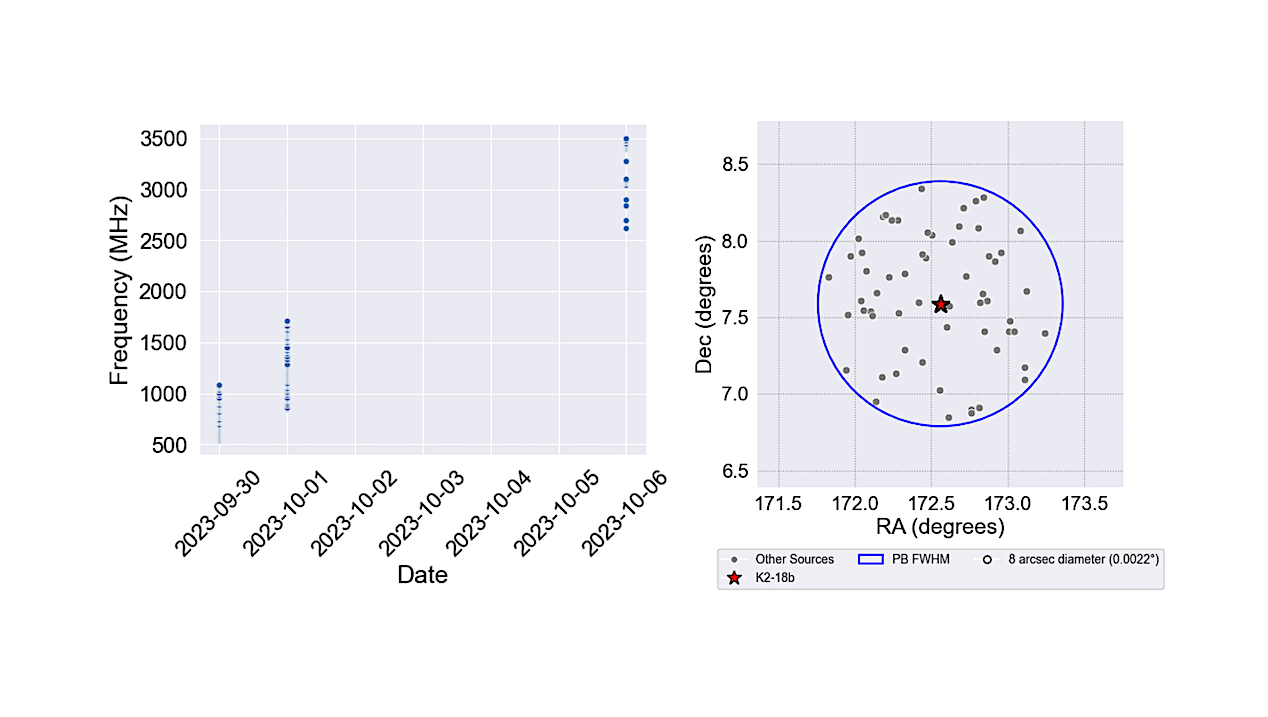
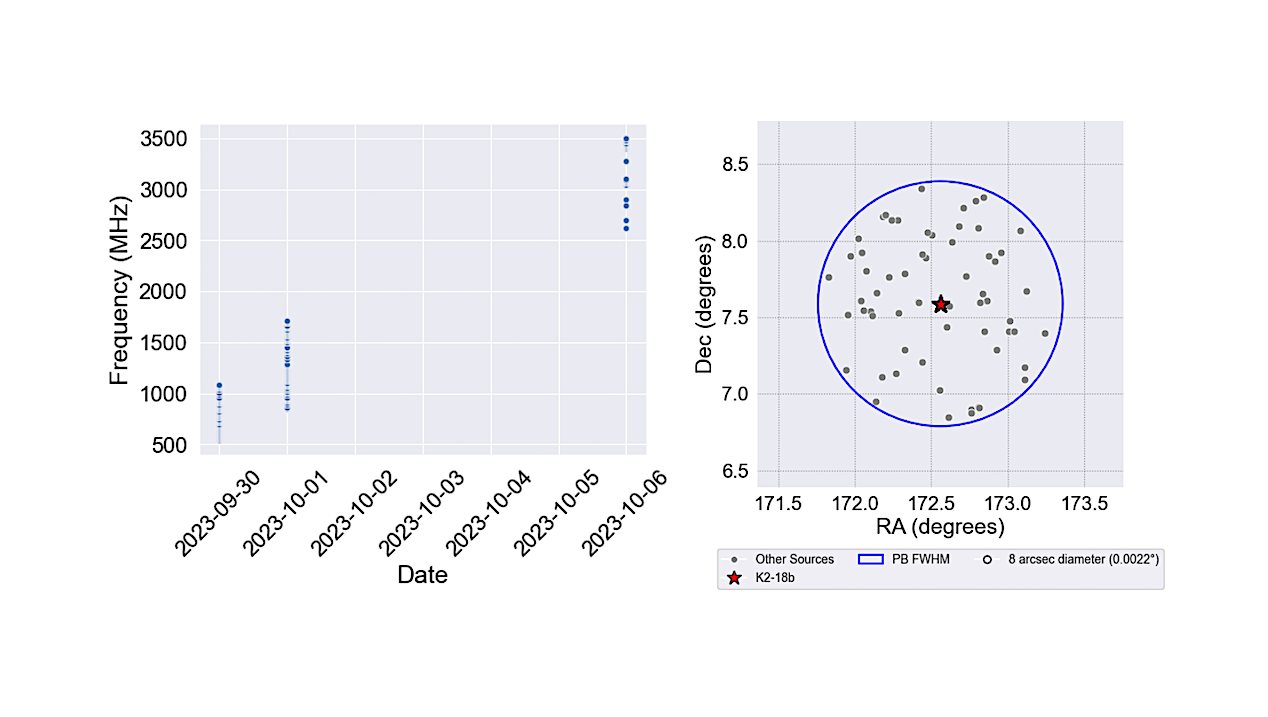
The observed sources and data collected during the K2-18b observing campaign. (Left) The dates of the observations and the frequencies in which signals were detected. (Right) The location of the 64 coherent beams (gray circles), the position of K2-18 (red star), and the FWHM PB for the MeerKAT telescope at L-band. — astro-ph.EP
K2-18b, a sub-Neptune exoplanet located in the habitable zone of its host star, has emerged as an important target for atmospheric characterization and assessments of potential habitability.
Motivated by recent interpretations of JWST observations suggesting a hydrogen-rich atmosphere consistent with Hycean-world scenarios, we conducted a coordinated, multi-epoch search for narrowband radio technosignatures using the Karl G. Jansky Very Large Array equipped with the COSMIC backend and the MeerKAT telescope with the BLUSE backend.
Our observations span frequencies from 544MHz to 9.8GHz and include multiple epochs that cover at least one full orbital period of the planet. In this work, we outline, create, and apply a comprehensive post-processing framework that incorporates observatory-informed RFI masking, drift-rate filtering based on the expected dynamics of the K2-18 system, multibeam spatial discrimination, primary and secondary transit filtering (when applicable), and SNR-based excision of weak and strong spurious signals.
Across all bands and epochs, no signals consistent with an astrophysical or artificial origin were identified at a limit of 10^12 to 10^13W. These non-detections allow us to place upper limits on the presence of persistent, isotropic narrowband transmitters within the K2-18 system, providing the first interferometric technosignature constraints for a Hycean-planet candidate.
Our results demonstrate the efficacy of coordinated multiepoch interferometric searches and establish a methodological framework for future technosignature studies of nearby potentially habitable exoplanets.
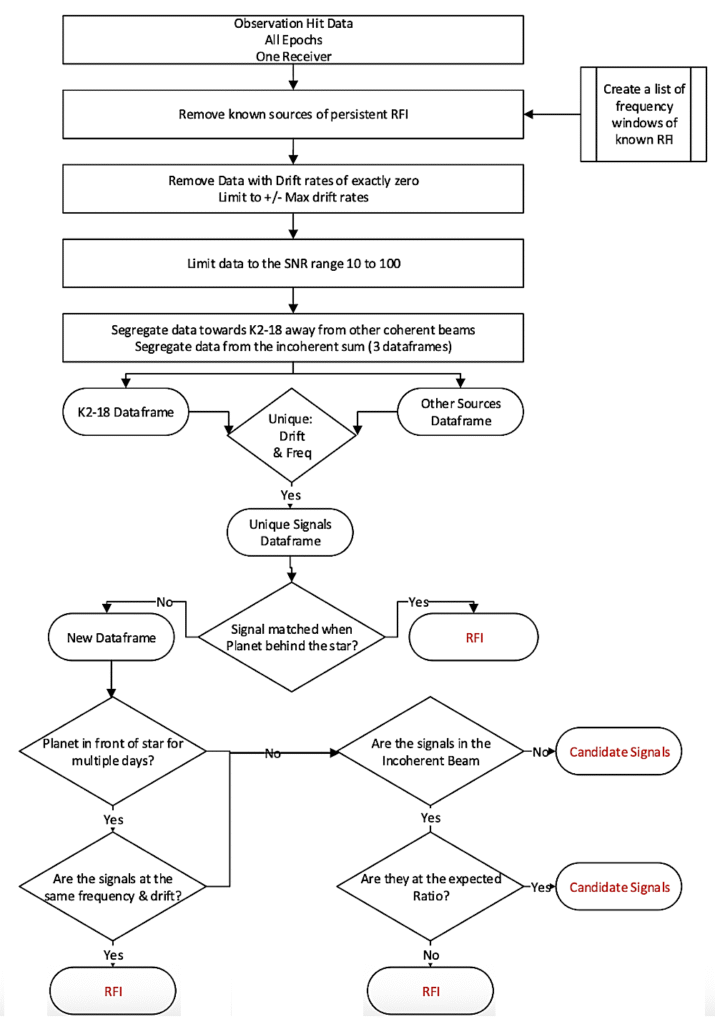
A block diagram summarizing the steps listed in Section 3 of the paper to filter the RFI discovered by the pipeline to find potential technosignature candidates. — astro-ph.EP
C. D. Tremblay, S. Chaudhary, Megan G. Li, Sofia Z. Sheikh, T. Myburgh, D. Czech, D. E. MacMahon, P. B. Demorest, R. A. Donnachie, A. P. V. Siemion, V. Gajjar, M. Lebofsky, K. Wandia, K. I. Perez., Nikku Madhusudhan
Comments: 18 pages, Accepted by AJ
Subjects: Earth and Planetary Astrophysics (astro-ph.EP); Instrumentation and Methods for Astrophysics (astro-ph.IM)
Cite as: arXiv:2602.09553 [astro-ph.EP] (or arXiv:2602.09553v1 [astro-ph.EP] for this version)
https://doi.org/10.48550/arXiv.2602.09553
Focus to learn more
Submission history
From: Chenoa Tremblay
[v1] Tue, 10 Feb 2026 09:01:09 UTC (1,824 KB)
https://arxiv.org/abs/2602.09553
Astrobiology, SETI, Technosignature,










Related Posts
Stay Informed With the Latest & Most Important News
Previous Post
Next Post

Advertisement
-
 01Two Black Holes Observed Circling Each Other for the First Time
 -
 02From Polymerization-Enabled Folding and Assembly to Chemical Evolution: Key Processes for Emergence of Functional Polymers in the Origin of Life
 -
 03Astronomy 101: From the Sun and Moon to Wormholes and Warp Drive, Key Theories, Discoveries, and Facts about the Universe (The Adams 101 Series)
 -
 04True Anomaly hires former York Space executive as chief operating officer
 -
 05Φsat-2 begins science phase for AI Earth images
 -
 06Hurricane forecasters are losing 3 key satellites ahead of peak storm season − a meteorologist explains why it matters
 -
 07Binary star systems are complex astronomical objects − a new AI approach could pin down their properties quickly