
Now Reading: Asteroid samples NASA brought to Earth suggest life’s building blocks may be widespread in the universe
-
01
Asteroid samples NASA brought to Earth suggest life’s building blocks may be widespread in the universe

Asteroid samples NASA brought to Earth suggest life’s building blocks may be widespread in the universe

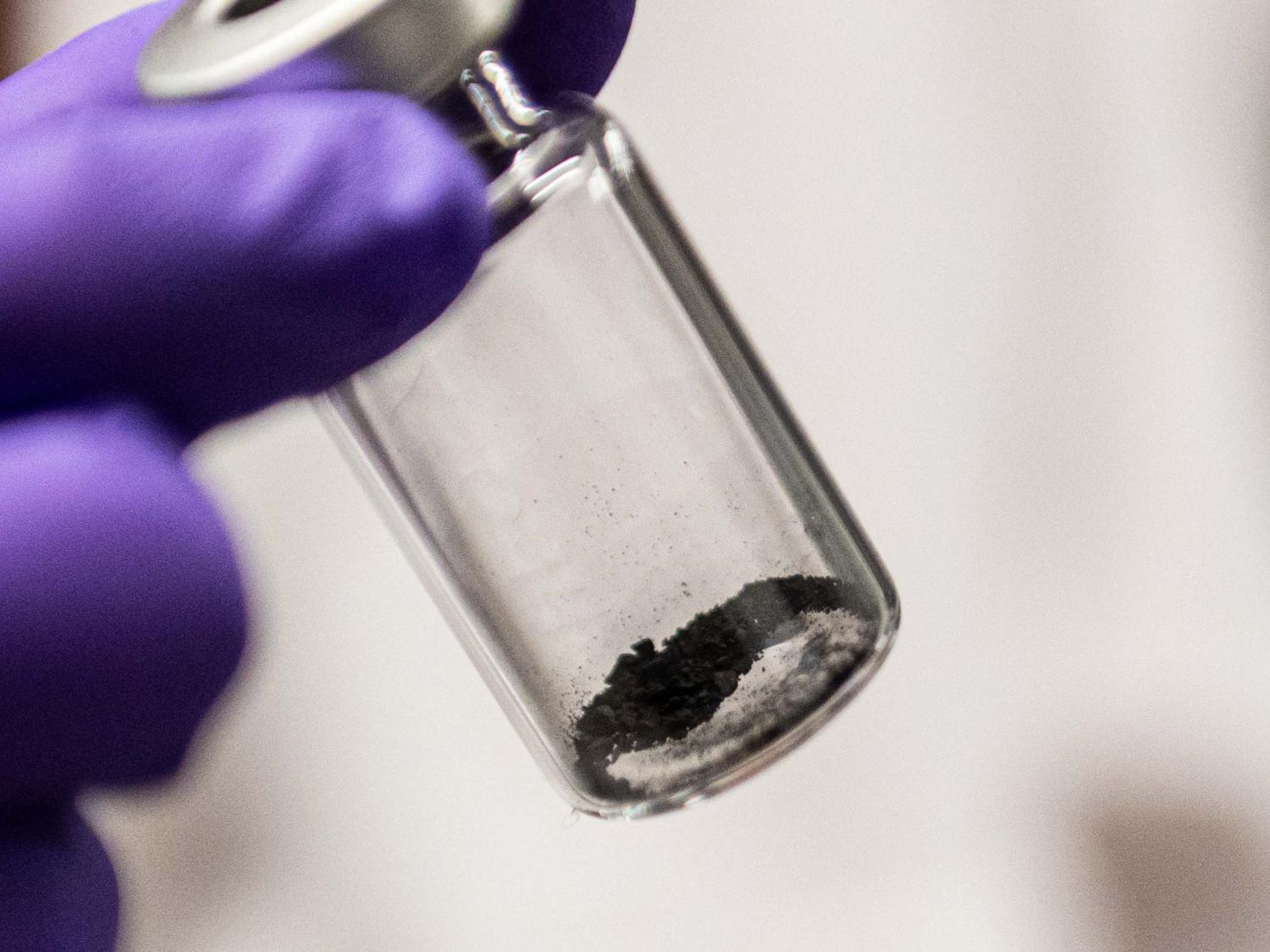
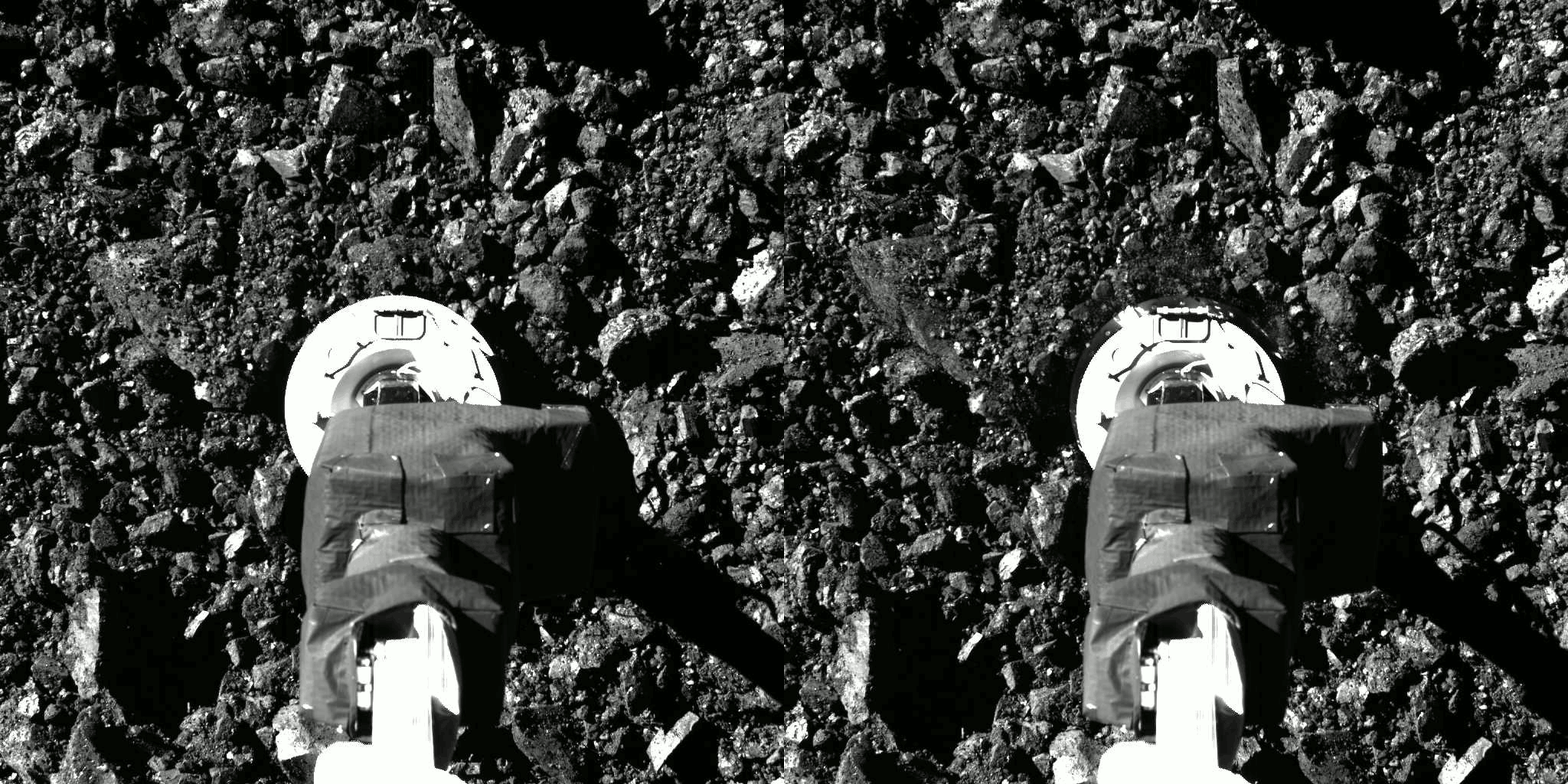
The origins of the building blocks of life may be even more widespread than we realized, as per a new discovery from the asteroid sample NASA’s OSIRIS-REx mission brought back to Earth from the space rock Bennu.
At least 14 of the 20 amino acids used by life on Earth, and 19 other amino acids not used by life, have been identified in the sample from Bennu, which was delivered to Earth in September 2023. It had been thought that these amino acids had formed in warm, watery conditions close to the infant sun 4.5 billion years ago.
“This confirms that life’s building blocks can be formed in a diversity of environments throughout the universe,” Allison Baczynski, an organic chemist at Penn State University and co-lead author of the new study, told Space.com.
Baczynski led a team who investigated the isotopic composition of Bennu’s amino acids, focusing on the simplest amino acid in the sample, which is glycine. On Earth, glycine forms when hydrogen cyanide, ammonia and organic compounds called aldehydes react with each other in warm water. Baczynski’s team used the Murchison meteorite that fell in Australia in 1969 as a reference; the amino acids found in Murchison have an isotopic composition that suggests they formed in this manner.
On the other hand, Bennu’s glycine, and other amino acids present, have isotopic compositions that differ from the Murchison amino acids. Instead, their isotopic composition matches what could be expected from having formed in a chemically distinct and frozen environment farther from the sun, though still dowsed in the solar ultraviolet radiation required to trigger the reaction to form the amino acids.

“It was really exciting to see that amino acids in Bennu showed a much different isotopic pattern than those in Murchison, suggesting that the amino acids formed by a different pathway and in different regions of the solar system,” said Baczynski.
The early solar system, during the era when the planets were still forming, was divided by a boundary known as the “snow line.” Beyond the snow line, water was frozen, while inside the snow line it existed as liquid or vapor. Chemical reactions proceeded differently depending upon which side of the snow line they took place on.
It is not entirely clear whether the amino acids formed beyond the snow line on icy dust grains and then migrated inwards where they were accreted by Bennu’s parent body (at some point in the past it was smashed apart by a collision, and Bennu is a large fragment of it), or whether Bennu’s parent body itself formed beyond the snow line. However, the evidence points to the latter as being the probable origin.
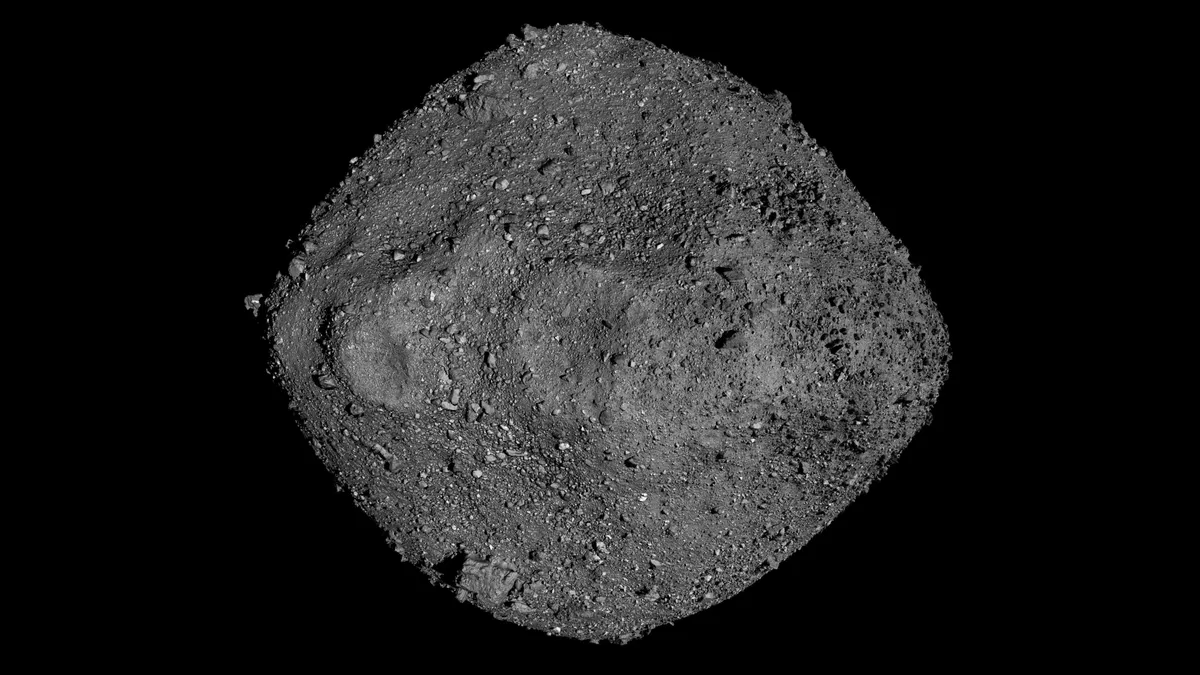
“Our isotopic data indicates that the amino acids formed in a cold, icy environment and other data acquired by the OSIRIS-REx mission suggests that the parent body of Bennu formed beyond the snow line,” said Baczynski.
A new mystery also came to light as part of the analysis of the isotopic composition of Bennu’s amino acids. Amino acids can come in two forms, left- or right-handed, referring to how their molecular structure can be mirror-imaged. For reasons that no scientists yet understand, all life on Earth uses left-handed amino acids.
Scientists had thought that for any given type of amino acid, the left- and right-handed versions were otherwise identical. Yet the analysis of one of the amino acids in the Bennu sample, glutamic acid, reveals that the left-handed and right-handed versions have different nitrogen isotopes. Why they should be different is a mystery, and although glutamic acid is not one of the amino acids that life uses, the question is whether this has any connection with why life uses only left-handed amino acids.
“It has often been assumed that the nitrogen isotope values would be the same for both forms. It was surprising, therefore, to discover that while the L- and D-glutamic acid in Bennu were in equal proportion, the nitrogen isotope values were very different,” said Baczynski. “This was one of the most intriguing findings and we’re excited to explore this further.”
The discovery that amino acids can form in more ways than we thought is another boost to the search for life beyond Earth. If life’s building blocks can form in a wide variety of conditions, it increases the number of locations where we could potentially look for life.
The findings were published on Feb. 9 in the journal Proceedings of the National Academy of Sciences.










Related Posts

Stay Informed With the Latest & Most Important News
Previous Post
Next Post


Advertisement
-
 01Two Black Holes Observed Circling Each Other for the First Time
 -
 02From Polymerization-Enabled Folding and Assembly to Chemical Evolution: Key Processes for Emergence of Functional Polymers in the Origin of Life
 -
 03Astronomy 101: From the Sun and Moon to Wormholes and Warp Drive, Key Theories, Discoveries, and Facts about the Universe (The Adams 101 Series)
 -
 04True Anomaly hires former York Space executive as chief operating officer
 -
 05Φsat-2 begins science phase for AI Earth images
 -
 06Hurricane forecasters are losing 3 key satellites ahead of peak storm season − a meteorologist explains why it matters
 -
 07Binary star systems are complex astronomical objects − a new AI approach could pin down their properties quickly