
Now Reading: Here’s what will happen during each phase of the Feb. 17 ‘ring of fire’ annular solar eclipse
-
01
Here’s what will happen during each phase of the Feb. 17 ‘ring of fire’ annular solar eclipse

Here’s what will happen during each phase of the Feb. 17 ‘ring of fire’ annular solar eclipse

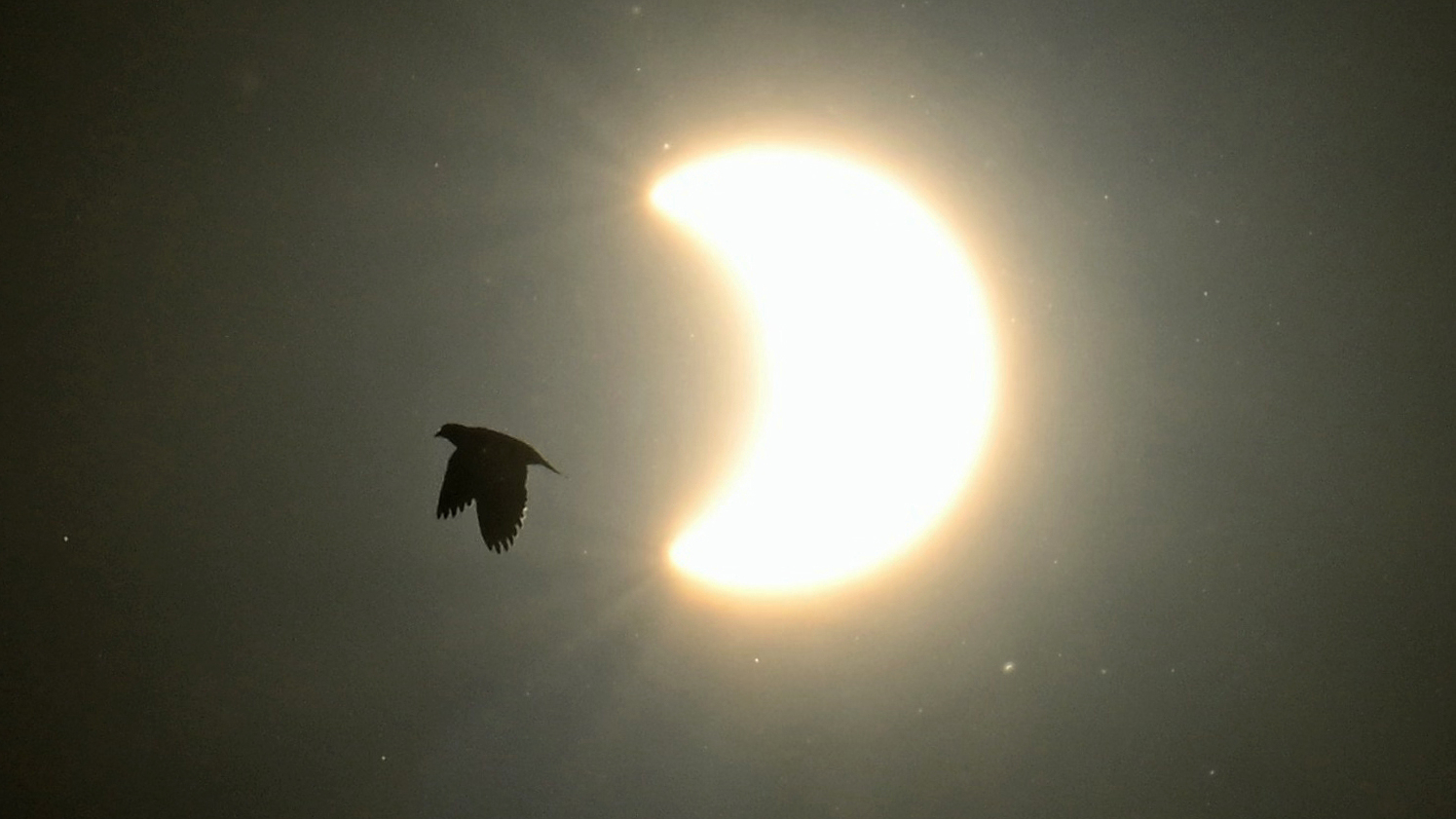
A breathtaking annular solar eclipse is set to sweep across Antarctica on Feb. 17. Here’s what to expect from each phase of the “ring of fire” eclipse as it plays out above one of the most remote regions on Earth.
An annular solar eclipse occurs when the moon passes directly in front of the sun‘s disk during the new moon phase while at a distant point from Earth in its elliptical orbit. Around this time, the lunar disk appears slightly smaller than the sun in Earth’s sky. As a result, a sliver of the sun can be seen surrounding the moon during annularity — the equivalent to totality during a total solar eclipse.
Partial eclipse
The moon will take its first bite out of the sun — a moment known to eclipse chasers as “first contact” — at 4:56 a.m. EST (0956 GMT) on Feb. 17. This will mark the global start time of the eclipse as the lunar disk begins to roll from left to right onto the sun’s surface, blocking its light.

Over the following hours, the moon’s silhouette will delve ever deeper into the sun’s disk, transforming the fiery orb into a glowing crescent, which will grow razor-thin in the moments approaching annularity as it hangs low over the ice-dominated landscape.
Annularity begins
The moon’s silhouette will pass entirely within the sun’s disk at the beginning of the path of annularity at 6:42 a.m. EST (1142 GMT), after which this phase of quasitotality will sweep across Antarctica, marking the beginning of annularity.

This climactic phase, also known as “second contact,” will last a shade under two hours at Concordia Station, which is one of just two research facilities that sit in the path of annularity. During this time, the vast majority of the solar disk will be occulted, leaving only its outermost rim visible as a golden ring shining in a darkened sky.
Point of maximum eclipse
The period of maximum eclipse will occur at 7:12 a.m. EST (1212 GMT) on Feb. 17, according to Time and Date, when the moon will be positioned at the heart of the sun from the viewer’s perspective, while haloed by the outer rim of our parent star’s disk.

Remember, staring at the sun with the naked eye can lead to immediate and permanent damage to your vision. To view an eclipse safely, you’ll need to pick up a pair of eclipse glasses, dedicated solar binoculars or a telescope filter sold from a trusted brand. Be sure to read our guide detailing how to check eclipse glasses and use them properly to ensure a safe viewing experience.
Partial eclipse
The period of annularity ends when the moon’s silhouette makes contact with the outer edge of the solar disk — “third contact” — breaking the golden ring and heralding the start of another partial eclipse phase. The following hour will see the moon retreat from the solar disk, which will transition from a crescent to its usual glorious orb. “Fourth contact” occurs as the last sliver of the moon leaves the sun altogether.
Eclipses always occur in pairs, with a lunar eclipse following a solar eclipse, or vice versa. February’s annular solar eclipse will be followed by a dramatic “Blood Moon” total lunar eclipse on March 3, when Earth passes directly between the full moon and sun, bathing the natural satellite in its shadow. Totality for the lunar eclipse will be visible to over a billion people spread across swathes of North America, East Asia, New Zealand and Australia.
Editor’s Note: If you capture an image of the Feb. 17 eclipse and want to share it with Space.com’s readers, then please send your photo(s), comments, and your name and location to spacephotos@space.com.










Related Posts


Stay Informed With the Latest & Most Important News
Previous Post
Next Post

Advertisement
-
 01Two Black Holes Observed Circling Each Other for the First Time
 -
 02From Polymerization-Enabled Folding and Assembly to Chemical Evolution: Key Processes for Emergence of Functional Polymers in the Origin of Life
 -
 03Astronomy 101: From the Sun and Moon to Wormholes and Warp Drive, Key Theories, Discoveries, and Facts about the Universe (The Adams 101 Series)
 -
 04True Anomaly hires former York Space executive as chief operating officer
 -
 05Φsat-2 begins science phase for AI Earth images
 -
 06Hurricane forecasters are losing 3 key satellites ahead of peak storm season − a meteorologist explains why it matters
 -
 07Binary star systems are complex astronomical objects − a new AI approach could pin down their properties quickly