
Now Reading: Axiom Space raises additional $350 million
-
01
Axiom Space raises additional $350 million


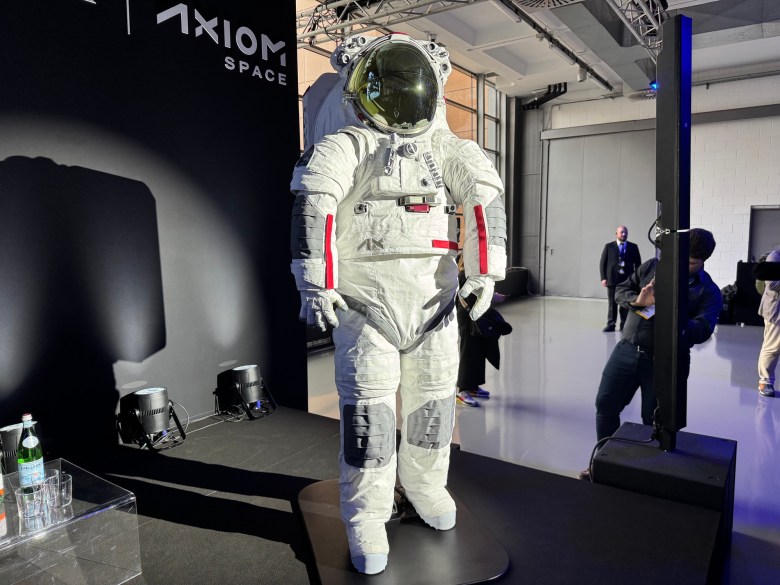
MOUNTAIN VIEW, Calif. — Axiom Space has raised $350 million to advance development of a commercial space station and new spacesuits for NASA.
The Houston-based company announced Feb. 12 that it raised a new funding round led by Type One Ventures and Qatar Investment Authority (QIA). Several other investors participated, including 1789 Capital, 4iG, and LuminArx Capital Management, along with company founder Kam Ghaffarian.
Axiom did not disclose the company’s valuation with this latest round, which includes both equity and debt components. It last announced a funding round in August 2023, a $350 million round co-led by Aljazira Capital and Boryung Co., Ltd.
In an interview, Jonathan Cirtain, president and chief executive of Axiom Space, said the bulk of the funding will go towards development of Axiom Station, the company’s planned commercial space station. That includes completing the first module, a Payload Power Thermal Module (PPTM) scheduled for launch in 2028, and continued development of a second module, a habitat, slated for 2029.
The company is maintaining plans it announced in late 2024 to launch the PPTM and berth it to the Internation Space Station. Axiom will them launch the habitat module, which will loiter in orbit until the PPTM is unberthed from the station and docks with the habitat. That will create, he said, “a continuously habitable, four-crew capable operational, free-flying space station before the retirement of the ISS.”
Axiom is developing the station with the intent of securing NASA support through its Commercial Low Earth Orbit Destinations, or CLD, program. Axiom has an agreement to use a port at the ISS for the PPTM as part of the initial phase of that program. However, NASA has delayed the second phase of the program after a decision last summer to revise the agency’s approach to supporting development of the stations.
Cirtain said he met earlier this week with NASA Administrator Jared Isaacman about the status of the CLD program and received assurances that the effort was a priority for the agency. “Administrator Isaacman told me on Monday, and he’s said this in public, that having a replacement to the International Space Station before 2030 is in the interest of the nation,” he said.
However, Axiom and other companies are still waiting on Isaacman to decide on any changes to the CLD program. “I think this is a pretty substantial acquisition for him during the first few years of his tenure as administrator, and I think it’s warranted that he takes a pretty significant look at this,” he said. “I’m quite confident that they’ll come out with a solicitation here in the next weeks that will be aligned with what the national interests are.”
Cirtain said that he did not expect any changes in NASA’s CLD strategy to significantly affect plans for Axiom Station. “I don’t see it impacting the way in which we’re executing our work, spending our capital or focusing on our development effort, but we are very much looking forward to seeing that solicitation out and then winning that solicitation later this year.”

Spacesuit development
Another major project for Axiom Space is development of new spacesuits that NASA will use on lunar landing missions, starting with Artemis 3. Axiom was initially one of two companies selected by NASA for services contracts to provide new spacesuits, but the other company, Collins Aerospace, later dropped out of the program.
Cirtain said most of the work on what his company calls the Axiom Extravehicular Mobility Unit, or AxEMU, is funded by NASA, but some of the funding from this latest round will go towards development of mission operations capabilities for the suit.
“This is an extension of what we’ve already developed for mission operations capabilities for the astronaut program, but additional capabilities need to be added to that to facilitate what’s necessary to operate the suit in either the lunar or the low Earth orbit environments,” he said.
The development of AxEMU for Artemis has been scrutinized, alongside work on lunar landers by SpaceX and Blue Origin, as key factors driving the schedule for the Artemis 3 mission. Isaacman has previously said he met with Axiom to find ways to accelerate work on the spacesuit.
“We are currently on the schedule NASA has provided for us for delivery of the suits in 2027 in preparation for Artemis 3,” he said. “Notwithstanding what NASA may have said in the past, we are currently on schedule.”
He added that Axiom is working with suppliers and NASA to ensure development of AxEMU remains on schedule, including NASA personnel who are “deeply integrated” into the suit development work. “That drives down risk, which improves schedule margin and maintains our cost profile,” he said.
Fundraising approach
Axiom Space worked with J.P. Morgan as the placement agent for the funding round. “They were a great ally for us in connecting with potential investors and getting the word out,” said Anton Brevde, chief investment officer at Axiom.
Axiom relied on its own contacts as well to raise the funding. That included 4iG, a Hungarian communications company that announced in December it would invest $100 million into Axiom Space. That came after Axiom flew a Hungarian astronaut, Tibor Kapu, on the Ax-4 private astronaut mission to the ISS last summer.
“It’s not a coincidence that we flew a Hungarian astronaut on Ax-4 and that kicked off a whole suite of opportunities within Hungary,” Brevde said. “Through that work, we got introduced to 4iG, which is a publicly traded telecommunications company, and are thrilled to have them joining us as an investor.”
He said the latest round reflects a greater role for institutional investors. “We’re really moving out of the world of venture into the world of institutional capital,” he said. “We’re very excited to partner with the likes of QIA, one of the biggest sovereign wealth funds in the world. These are groups that are primarily financially motivated.”
Cirtain noted that Brevde and Ghaffarian had worked to raise $2 billion in the last year to support companies in Ghaffarian’s portfolio, which includes Intuitive Machines, Quantum Space and X-Energy.
“Kam and Anton are quite the experts at creating the network of investors, whether those are institutional investors, venture capital investors or just high net worth individuals, that are that resonate with Kam’s vision,” he said.










Related Posts
Stay Informed With the Latest & Most Important News
Previous Post
Next Post


Advertisement
-
 01Two Black Holes Observed Circling Each Other for the First Time
 -
 02From Polymerization-Enabled Folding and Assembly to Chemical Evolution: Key Processes for Emergence of Functional Polymers in the Origin of Life
 -
 03Astronomy 101: From the Sun and Moon to Wormholes and Warp Drive, Key Theories, Discoveries, and Facts about the Universe (The Adams 101 Series)
 -
 04True Anomaly hires former York Space executive as chief operating officer
 -
 05Φsat-2 begins science phase for AI Earth images
 -
 06Hurricane forecasters are losing 3 key satellites ahead of peak storm season − a meteorologist explains why it matters
 -
 07Binary star systems are complex astronomical objects − a new AI approach could pin down their properties quickly