
Now Reading: Wrinkly Rocks May Actually Be A Fossilized Microbial Community
-
01
Wrinkly Rocks May Actually Be A Fossilized Microbial Community


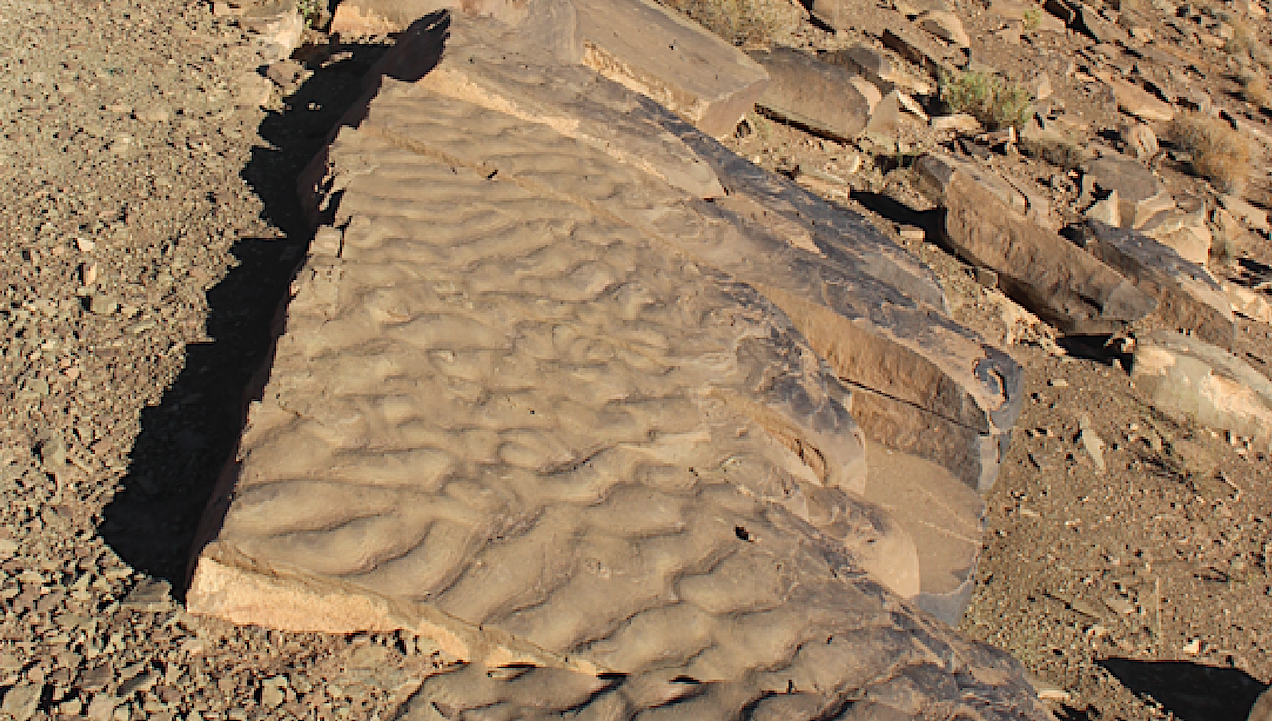

Tagoudite Formation in the Central High Atlas Mountains, Morocco
In 2016 while hiking on a hillside in Morocco, geologist Rowan Martindale saw something that made her stop in her tracks: a slab of sedimentary rock covered in a wrinkly texture reminiscent of elephant skin.
“I looked at the wrinkles and I was like, ‘These aren’t supposed to be in rocks like this. What the heck is going on?’” said Martindale, an associate professor at The University of Texas at Austin’s Jackson School of Geosciences.
Rock textures hold clues about the geological activity that shaped them. To Martindale, these wrinkles in time were a textbook example of microbial mat fossils. They captured a teeming community of bacterial ooze that lived over 180 million years ago during the Early Jurassic.
She had seen dozens of photographs and samples that had the same texture as the slab while in graduate school, thanks to a lab mate who had specialized in microbial fossils from the Early Triassic age.
There was just one problem: the geologic setting was all wrong.
The sediment where the wrinkles had formed was originally from the deepwater ocean, almost 600 feet below the surface. But the prevailing explanation in the geological community was that the wrinkle structures made by microbes were limited to shallow water environments in stressful settings or after extinction events – both situations where the microbes would have access to sunlight and be free from marine life that would readily gobble them up.
For deepwater settings, the usual explanation for wrinkle-like textures was impressions made be an underwater landslide, which pushed sediment around into ridges and furrows. But Martindale didn’t buy it. The wrinkles in the hillside had that microbial look.
“It was one of those things, knowing what to look for and having that ‘search image’ of wrinkle structures in my head, that made me want to stop and dig into this,” she said.
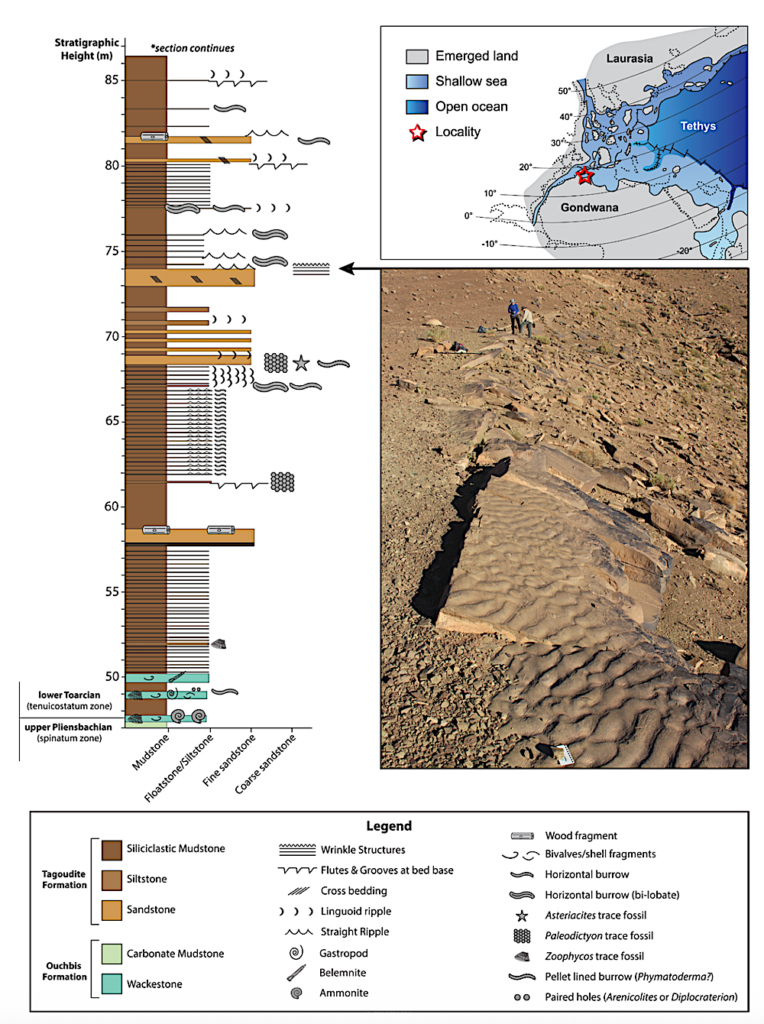
Lithological log of the Tagoudite Formation in the Central High Atlas Mountains, Morocco. Inset map shows the Toarcian paleoenvironmental reconstruction of the western Tethys Ocean (modified from Bodin et al., 2016, and references therein) and the location of the study area. Photograph of the wrinkle structure outcrop shows the top of the rippled bed at ∼74 m. The section continues below (Ouchbis Formation) and above (Tagoudite and Tafraout Formations) the log.
In a recent paper published in Geology, she and her co-authors propose a new explanation for the wrinkle structures that unites the worlds of biology and geology. The wrinkles weren’t formed by physical forces during an underwater landslide — but the landslide did set the stage for the microbes to grow by transporting nutrients to the ocean floor.
In their paper, the researchers propose that the wrinkles were formed by a microbial mat that sustained itself with nutrients swept to the ocean depths by the landslide rather than sunlight, a mode of making energy called chemosynthetic. Their intake of chemicals may have also enabled these microbial communities to emit toxic sulfur compounds that would have kept sea life at bay.
There are microbial communities found in ocean depths today that live in a similar manner, such as the microbial mats that coat whale carcasses that drift down to the seafloor and help seed rich and ephemeral “whale fall” ecosystems.
Jake Bailey, a professor at the University of Minnesota who studies how microbes shape the Earth’s environment, said the research upends assumptions about ancient wrinkle structures being from just one type of microbial community.
“In the present, some of the largest microbial ecosystems on our planet are found in the dark ocean,” said Bailey, who was not involved with the research. “The research here shows that certain ancient sedimentary structures may record the presence of these chemolithotrophs rather than phototrophs (organisms that need sunlight to make energy). ”
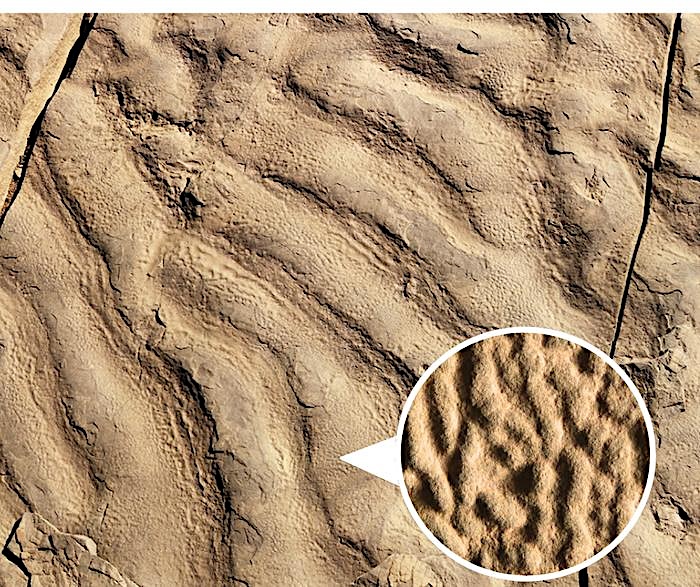
Preserved seabed ripples on an outcrop in Morocco covered with wrinkle structures thought to be formed by an ancient microbial community from the Early Jurassic. The inset shows a close-up of the wrinkle structures covering the ripples. Credit Main photo: Rowan Martindale. Inset: Jackson School of Geosciences.
Martindale said that the finding is important because it suggests that fossils of chemosynthetic microbial communities might be more prevalent in the fossil record than previously thought. What’s more, a bias for interpreting wrinkles as purely physical structures could lead to geoscientists misclassifying fossils as natural formations. This bias is worsened by the lack of specific language for describing wrinkles in rock.
“The terminology is pretty lax,” Martindale said. “Wrinkly can be mean lots of things, so there’s a lack of diagnostic language.”
Martindale’s usual research focus is ancient coral reefs and mass extinctions. She wasn’t expecting to go on a research detour into deep-sea microbial mats. But when a vexing question appears under your nose, sometimes you have to see where the science leads.
“It’s really cool to have gone in this direction that I totally wasn’t expecting,” she said. “There was no hypothesis that I would find these microbial mats here. It was just being in the right place at the right time, with the right search image. And then being so stubborn as to not let go of it.”
The research was funded by the National Science Foundation.
Chemosynthetic microbial communities formed wrinkle structures in ancient turbidites, Geology (open access)
Astrobiology,










Related Posts
Stay Informed With the Latest & Most Important News
Previous Post
Next Post



Advertisement
-
 01Two Black Holes Observed Circling Each Other for the First Time
 -
 02From Polymerization-Enabled Folding and Assembly to Chemical Evolution: Key Processes for Emergence of Functional Polymers in the Origin of Life
 -
 03Astronomy 101: From the Sun and Moon to Wormholes and Warp Drive, Key Theories, Discoveries, and Facts about the Universe (The Adams 101 Series)
 -
 04True Anomaly hires former York Space executive as chief operating officer
 -
 05Φsat-2 begins science phase for AI Earth images
 -
 06Hurricane forecasters are losing 3 key satellites ahead of peak storm season − a meteorologist explains why it matters
 -
 07Binary star systems are complex astronomical objects − a new AI approach could pin down their properties quickly