
Now Reading: Low-profile Chinese launch firm conducts first stage static fire
-
01
Low-profile Chinese launch firm conducts first stage static fire


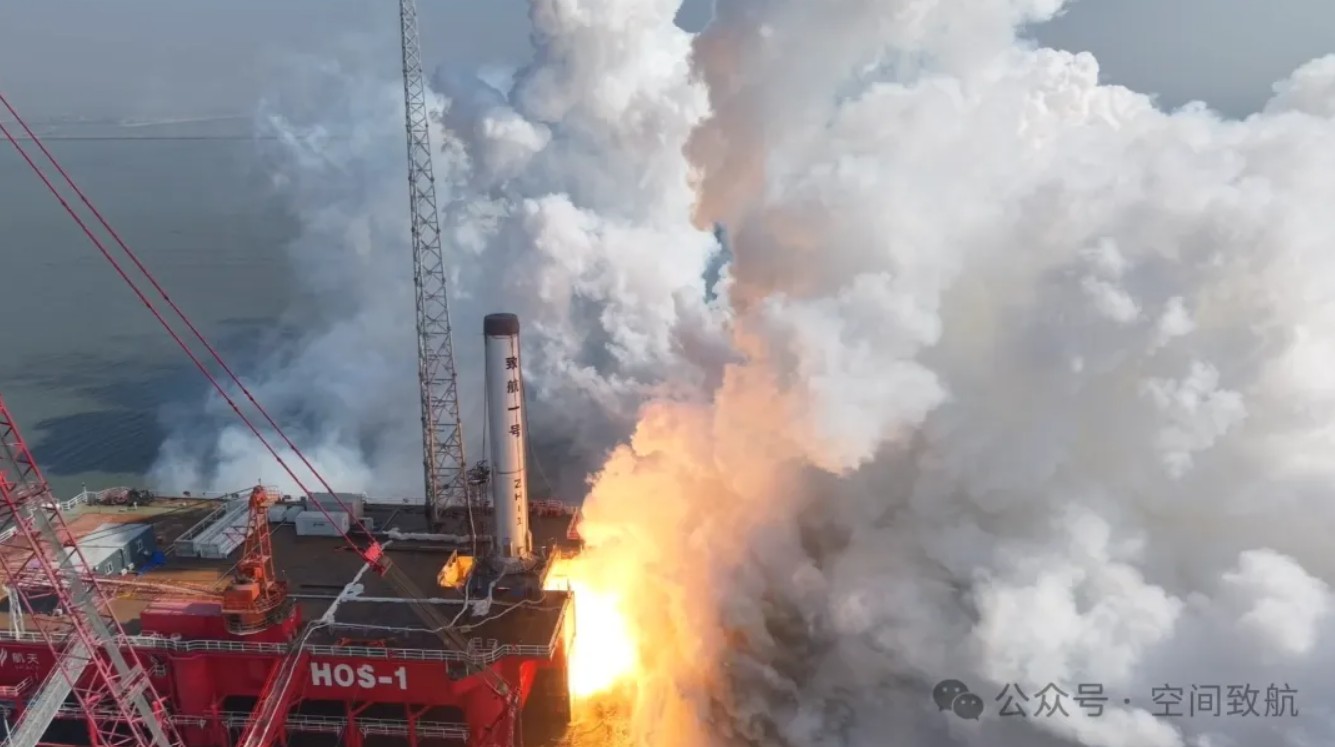

ESPOO, Finland — One of China’s lower profile launch startups, Zenk Space, has conducted a first stage static fire for its Zhihang-1 rocket ahead of a planned launch.
Zenk Space, full name Beijing Space Zhihang Technology Co., Ltd., conducted the static fire test of the Zhihang-1 first stage Feb. 11 using the HOS-1 mobile sea platform facilities off the coast of Shandong province. The company did not explicitly state the length of the test firing, but published tens of seconds of footage from the test. Commercial tank manufacturer R-Space provided the storage tanks for the test, according to a statement.
“The success of this test marks that the Zhihang-1 rocket has fully completed all major ground tests prior to its debut flight and will soon proceed to its first flight test mission.” Zenk Space said in a statement.
Earlier statements had indicated plans for a launch before the end of February, with company materials shared online suggesting that Zhihang-1, or ZH-1, will be a roughly 50-meter-long, three-stage kerosene-liquid oxygen launch vehicle with 3.35-meter-diameter stages. Powered by four YF-102 kerolox engines developed by China’s main state-owned space contractor CASC on the first stage, the ZH-1 will be capable of lifting 4,000 kilograms to a 500-kilometer-altitude sun-synchronous orbit (SSO). YF-102 gas generator engines have been used on Space Pioneer’s Tianlong-2 and will power CAS Space’s new Kinetica-2.
Zenk Space, which was established in 2019, acknowledged the guidance and support it received from the State Administration for Science, Technology and Industry for National Defense (SASTIND) and various levels of national defense science and technology industry management departments in Shandong Province. The company also stated it will remain committed to its founding principles, follow fundamental engineering disciplines, build high-quality products, and contribute to China’s space industry.
The company is planning partial engine recovery for the ZH-1, as part of an incremental plan to develop reusable launchers. The first stage of the ZH-1 will not be recovered, according to one presentation shared online, instead the engine bay section will separate from the first stage after second stage separation. Thermal protection will assist high-speed reentry through the atmosphere, before parachutes deploy to slow descent, with airbags for buoyancy after splashdown. The engines can then be recovered, inspected and refurbished and potentially integrated with a new first stage. The plan echoes the SMART recovery system studied by United Launch Alliance.
Zenk Space plans to develop the larger, 62m-long ZH-2 capable of carrying 12,000 kg to a 500-km SSO while also planning to recover the first stage. ZH-3 will be a 5-meter-diameter, 81-meter-long launcher with first stage recovery.
Zhihang-1 is one of a number of new Chinese launch vehicles expected to have debut flights in 2026. CASC is preparing for the first launches of the Long March 10A, Long March 10B and Long March 12B, all of which are designed for recovering the first stage. Commercial firms are also making preparations for first launches, including Galactic Energy’s Pallas-1, Nebula-1 from Deep Blue Aerospace, Gravity-2 from Orienspace, Kinetica-2 from CAS Space, Yuan Xing Zhe-1 (YXZ-1) from Space Epoch and Tianlong-3 from Space Pioneer.
Landspace’s Zhuque-3 and CASC’s Long March 12A are expected to make new launch attempts. The pair both reached orbit in December 2025, but first stage recovery attempts failed. China also earlier this month launched its experimental reusable spacecraft, suspected to be a spaceplane, for the fourth time.










Related Posts
Stay Informed With the Latest & Most Important News
Previous Post
Next Post




Advertisement
-
 01Two Black Holes Observed Circling Each Other for the First Time
 -
 02From Polymerization-Enabled Folding and Assembly to Chemical Evolution: Key Processes for Emergence of Functional Polymers in the Origin of Life
 -
 03Astronomy 101: From the Sun and Moon to Wormholes and Warp Drive, Key Theories, Discoveries, and Facts about the Universe (The Adams 101 Series)
 -
 04True Anomaly hires former York Space executive as chief operating officer
 -
 05Φsat-2 begins science phase for AI Earth images
 -
 06Hurricane forecasters are losing 3 key satellites ahead of peak storm season − a meteorologist explains why it matters
 -
 07Binary star systems are complex astronomical objects − a new AI approach could pin down their properties quickly