
Now Reading: Leonardo funding development of Earth observation constellation
-
01
Leonardo funding development of Earth observation constellation


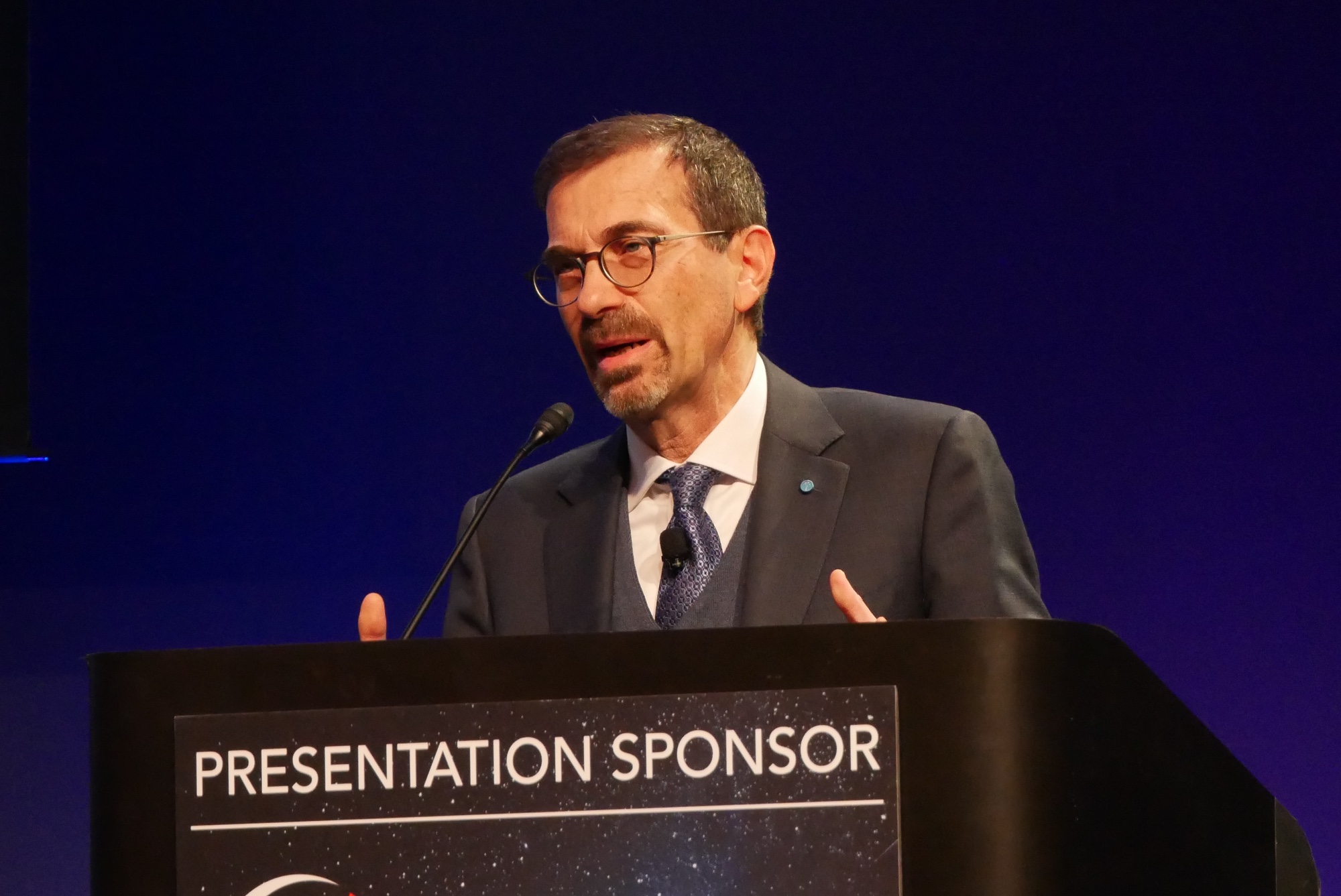

MOUNTAIN VIEW, Calif. — Leonardo is funding development of an Earth observation constellation designed to highlight its capabilities while also being a model for larger European initiatives.
Speaking at last week’s SmallSat Symposium, Marco Brancati, a senior vice president in Leonardo’s space division, discussed the Leonardo EO Constellation, a system of about 20 satellites with high-resolution optical and synthetic aperture radar (SAR) payloads.
Work on the constellation started last July, with a preliminary design review finished earlier this month, he said. A critical design review for the constellation is planned for June, with launches projected for 2027 and 2028.
The constellation has two goals. “The idea is, on one side, to provide the downstream component of the company with proprietary Earth observation data,” he said, referring to the geospatial intelligence services offered by e-GEOS, owned in part by Leonardo.
“On the other side, the goal is to show customers in the market that Leonardo is now really able to deploy an end-to-end system, both ground and space segments,” he said. That was one motivation for Leonardo establishing a space division in early 2025. “The best way to show that is to build it for yourself.”
Brancati said Leonardo is investing nearly 500 million euros ($590 million) in the project. It has selected Thales Alenia Space, a joint venture of Leonardo and Thales, to build the satellites at its new “Space Smart Factory” in Rome, designed to produce up to 100 satellites a year.
The constellation features one plane of nine satellites: six with SAR payloads, two with high-resolution optical imagers and one dedicated communications satellite. The spacecraft will have optical intersatellite links while the communications satellite will have additional terminals to enable optical communications with other spacecraft or optical ground stations.
The configuration of a second plane is still being finalized, he said. One option being considered would be to have seven dedicated high-resolution optical imaging satellites and two with both optical imaging and communications payloads.
He said Leonardo could incorporate satellites from other partners into the system. “The concept of federation is very important,” he said. “We have the possibility to federate constellations from additional partners.”
The Leonardo satellites will use a modular bus called NIMBUS developed by Thales Alenia Space. The radar, optical and communications satellites will use common components, but with different payload modules based on their mission.
Brancati described the system as a “preparatory constellation” but did not disclose plans for expanding it beyond the two planes he described in his presentation. However, he suggested it could be a model or precursor of some kind for future European imaging satellites systems, such as those funded by the European Space Agency’s European Resilience from Space (ERS) program or the future European Commission’s Earth Observation Government Service (EOGS) initiative.
“We’re looking at the potential synergies with European programs like, for instance, ERS and EOGS,” he said.
ESA member states committed more than 1.3 billion euros to ERS at the ministerial conference last November, with ESA electing to keep subscriptions to the program open to late 2026. ESA, though, has provided few details about ERS, including requirements for imaging satellites that the program will fund initial development of.










Related Posts
Stay Informed With the Latest & Most Important News
Previous Post
Next Post
Advertisement
-
 01Two Black Holes Observed Circling Each Other for the First Time
 -
 02From Polymerization-Enabled Folding and Assembly to Chemical Evolution: Key Processes for Emergence of Functional Polymers in the Origin of Life
 -
 03Astronomy 101: From the Sun and Moon to Wormholes and Warp Drive, Key Theories, Discoveries, and Facts about the Universe (The Adams 101 Series)
 -
 04True Anomaly hires former York Space executive as chief operating officer
 -
 05Φsat-2 begins science phase for AI Earth images
 -
 06Hurricane forecasters are losing 3 key satellites ahead of peak storm season − a meteorologist explains why it matters
 -
 07Binary star systems are complex astronomical objects − a new AI approach could pin down their properties quickly