
Now Reading: Black hole belches radiation long after eating a star
-
01
Black hole belches radiation long after eating a star


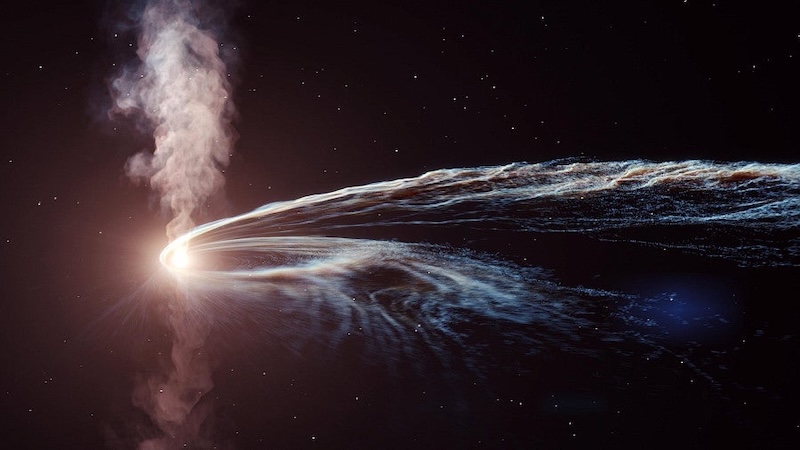

- A supermassive black hole called AT2018hyz ripped apart a star in 2018 and then unexpectedly began emitting strong radio waves 2.5 years later.
- The black hole is now 50 times brighter in radio wavelengths than in 2019 and may keep getting brighter until 2027.
- Scientists think the black hole might be shooting out a powerful jet of radiation, but they are still studying what is causing this unusual behavior.
EarthSky’s 2026 lunar calendar is available now. Get yours today! Makes a great gift.
A puzzling interaction between a black hole and star
When a star comes too close to a supermassive black hole, powerful gravitational forces will rip it apart. Astronomers call this a tidal disruption event. In 2018, they detected one such event in a supermassive black hole called AT2018hyz. Then, they revisited it several times with radio telescopes. To their surprise, after being quiet for about 2.5 years, it began spewing radiation in radio wavelengths. Interestingly, this was happening long after the black hole had ripped the star apart. On February 4, 2026, the scientists said recent observations show AT2018hyz has become 50 times brighter than it was in 2019.
The scientists also suspect there is a jet of electromagnetic radiation shooting out of the black hole. In addition, their calculations suggest this black hole will continue emitting radio waves, rising sharply to a peak in 2027.
Yvette Cendes, at the University of Oregon, lead the study of this enigmatic object. She said:
This is really unusual. I’d be hard-pressed to think of anything rising like this over such a long period of time.
The team published their study in the peer-reviewed Astrophysical Journal on February 5, 2026.

Black hole tidal disruption events
When a star gets too close to the powerful gravitational clutches of a supermassive black hole, it undergoes what’s called a tidal disruption event. Its matter gets pulled out in long streams, a process astronomers call spaghettification.
Some of these streams of material get caught in loops around the black hole, just beyond the event horizon (the region where nothing can escape), called an accretion disk. As a result, the star’s material temporarily orbits the black hole. As star material and energy flow outward from the unstable accretion disk, the disk emits electromagnetic radiation in radio wavelengths. Meanwhile, astronomers also know that some black holes expel a powerful jet of radiation, as some of the star remnants are flung out close to the speed of light.
In recent decades, astronomers have observed numerous black hole tidal disruption events. But prior to that, they assumed that once the black hole consumed the star, it would go quiet until the next unfortunate star wandered too close.
But they’re now discovering that some black holes go quiet for a while, then start emitting radiation in radio wavelengths. Cendes compares this to burping after a meal.
AT2018hyz is interesting not only because it is continuing to emit energy in radio wavelengths long after shredding the star. But it’s also turning out to be one of the most energetic cosmic phenomena in the universe.
Another look at AT2018hyz, aka Jetty McJetface
AT2018hyz is 665 million light-years away, in the direction of the constellation Sextans. This supermassive black hole lives in the center of a galaxy named LEDA 3119592.
Cendes jokingly calls it “Jetty McJetface.” That’s a reference to how a British marine research vessel was almost christened Boaty McBoatface, after someone nominated that name and it won in a public vote. (The name ended up going to an autonomous underwater vehicle.)
Astronomers first observed this tidal disruption event in 2018, as a sudden brightening of LEDA 3119592 in optical wavelengths. At the time, it did not attract much attention. For about 2.5 years, the black hole remained quiet in radio wavelengths. Then, this formerly quiescent black hole started emitting powerful radio waves.
In her new paper, Cendes and her colleagues re-examined AT2018hyz during observing runs from 2022 to 2024. They used sensitive radio telescopes in New Mexico and South Africa. (They did not study it in optical wavelengths because it was now very dim.)

What’s going on at AT2018hyz?
The researchers analyzed the new data from the radio telescopes. As a result, they discovered that AT2018hyz is 50 times brighter, in radio wavelengths, compared to measurements astronomers had obtained in 2019. Moreover, they’re predicting that these radio waves will continue to increase significantly, reaching peak intensity in early 2027.
However, they’re not really sure what is going on at AT2018hyz. Perhaps the supermassive black hole had a delayed burp, 2.5 years after shredding the star, and is throwing out material at a high speed, but not close to the speed of light.
But their analysis also suggests it could be something even more interesting. Material could be shooting out of the supermassive black hole as a single jet, close to the speed of light. If that’s the case, perhaps the researchers did not initially detect the radiation because the jet was not aimed in our direction. But as the jet has widened, it is entering our field of view. The research team will know for sure in a few years as they continue to monitor AT2018hyz. They also plan more follow-up observations with other sensitive radio telescopes.
Another thing the researchers concluded is that the outflow of energy from this black hole is astonishingly high. It’s close to that of gamma ray bursts, some of the most energetic events in the universe.
Looking for other weird black holes
Cendes and her colleagues would like to look for other black holes with this strange behavior. But getting observing time on telescopes is highly competitive. They would have to justify why they want to follow-up on black hole tidal disruption events.
She commented:
If you have an explosion, why would you expect there to be something years after the explosion happened when you didn’t see something before?
Now, they have a case for justifying why such follow-up observations are important.
Bottom line: A black hole has been spewing out powerful radio waves years after shredding a star, and it’s expected to get brighter until 2027.
Source: Continued Rapid Radio Brightening of the Tidal Disruption Event AT2018hyz
Read more: Dark matter, not a black hole, could power Milky Way’s heart
Read more: Did we see a black hole explode? If so, it could explain a lot
The post Black hole belches radiation long after eating a star first appeared on EarthSky.










Related Posts
Stay Informed With the Latest & Most Important News
Previous Post
Next Post


Advertisement
-
 01Two Black Holes Observed Circling Each Other for the First Time
 -
 02From Polymerization-Enabled Folding and Assembly to Chemical Evolution: Key Processes for Emergence of Functional Polymers in the Origin of Life
 -
 03Astronomy 101: From the Sun and Moon to Wormholes and Warp Drive, Key Theories, Discoveries, and Facts about the Universe (The Adams 101 Series)
 -
 04True Anomaly hires former York Space executive as chief operating officer
 -
 05Φsat-2 begins science phase for AI Earth images
 -
 06Hurricane forecasters are losing 3 key satellites ahead of peak storm season − a meteorologist explains why it matters
 -
 07Binary star systems are complex astronomical objects − a new AI approach could pin down their properties quickly