
Now Reading: Artemis haters, can we have a moment, please?
-
01
Artemis haters, can we have a moment, please?


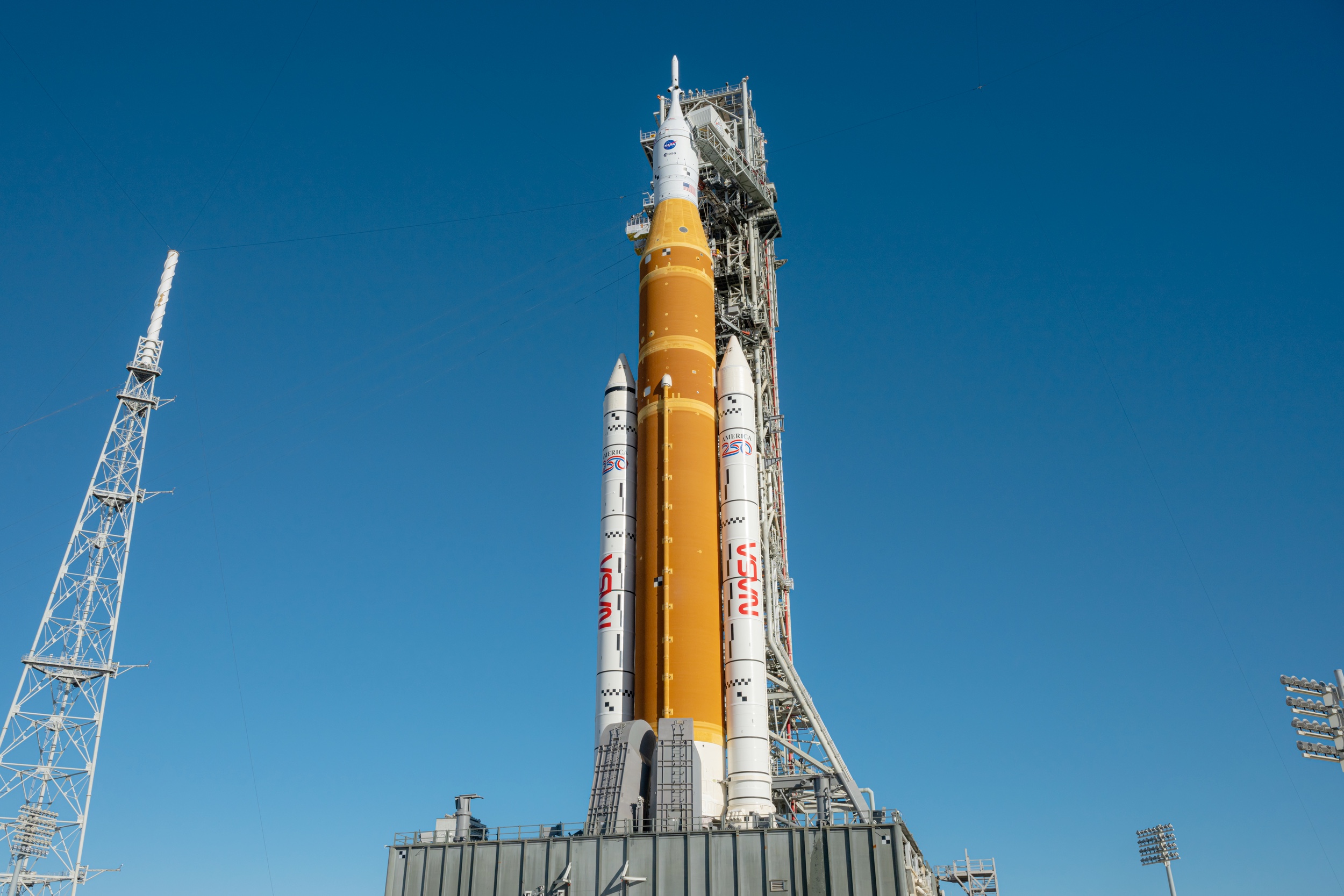

It’s taking too long. It costs too much. Yet it’s not being talked about enough. It’s not historic enough. It’s not safe enough. I’m talking about Artemis. Or at least what a goodly portion of the space community is saying privately or online, replete with sensationalist interviews and even vomit emojis.
Let’s take a breath, shall we?
I may not convince you, but I’m going to lay out why I think Artemis matters, why we should celebrate successes in the program even as it needs change, why comparisons to Apollo are becoming mind-numbing and why this particular mission is historic and inspirational.
Why Artemis does matter
This is our return to human deep-space exploration.
This is a step, if presently halting, toward future lunar missions and a long-term human presence on our companion world, one so important that even SpaceX is setting aside Mars for a greater focus on the moon and Blue Origin is setting aside suborbital space tourism for the same.
That is huge. Humans have not been to the moon in more than half a century. We’ve stayed in low Earth orbit for decades, doing remarkable things — but not exactly lighting the candle for the deep-space journeys. Those journeys can inspire us to better value curiosity, cooperation and boldness, all elements of a worthy future.
Artemis is the program now. It’s not perfect. But just imagine not having any lunar or deep-space program or architecture. Imagine if we were still just presenting slide decks at aerospace conferences.
The whole reason we are in this lunar revival is because of water ice — a scientific archive and a resource. A permanent human presence on the moon can help us learn how to live better there, on Mars and perhaps here on Earth. We can learn how to balance science with commerce, extraction with sustainability, all the while inspiring people around the world. As I like to say, we can learn the art of solving problems without creating new ones.
Artemis is the best bet we have to begin being an exploration culture again and one that might give us a permanent off-Earth foothold. I’m glad it’s real.
What’s going right, if slowly
Despite the tanking problems that delayed Artemis 2 — which must be fixed for this and future Artemis missions to improve cadence — it’s worth noting that the Space Launch System flew an uncrewed Orion to the moon successfully on its first try. Saturn didn’t do that.
So SLS is expensive and tetchy, but it’s baked-in for the time being. Critics like to harp on Congress for creating a Frankenrocket or the Senate Launch System without fully appreciating that NASA — as a civilian space agency answerable to Congress and, ultimately, us — is trying to do what it has been asked to do. (And, yes, Congress should have authorized and mandated a test-stack to hone in on the leaky hydrogen seals on the tanking umbilical.)
So criticism is one thing, but the torrent of disparagement against an agency that is America’s best-known brand and that is home to dedicated civil servants — I’m sick of it.
Artemis personnel are doing the best they can with a difficult vehicle. We should cheer them on, even as we look for an SLS off-ramp in the years ahead.
I’m a child of Apollo, but enough already
I watched Apollo 11 live. I was six. I was carrying a cardboard lunar lander in my hand — courtesy of an Esso gas station — and I made hissing sounds like rockets. The pale, translucent astronauts moved on the television screen. It’s one of my most vivid and inspiring memories. It’s part of the reason why I care so much about space.
I know now what I didn’t know then: Like Artemis, Apollo was intensely political. Different times, different needs — the U.S. wanted to establish its hegemony to best the Soviet Union. President Kennedy did not care about space. He issued the rousing clarion call at Rice University for a Moonshot only because we could do it and beat the Soviets. We did.
Then we lost interest because the program misunderstood how to communicate with the public and because in a democracy voters select candidates who, like Richard Nixon, implement their own policies. We got the Shuttle, not the Apollo applications program. We got LEO, not Mars. Public support for Apollo has been consistently misunderstood as greater than it was.
“As of its first crewed launch attempt, NASA has spent approximately $105 billion on Artemis and its related SLS and Orion programs since their inception,” notes Casey Dreier, policy expert at The Planetary Society, citing figures adjusted for inflation. “In contrast, Apollo cost $309 billion over 13 years.”
The slower Artemis pace might be an ironic blessing. It means we can possibly sustain a longer lunar and deep-space exploration program than Apollo, one with some element of bipartisan (rare word!) inertia to keep it moving forward. And this is an international effort unlike Apollo. Agencies and companies from around the world are contributing this time. ESA and Airbus built the Orion service module. The many countries who have signed the Artemis Accords have a stake in this program too.
In a fragmented, monetized-distraction media ecosystem all that context can get lost, along with the mission itself. Apollo was an all-in, rushed program in a time when the United States had three commercial TV networks and about twice the number of national print publications people turned to.
The fact that public attention on Artemis comes via different media and blips along in minutes-long news cycles is not the fault of the mission. Far from it. Certainly the chaos of democracy under assault and billionaire sex-trafficking schemes — to select just two of the many problems we face — demands our attention and our action.
But Artemis 2 can provide a hopeful counterbalance, the kind of good news we can use now…not unlike Apollo 8’s 1968 first flight to the Moon. That’s one Apollo comparison I’m down with.
Artemis 2: for all humanity
Critics think that one reason Artemis 2 isn’t a banner headline is it’s a fly-by. It won’t orbit the moon. I doubt the wider public cares particularly about that difference.
What is manifest: This mission is taking humans farther than they have gone before. Four humans will travel farther than any humans before. Let me say that again: Four humans will travel farther than any humans before. Doesn’t that amaze you? Your response is “meh?”
It took three uncrewed Apollo flights, the deadly Apollo 1 plugs-out fire and an Earth-orbital mission before we flew around the moon in Apollo 8. Artemis 2, by that standard, is more, not less, ambitious.
Now, ironically, critics of how NASA has handled the heat shield issues revealed on Artemis 1 are also unhappy with this being a fly-by — even though free return is the safest flight trajectory. For me, the bottom line is that the crewmembers of Artemis 2 have families. They wouldn’t be willing to go if they didn’t believe the risk was acceptable.
And those who say “been-there-done-that” don’t appreciate how much we have to learn about our companion world, how much it has mattered across time and cultures and just how dramatic and sublime its surface is.
The far side is radically different from the moon we see from Earth. Artemis 2 will help us elucidate its features and history. I mean — I find that exciting.
Not convinced? Fine. Call Congress
You’re not excited. Fair.
If you want to see changes to Artemis, fine. Say so. If you, like me, believe that we can do both space and earth science and human space flight, say so. If you, like me, are weary of a White House that announces an unrealistic landing goal while trying to gut NASA and destroy its morale and institutional knowledge, say so.
Recently The Planetary Society mounted a huge grassroots effort to preserve NASA. And it worked. I felt humbled to be part of that effort, meeting with Congressional staff in my home state of Utah. (Rule of thumb: For every comment I post online, I contact a politician.)
Perhaps we can agree that the crew is authentic, kind, smart and brave. Commander Reid Wiseman, pilot Victor Glover, mission specialist Christian Koch and Canadian mission specialist Jeremy Hansen are also excellent communicators. Going to cislunar space is the first woman, the first African-American and the first non-American space traveler. They look more like the rest of the world than the Apollo crews, and I find that inspiring. Listen to them. Maybe you’ll be moved enough by their dedication to Artemis to reconsider yours.
As I write these words, the waning moon is setting at dawn. So I’ll do what I often do: Get out my telescope and explore that world — just like Artemis 2. Perhaps that simple act of getting offline and to an eyepiece can bring some excitement to focus for you as well. I hope so.
Christopher Cokinos is the author of Still as Bright: An Illuminating History of the Moon from Antiquity to Tomorrow, a Toronto Globe & Mail Best Book of 2024. He is part of the team for Moon Bound, a project of the Moon Gallery Foundation.
SpaceNews is committed to publishing our community’s diverse perspectives. Whether you’re an academic, executive, engineer or even just a concerned citizen of the cosmos, send your arguments and viewpoints to opinion (at) spacenews.com to be considered for publication online or in our next magazine. If you have something to submit, read some of our recent opinion articles and our submission guidelines to get a sense of what we’re looking for. The perspectives shared in these opinion articles are solely those of the authors and do not necessarily represent their employers or professional affiliations.










Related Posts
Stay Informed With the Latest & Most Important News
Previous Post
Next Post

Advertisement
-
 01Two Black Holes Observed Circling Each Other for the First Time
 -
 02From Polymerization-Enabled Folding and Assembly to Chemical Evolution: Key Processes for Emergence of Functional Polymers in the Origin of Life
 -
 03Astronomy 101: From the Sun and Moon to Wormholes and Warp Drive, Key Theories, Discoveries, and Facts about the Universe (The Adams 101 Series)
 -
 04True Anomaly hires former York Space executive as chief operating officer
 -
 05Φsat-2 begins science phase for AI Earth images
 -
 06Hurricane forecasters are losing 3 key satellites ahead of peak storm season − a meteorologist explains why it matters
 -
 07Binary star systems are complex astronomical objects − a new AI approach could pin down their properties quickly