
Now Reading: Landspace targets Q2 for next Zhuque-3 orbital launch and recovery attempt
-
01
Landspace targets Q2 for next Zhuque-3 orbital launch and recovery attempt


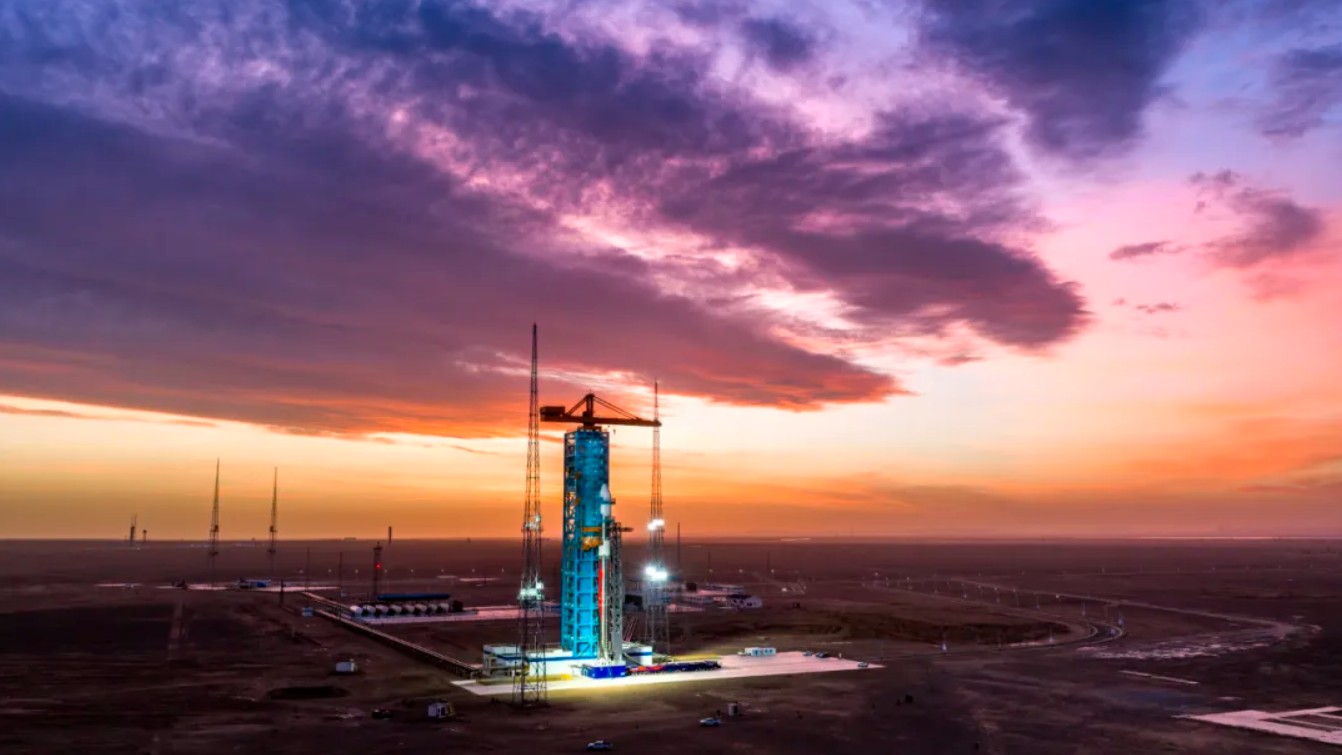

HELSINKI — Chinese commercial launch firm Landspace is targeting Q2 for a second orbital launch and booster recovery attempt and aiming for a reuse test in Q4.
The attempt follows Landspace’s successful first orbital launch of the Zhuque-3 stainless steel, methalox rocket in early December 2025, which saw China’s first attempt at landing an orbital booster. The recovery attempt ended in failure following an anomaly which started after initiation of the Zhuque-3 first stage’s landing burn.
The stage impacted around 40 meters off center of a dedicated landing area in Wuwei County, Gansu province, some 390 kilometers downrange from Jiuquan Satellite Launch Center, northwest China.
Landspace official Cai Guorui, general manager for the department of quality and safety, says the company is targeting Q2 2026 for a second orbital launch and landing attempt and, assuming a successful recovery, reuse of the first stage in Q4 2026.
The updates were presented during a technical briefing at the 2026 session of the United Nations Committee on the Peaceful Uses of Outer Space (COPUOS) Scientific and Technical Subcommittee in February 2026.
Cai noted that events during the recovery attempt, including high-altitude gliding and attitude adjustment, grid fin deployment, reentry burn and aerodynamic deceleration were executed as planned.
“Landspace will continue to optimize the first stage recovery workflow and try to achieve successful recovery in the next flight of ZQ-3,” the presentation states.
The second stage of the first Zhuque-3 launched in December successfully entered a planned 200 by 200-kilometer orbit inclined by 55 degrees. Cai revealed that the second stage completed a 1400-second long coast phase and a re-ignition test, enabling higher-energy missions and more complex deployment profiles. Stage passivation was completed, with orbital decay recorded on January 30, 2026.
The Zhuque-3 is stated to have a payload capacity of 21,300 kilograms when expendable to a 450-km low Earth orbit, 18,300 kg when the first stage is recovered downrange, or 12,500 kg when returning to the launch site. This would appear to put the Zhuque-3 launcher at around 75-85 percent of the Falcon 9 in terms of reusable launch capacity, and provide a big boost to China’s launch capacity and cadence in terms of deploying satellites for the country’s megaconstellations.
Cai laid out key technologies validated by the first flight of the Zhuque-3. He also outlined Landspace’s vertically integrated industrial ecosystem, highlighting facilities including a Beijing headquarters for engine and system-level launch vehicle research and development, propulsion and power systems work in Xi’an, structures development in Shanghai, a Huzhou intelligent engine manufacturing base for production and hot-fire testing, and an intelligent rocket manufacturing base in Jiaxing for vehicle assembly, inspection and integration. Launch operations are supported by the company’s pad within the Dongfeng commercial zone at Jiuquan spaceport.
Landspace has recently secured launch contracts for the Guowang megaconstellation and had an application accepted for an IPO targeting $1 billion. Fellow commercial Chinese entities Galactic Energy, Space Pioneer, CAS Space, Orienspace, Space Epoch, iSpace and Deep Blue Aerospace are targeting debuts of potentially reusable rockets during 2026, while state-owned CASC is expected to debut the Long March 10A, 10B and 12B, having made a first orbital booster recovery attempt with the Long March 12A in December.










Related Posts
Stay Informed With the Latest & Most Important News
Previous Post
Next Post

Advertisement
-
 01Two Black Holes Observed Circling Each Other for the First Time
 -
 02From Polymerization-Enabled Folding and Assembly to Chemical Evolution: Key Processes for Emergence of Functional Polymers in the Origin of Life
 -
 03Astronomy 101: From the Sun and Moon to Wormholes and Warp Drive, Key Theories, Discoveries, and Facts about the Universe (The Adams 101 Series)
 -
 04True Anomaly hires former York Space executive as chief operating officer
 -
 05Φsat-2 begins science phase for AI Earth images
 -
 06Hurricane forecasters are losing 3 key satellites ahead of peak storm season − a meteorologist explains why it matters
 -
 07Binary star systems are complex astronomical objects − a new AI approach could pin down their properties quickly