
Now Reading: Carbon Chain Diversity In L1544 And IRAS 16293-2422: An Astrochemical Pathfinder Study For The SKAO
-
01
Carbon Chain Diversity In L1544 And IRAS 16293-2422: An Astrochemical Pathfinder Study For The SKAO

Carbon Chain Diversity In L1544 And IRAS 16293-2422: An Astrochemical Pathfinder Study For The SKAO

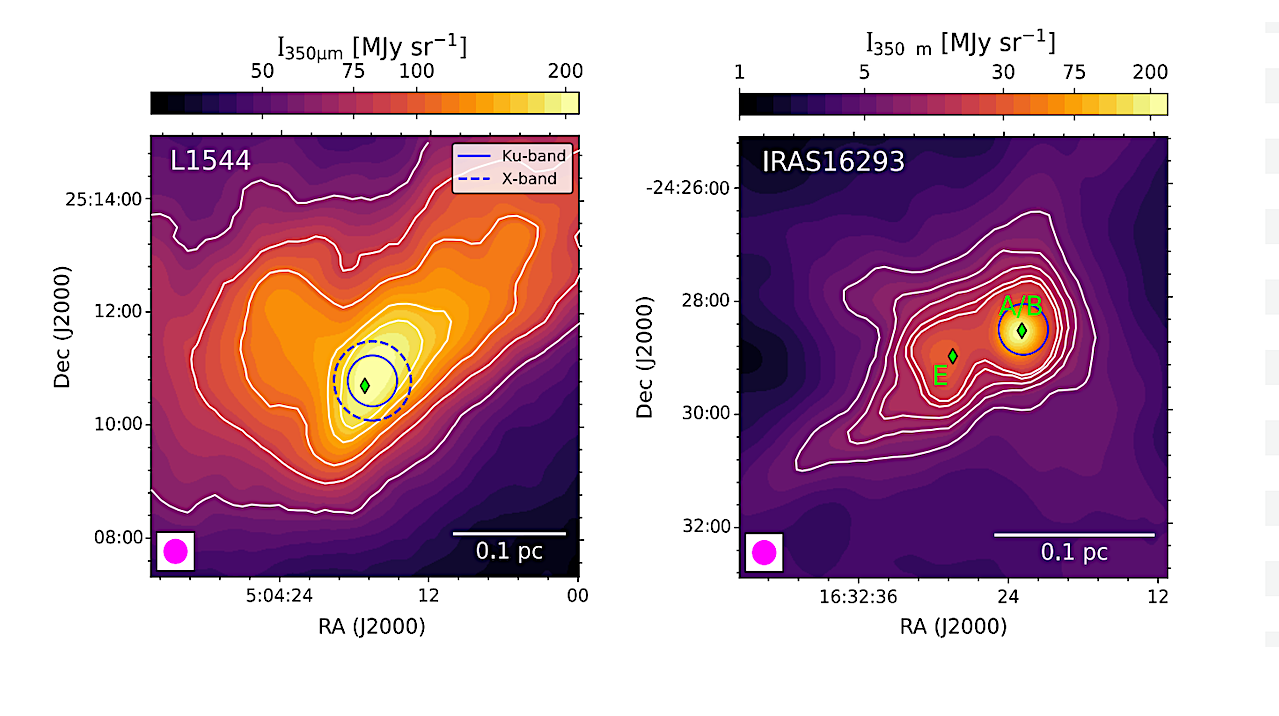
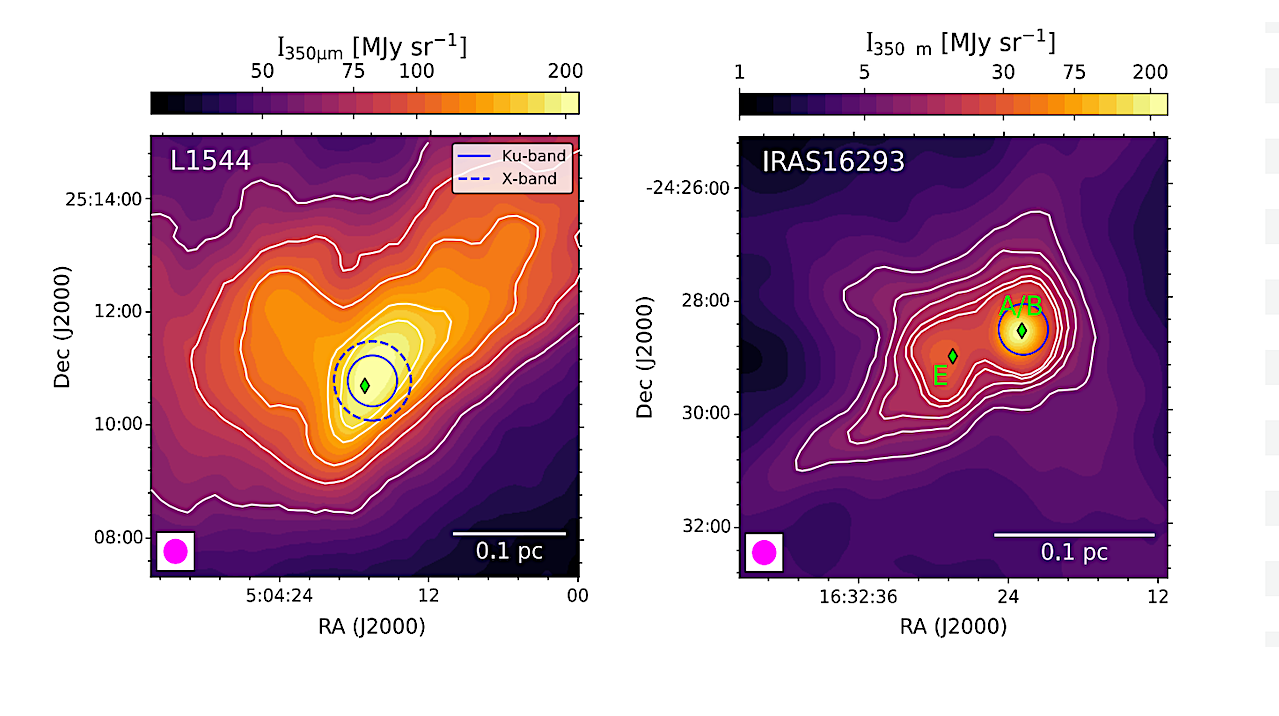
Overview of the L1544 (LEFT panel) and IRAS 16293–2422 (RIGHT panel) regions as traced by the Herschel3 continuum maps at 350 𝜇m. The white contours correspond to [5,7,9,12,14]𝜎, where 𝜎 is 12 MJy sr−1 in L1544, and 1.1 MJy sr−1 in IRAS 16293–2422, respectively. The FoVs of the GBT observations are shown as blue circles – solid line for Ku-band and dashed line for X-band observations (see Sect. 3). Green diamonds identify the continuum (∼1.3 mm) peak position in L1544 (Ward-Thompson et al. 1999) and the position of the A/B, and E objects in IRAS 16293–2422 (Kahle et al. 2023). The size of the Herschel beam (25′′) is shown in the bottom left corner, while the scale bar is shown in the bottom right. — astro-ph.GA
Astrochemical observations have revealed a surprisingly high level of chemical complexity, including long carbon chains, in the earliest stages of Sun-like star formation.
The origin of these species and whether they undergo further growth, possibly contributing to the molecular complexity of planetary systems, remain open questions. We present recent observations performed using the 100-m Green Bank Telescope of the prestellar core L1544 and the protostellar system IRAS 16293-2422.
In L1544, we detected several complex carbon-bearing species, including C2S, C3S, C3N, c-C3H, C4H, and C6H, complementing previously reported emission of cyanopolyynes. In IRAS 16293-2422, we detected c-C3H and, for the first time, HC7N. Thanks to the high spectral resolution, we refine the rest frequencies of several c-C3H and C6H transitions.
We perform radiative transfer analysis, highlighting a chemical difference between the two sources: IRAS 16293-2422 shows column densities 10-100 times lower than L1544. We perform astrochemical modeling, employing an up-to-date chemical network with revised reaction rates.
The models reproduce the general trends, with cyanopolyyne and polyynyl radical abundances decreasing as molecular size increases, but they underestimate the abundances of cyanopolyynes longer than HC5N by up to two orders of magnitude. Current models, which include the dominant neutral-neutral formation routes, cannot account for this discrepancy, suggesting that the chemical network is incomplete.
We propose that additional ion-molecule reactions are crucial for the formation of these species. Developing a more comprehensive chemical network for long carbon chains is essential for accurately interpreting present and future observations.
Lisa Giani, Eleonora Bianchi, Anthony Remijan, Claudio Codella, Giovanni Sabatini, Linda Podio, Cecilia Ceccarelli, Marta De Simone, Nadia Balucani, Paola Caselli, Eric Herbst, Francois Lique, Silvia Spezzano, Charlotte Vastel, Brett McGuire
Subjects: Astrophysics of Galaxies (astro-ph.GA)
Cite as: arXiv:2602.14804 [astro-ph.GA] (or arXiv:2602.14804v1 [astro-ph.GA] for this version)
https://doi.org/10.48550/arXiv.2602.14804
Focus to learn more
Journal reference: Monthly Notices of the Royal Astronomical Society, Volume 544, Issue 4, December 2025, Pages 4043-4061
Related DOI:
https://doi.org/10.1093/mnras/staf1941
Focus to learn more
Submission history
From: Lisa Giani
[v1] Mon, 16 Feb 2026 14:56:46 UTC (2,726 KB)
https://arxiv.org/abs/2602.14804
Astrobiology, Astrochemistry,










Related Posts
Stay Informed With the Latest & Most Important News
Previous Post
Next Post


Advertisement
-
 01Two Black Holes Observed Circling Each Other for the First Time
 -
 02From Polymerization-Enabled Folding and Assembly to Chemical Evolution: Key Processes for Emergence of Functional Polymers in the Origin of Life
 -
 03Astronomy 101: From the Sun and Moon to Wormholes and Warp Drive, Key Theories, Discoveries, and Facts about the Universe (The Adams 101 Series)
 -
 04True Anomaly hires former York Space executive as chief operating officer
 -
 05Φsat-2 begins science phase for AI Earth images
 -
 06Hurricane forecasters are losing 3 key satellites ahead of peak storm season − a meteorologist explains why it matters
 -
 07Binary star systems are complex astronomical objects − a new AI approach could pin down their properties quickly