
Now Reading: Supermassive serial killers: Astronomers discover how black holes ‘kill off’ neighboring galaxies
-
01
Supermassive serial killers: Astronomers discover how black holes ‘kill off’ neighboring galaxies

Supermassive serial killers: Astronomers discover how black holes ‘kill off’ neighboring galaxies

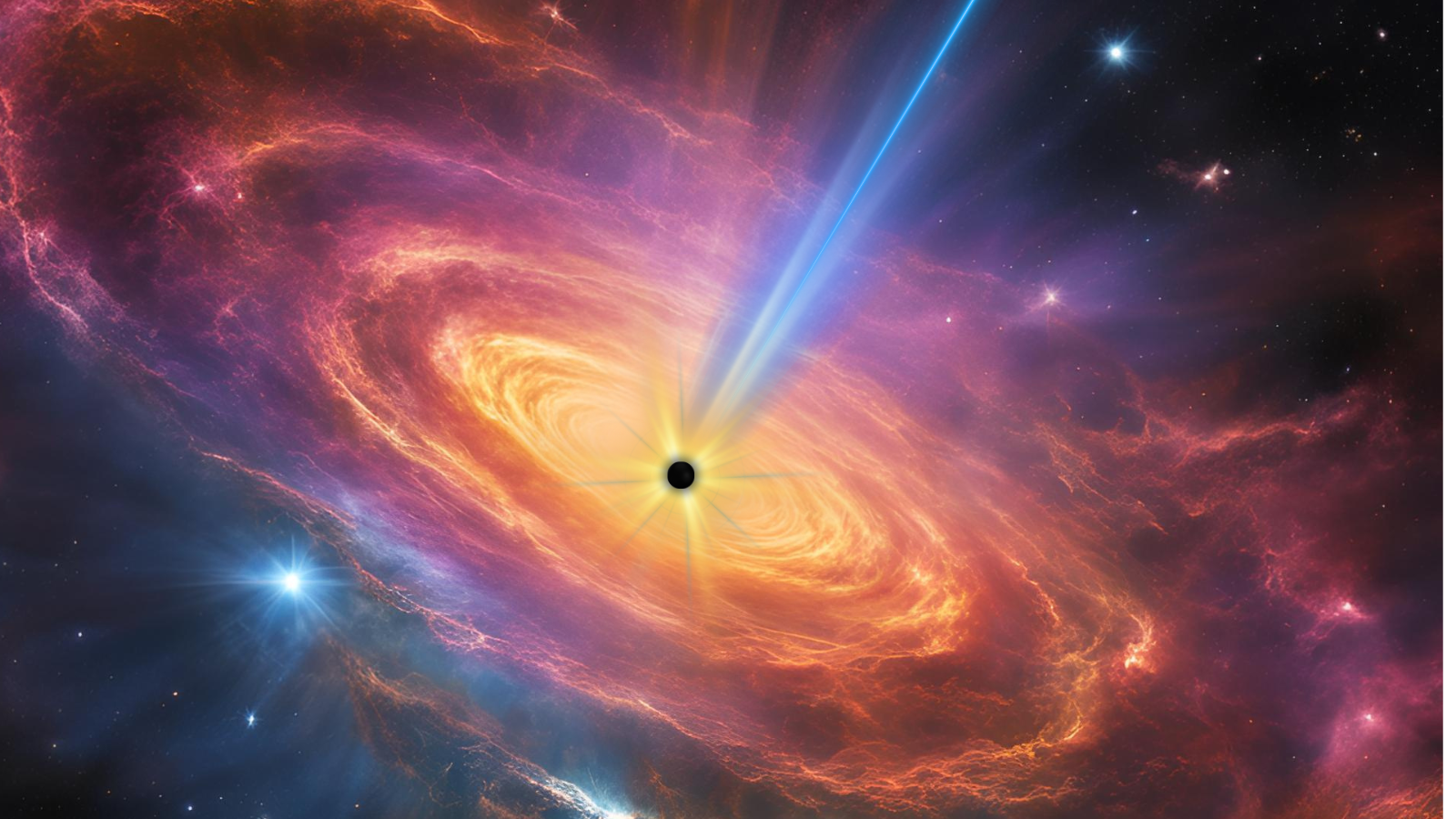
Scientists have long suspected that active supermassive black holes can kill their own host galaxies, but new research suggests these cosmic titans are more like serial killers that can extend their murderous rampage across many light-years and destroy neighboring galaxies, too.
For scientists, “death” for a galaxy means the curtailing of star formation. Supermassive black holes are known to cause this when they are actively feeding, as they heat their larder of gas and dust, provoking that matter content to emit powerful radiation. This radiation either pushes away gas, the building blocks of stars — thereby starving the galaxies and black holes themselves — or simply heats that gas and prevents it from cooling enough to collapse and birth a stellar body. Both outcomes can slow or even stop star formation.
Zhu and colleagues point out that this influence suggests the existence of a “galactic ecosystem” akin to the linked ecosystems of Earth in which changes in one region can deeply impact conditions in another.
“An active supermassive black hole is like a hungry predator dominating the ecosystem,” he said. “Simply put, it swallows up matter and influences how stars in nearby galaxies grow.”
There goes the neighborhood!
Though supermassive black holes with masses of millions or even billions of times that of the sun are thought to dwell at the hearts of all large galaxies, not all of these objects are cosmic killers. For instance, Sagittarius A* (Sgr A*) at the heart of the Milky Way may once have quenched star formation in our galaxy, but today it is quiet, existing on a diet equivalent to a human eating one grain of rice every million years.
Active supermassive black holes greedily feast on matter from a surrounding swirling cloud called an accretion disk. Their immense gravity generates tidal forces in this accretion disk that cause intense friction, resulting in high temperatures that cause this region to brightly glow across the electromagnetic spectrum. This turbulent region, an Active Galactic Nucleus (AGN), can be seen from across the cosmos as a phenomenon known as a “quasar,” often outshining the combined light of every star in its host galaxy.
Not all of the matter in an accretion disk is channeled to the black hole, however. Some matter is channeled to the poles of the supermassive black hole from where it is blasted out as parallel twin jets travelling at near light-speeds. These jets can stretch out far beyond the limits of the galaxy that hosts the active supermassive black hole.
It is little wonder, given the intense radiation of the accretion disk and the violent outflows represented by these twin jets, that active supermassive black holes have a powerful influence over the evolution of their host galaxies.
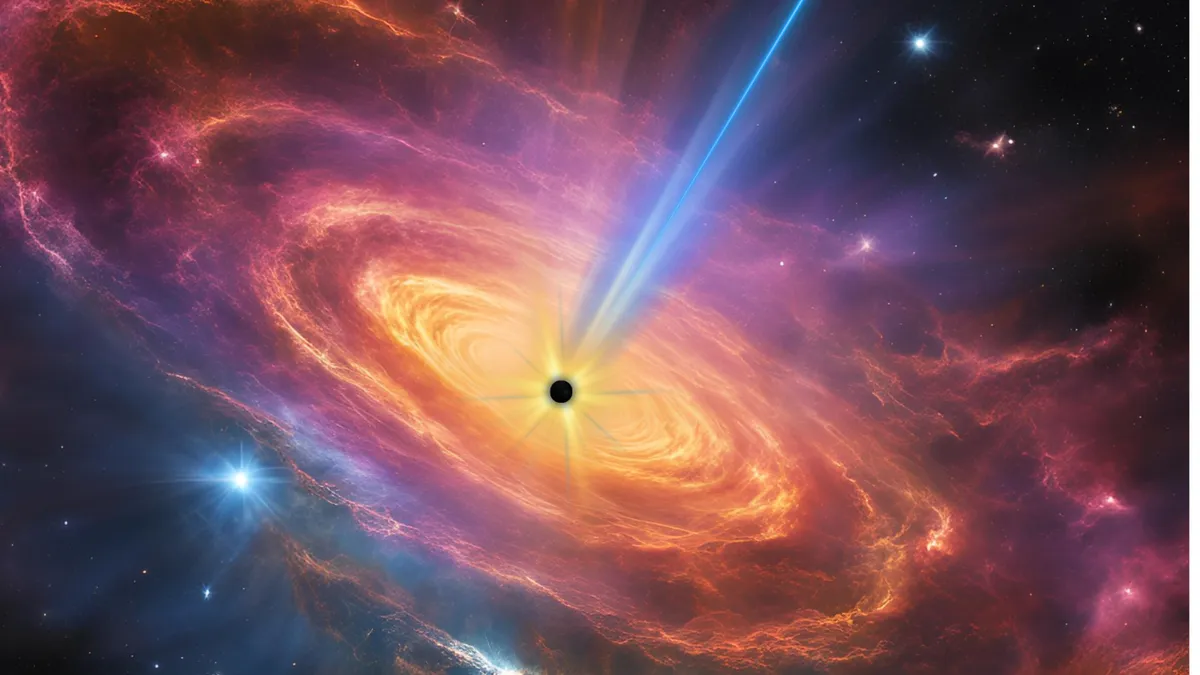
Since the James Webb Space Telescope (JWST) began investigating the cosmos, a curious pattern has emerged regarding quasars. The more massive and powerful these active supermassive black holes are, the less they seem to be surrounded by neighboring galaxies. That’s curious because large galaxies are usually found clustered together, not in isolation.
“We were puzzled,” Zhu explained. “Was the expensive JWST broken?” he added with a laugh. “Then we realized the galaxies might actually be there, but difficult to detect because their very recent star formation was suppressed.”
Zhu and colleagues began to suspect that bright quasars may not just be dampening star formation in their own galactic backyards; they may be disturbing the neighbors, too.
To investigate the possibility of active supermassive black holes killing star formation in neighboring galaxies, the team set about studying one of the brightest quasars ever seen, J0100+2802. This quasar existed when the universe was less than 1 billion years old, and its central engine is a supermassive black hole with around 12 billion times the mass of the sun.
Using the JWST, the scientists hunted for traces of ionized oxygen in the galaxies around J0100+2802, which is a sign of recent star formation. They found this tracer of star birth was much scarcer in galaxies within a million light-years of the powerful quasar than in galaxies outside that radius. That hints at squashed star formation in these proximate galaxies.
“Black holes are known to ‘eat’ a lot of stuff, but during the active eating process and in their luminous quasar form, they also emit very strong radiation. The intense heat and radiation split the molecular hydrogen that makes up vast, interstellar gas clouds, quenching its potential to accumulate and turn into new stars,” Zhu said. “For the first time, we have evidence that this radiation impacts the universe on an intergalactic scale.
“Quasars don’t just suppress stars in their host galaxies, but also in nearby galaxies within a radius of at least a million light-years.”
The team now intends to look for this effect in other so-called quasar fields to develop a clearer picture of how supermassive black holes influence their cosmic neighborhoods.
“Understanding how galaxies influenced one another in the early universe helps us better understand how our own galaxy came to be,” Zhu said. “Now we realize that supermassive black holes may have played a much larger role in galaxy evolution than we once thought — acting as cosmic predators, influencing the growth of stars in nearby galaxies during the early universe.”
The team’s results were published on Dec. 3, 2025 in The Astrophysical Journal Letters.










Related Posts
Stay Informed With the Latest & Most Important News
Previous Post
Next Post

Advertisement
-
 01Two Black Holes Observed Circling Each Other for the First Time
 -
 02From Polymerization-Enabled Folding and Assembly to Chemical Evolution: Key Processes for Emergence of Functional Polymers in the Origin of Life
 -
 03Astronomy 101: From the Sun and Moon to Wormholes and Warp Drive, Key Theories, Discoveries, and Facts about the Universe (The Adams 101 Series)
 -
 04True Anomaly hires former York Space executive as chief operating officer
 -
 05Φsat-2 begins science phase for AI Earth images
 -
 06Hurricane forecasters are losing 3 key satellites ahead of peak storm season − a meteorologist explains why it matters
 -
 07Binary star systems are complex astronomical objects − a new AI approach could pin down their properties quickly