
Now Reading: Did an epic collision form Saturn’s moon Titan and rings?
-
01
Did an epic collision form Saturn’s moon Titan and rings?


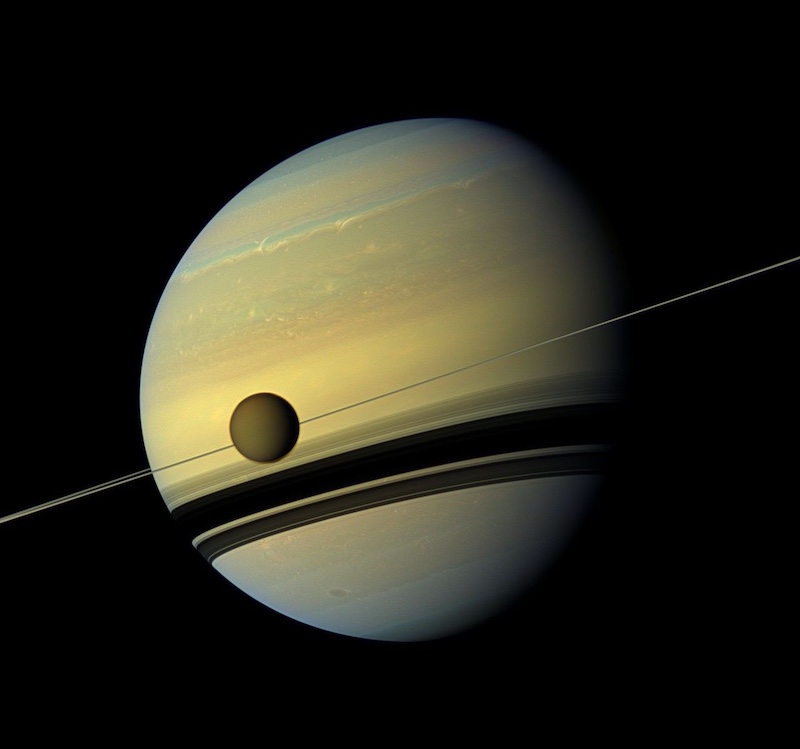

- Titan is Saturn’s largest moon. And Saturn’s ring system is the largest in the solar system. A new hypothesis could explain the formation of both.
- The collision and merger of two old moons might have formed what we now call Titan. The impact could have destabilized smaller moons closer to Titan.
- Those small moons and other scattered debris then later formed Saturn’s rings about 100 million years ago.
EarthSky’s 2026 lunar calendar is available now. Get yours today! Makes a great gift.
How did Saturn’s moon Titan form?
Titan is Saturn’s largest moon, and the 2nd-largest moon in the solar system. How did this fascinating world of liquid methane rivers, lakes and seas form? A team of researchers in the U.S. and France, led by the SETI Institute, said on February 11, 2026, that Titan likely formed from a collision between two former moons. In addition, the new study suggests the same collision eventually led to the formation of Saturn’s majestic rings.
Simulations suggest a former large moon collided with what we today know as Titan. This created additional material from other smaller, inner moons that destabilized and also collided together.
The researchers published their not-yet peer-reviewed draft paper on arXiv on February 11, 2026. It has been accepted for publication in the Planetary Science Journal.

Did a huge collision create Titan?
According to the new study, Titan formed from the collision and merger of two moons. The researchers call the objects a Proto-Titan, nearly as large as Titan itself, and a smaller Proto-Hyperion. Proto-Titan might have resembled Jupiter’s moon Callisto. It likely had no atmosphere and was covered in craters.
This merger could explain some mysteries about Titan, such as its few impact craters and Titan’s eccentric orbit. That orbit is now becoming rounder over time. Also, Proto-Hyperion might have tilted the orbit of another Saturn moon, Iapetus.

Hyperion provides clues
Some of the best clues come from another of Saturn’s current small moons, Hyperion. It is tiny and misshapen, and constantly tumbling in its orbit. Scientist Matija Cuk at the SETI Institute explained:
Hyperion, the smallest among Saturn’s major moons, provided us the most important clue about the history of the system. In simulations where the extra moon became unstable, Hyperion was often lost and survived only in rare cases. We recognized that the Titan-Hyperion lock is relatively young, only a few hundred million years old. This dates to about the same period when the extra moon disappeared. Perhaps Hyperion did not survive this upheaval but resulted from it. If the extra moon merged with Titan, it would likely produce fragments near Titan’s orbit. That is exactly where Hyperion would have formed.

Saturn’s rings
The collision that formed today’s Titan might also have created Saturn’s rings, the study suggests. The researchers had first proposed more than 10 years ago that the rings formed from collisions of smaller moons closer to Saturn.
Titan’s eccentric orbit could have destabilized some of those moons. The formation of the rings would have occurred some time after the collision that created Titan, however. The researchers say that this is consistent of the estimated age of the rings, which is about 100 million years.
NASA’s Dragonfly mission is scheduled to arrive at Titan in 2034. It might reveal further evidence to support the hypothesis of Titan forming from the collision and merger of two former moons. What else will it find on this intriguing world?
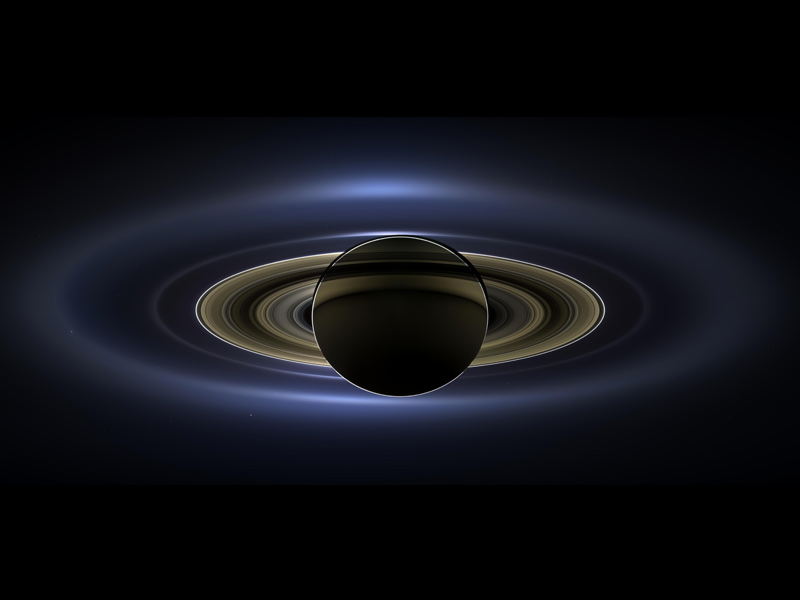
Bottom line: How did Saturn’s moon Titan and Saturn’s iconic rings form? A new study suggests a huge collision between two former moons was responsible for both.
Source: Origin of Hyperion and Saturn’s Rings in A Two-Stage Saturnian System Instability
Read more: No ocean on Titan? New research reveals slushy ice world
Read more: Saturn’s rings much younger than Saturn itself
The post Did an epic collision form Saturn’s moon Titan and rings? first appeared on EarthSky.










Related Posts
Stay Informed With the Latest & Most Important News
Previous Post
Next Post
Advertisement
-
 01Two Black Holes Observed Circling Each Other for the First Time
 -
 02From Polymerization-Enabled Folding and Assembly to Chemical Evolution: Key Processes for Emergence of Functional Polymers in the Origin of Life
 -
 03Astronomy 101: From the Sun and Moon to Wormholes and Warp Drive, Key Theories, Discoveries, and Facts about the Universe (The Adams 101 Series)
 -
 04True Anomaly hires former York Space executive as chief operating officer
 -
 05Φsat-2 begins science phase for AI Earth images
 -
 06Hurricane forecasters are losing 3 key satellites ahead of peak storm season − a meteorologist explains why it matters
 -
 07Binary star systems are complex astronomical objects − a new AI approach could pin down their properties quickly