
Now Reading: Golden Dome to require unprecedented coordination between U.S. combatant commands
-
01
Golden Dome to require unprecedented coordination between U.S. combatant commands


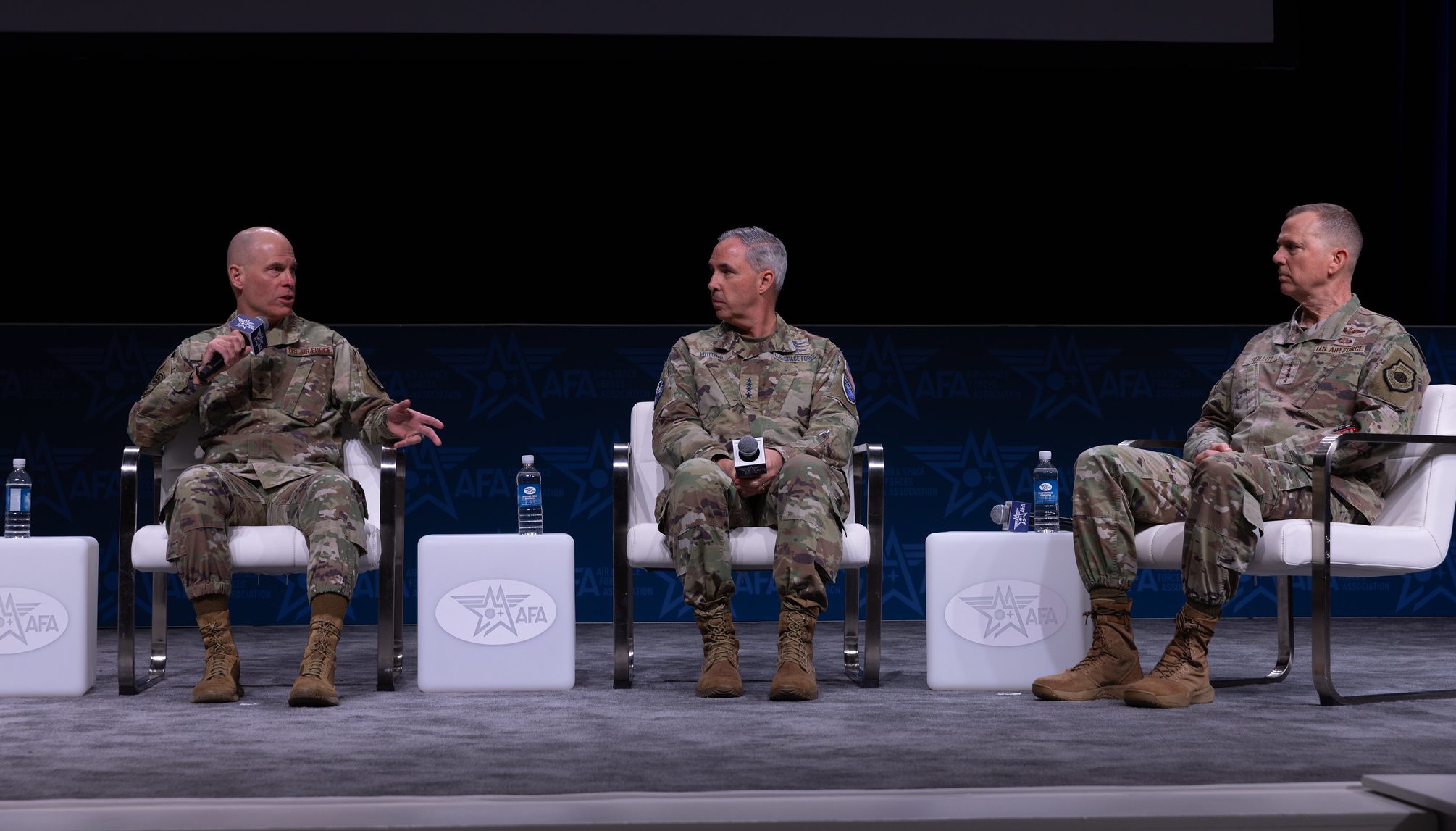

WASHINGTON — The commanders of three key combatant commands said they have been deeply involved in shaping the requirements for the Pentagon’s Golden Dome missile defense initiative.
Speaking Feb. 24 at the Air & Space Forces Association Warfare Symposium in Aurora, Colorado, Gen. Stephen Whiting, commander of United States Space Command, described close collaboration with Gen. Michael Guetlein, the Golden Dome program manager.
“Gen. Michael Guetlein has just been a fantastic partner throughout this … and we’ve been fully engaged with his office,” Whiting said.
“We have sent liaison officers to sit in the Pentagon with his team for months at a time to really make sure we’re as tightly connected as we can be,” he added.
Golden Dome is a proposed layered U.S. missile defense architecture intended to protect the homeland against ballistic, hypersonic and cruise missile threats by integrating ground-, air- and space-based sensors, interceptors and command-and-control systems into a unified network.
The envisioned architecture includes a substantial space layer, potentially involving hundreds or thousands of satellites for sensing, tracking and interceptor coordination. As the combatant command responsible for military operations in the space domain, Space Command would be expected to help integrate those space-based assets into joint fire-control networks and protect them from interference.
Given the scale of the space component, Whiting said the focus is on ensuring interoperability across commands.
“We want to make sure that those capabilities, as they come online, can nest right into our overall command and control system, but more importantly, that those command and control systems can nest well with other combatant commands as well,” he said.
Hypersonic missiles, he noted, complicate traditional geographic defenses. Unlike conventional ballistic missiles that follow predictable arcs through space, hypersonic glide vehicles can maneuver at high speed within the atmosphere, potentially crossing multiple countries’ airspace and different combatant command boundaries before reaching a target. Some systems transition between space and the upper atmosphere during flight.
That blurring of domains means detection, tracking and interception require coordination across regional commands and between air and space surveillance networks.
“Ultimately, NORTHCOM is going to have a huge role to help defend the American people from those threats. And all of that is going to have to work incredibly tightly together,” Whiting said.
The commander of United States Northern Command, Gen. Gregory Guillot, said Northern Command and Space Command took an early role in shaping the program’s requirements.
‘Co-writing’ requirements
“When the Golden Dome initiative was announced,” Whiting said, leaders from the two commands “went to the Pentagon and said, ‘Hey, we want to co-write the requirements document for the Golden Dome.’” He said they received “an instant thumbs up” and delivered input on compressed timelines to inform Guetlein’s planning.
Northern Command is responsible for defending the continental United States, Alaska and Canada, in coordination with NORAD. It already executes homeland ballistic missile defense using ground-based interceptors in Alaska and California, under operational control from United States Strategic Command.
“Our three combatant commands are actually a part of an executive council that supports him in his role that he’s been tasked by the President to accomplish,” said Lt. Gen. Michael Lutton, deputy commander of Strategic Command.
Strategic Command oversees global missile defense planning and integration, as well as nuclear deterrence.
Guillot said Northern Command has also embedded a liaison officer with Guetlein’s team. “We have an incredibly tight relationship with General Guetlein and his team,” he said.
He added that one day after being confirmed to lead Golden Dome, Guetlein traveled to Colorado Springs to meet with Guillot and Whiting.
“The three of us left the room without any exaggeration, 100% aligned on what we thought Golden Dome for America should look like, the timeline, what should be emphasized, what would be a follow on capability,” Guillot said.
Because of that coordination, Guillot predicted the initial capability may arrive sooner than some expect.
“When Golden Dome first was discussed, I think some thought it would be a 2040 Buck Rogers type of capability, and it’s not,” he said. “It’s much closer. And a lot of the capabilities are there.”










Related Posts
Stay Informed With the Latest & Most Important News
Previous Post
Next Post

Advertisement
-
 01Two Black Holes Observed Circling Each Other for the First Time
 -
 02From Polymerization-Enabled Folding and Assembly to Chemical Evolution: Key Processes for Emergence of Functional Polymers in the Origin of Life
 -
 03Astronomy 101: From the Sun and Moon to Wormholes and Warp Drive, Key Theories, Discoveries, and Facts about the Universe (The Adams 101 Series)
 -
 04True Anomaly hires former York Space executive as chief operating officer
 -
 05Φsat-2 begins science phase for AI Earth images
 -
 06Hurricane forecasters are losing 3 key satellites ahead of peak storm season − a meteorologist explains why it matters
 -
 07Binary star systems are complex astronomical objects − a new AI approach could pin down their properties quickly