
Now Reading: Simulation Of Proton Radiolysis Of H2O And O2 Ices With The Nautilus Code
-
01
Simulation Of Proton Radiolysis Of H2O And O2 Ices With The Nautilus Code


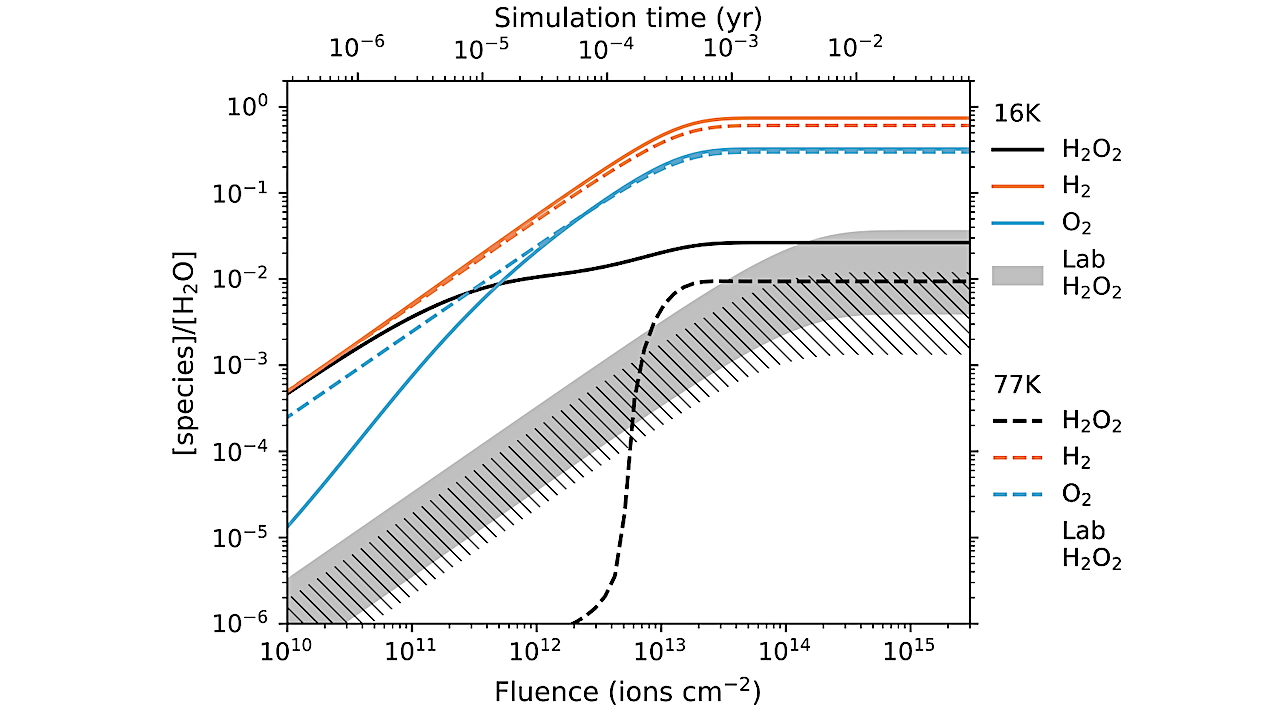
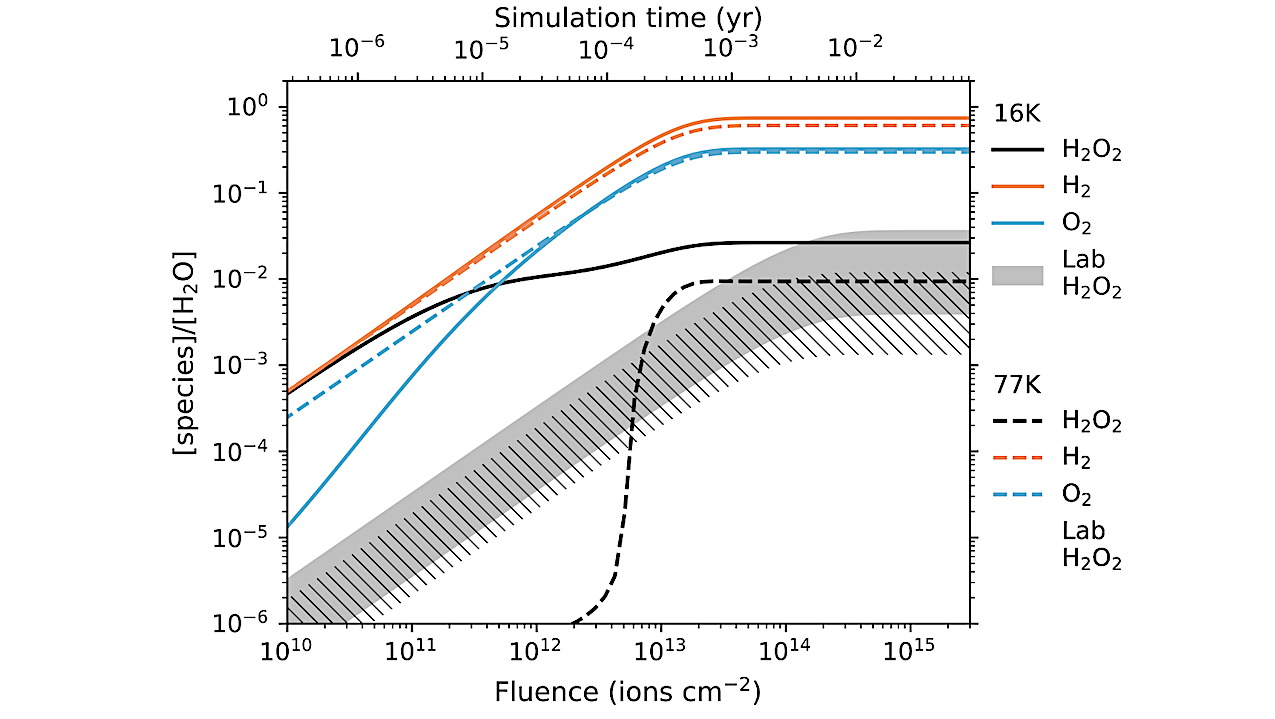
Simulation results of abundance ratios [H2O2]/[H2O] (black lines), [H2]/[H2O] (orange lines), and [O2]/[H2O] (blue lines) with our model (model A) at 16 K (solid lines) and 77 K (dashed lines). The gray shaded and line filled regions show the experimental results of [H2O2]/[H2O] by Gomis et al. (2004a) at 16 and 77 K, respectively, with an assumed uncertainty of a factor of 3. — astro-ph.GA
The radiolysis effect of cosmic rays (CRs) plays an important role in the chemistry in molecular clouds. CRs can dissociate the molecules on dust grains, producing reactive suprathermal species and radicals which facilitate the formation of large molecules. We add the radiolysis process and some relevant reactions into the Nautilus astrochemical code.
By adjusting some parameters, we investigate the sensitivity of the simulation results of the H2O ice on the removal of reaction-diffusion competition, the removal of non-diffusive chemistry, and the desorption energies of the suprathermal species.
We find the model, with a few adjustments of the chemistry, can reproduce the steady-state [H2O2]/[H2O] and [O3]/[O2]_0 abundance ratios in the H2O and O2 radiolysis experiments at any CR flux in the experiments. These adjustments in the model do not fully reproduce the fluence required to reach the steady state. It tends also to overestimate the destruction of H2O as measured in H2O radiolysis experiments.
We show that reducing the G-values of H2O radiolysis, which implies an increase in the efficiency of immediate reformation of water locally after ion impact, leads to simulated H2O destruction rates closer to the experiments. The effect of reaction-diffusion competition on the simulation results of H22O ice is significant at ζ≲10−14 s−1.
The non-diffusive chemistry affects the simulation results at 16 K but not 77K, while the results are sensitive to the desorption energies of suprathermal H, O, O3 and OH at 77 K. Our results show that the steady-state [H2O2]/[H2O] and [O3]/[O2]_0 in experiments can be reproduced by fine-tuning the chemical model, but still call for more constraints on the intermediate pathways in the radiolysis processes, especially the ion chemistry in the ice bulk, as well as activation barriers and branching ratios of the reactions in the network.
Tian-Yu Tu, Valentine Wakelam, Jean-Christophe Loison, Marin Chabot, Emmanuel Dartois, Yang Chen
Comments: 12 pages, 8 figures, accepted for publication in A&A, abstract adjusted for the requirements of ArXiv
Subjects: Astrophysics of Galaxies (astro-ph.GA)
Cite as: arXiv:2602.19996 [astro-ph.GA] (or arXiv:2602.19996v1 [astro-ph.GA] for this version)
https://doi.org/10.48550/arXiv.2602.19996
Focus to learn more
Submission history
From: Tianyu Tu
[v1] Mon, 23 Feb 2026 16:03:16 UTC (123 KB)
https://arxiv.org/abs/2602.19996
Astrobiology,










Related Posts
Stay Informed With the Latest & Most Important News
Previous Post
Next Post


Advertisement
-
 01Two Black Holes Observed Circling Each Other for the First Time
 -
 02From Polymerization-Enabled Folding and Assembly to Chemical Evolution: Key Processes for Emergence of Functional Polymers in the Origin of Life
 -
 03Astronomy 101: From the Sun and Moon to Wormholes and Warp Drive, Key Theories, Discoveries, and Facts about the Universe (The Adams 101 Series)
 -
 04True Anomaly hires former York Space executive as chief operating officer
 -
 05Φsat-2 begins science phase for AI Earth images
 -
 06Hurricane forecasters are losing 3 key satellites ahead of peak storm season − a meteorologist explains why it matters
 -
 07Binary star systems are complex astronomical objects − a new AI approach could pin down their properties quickly