
Now Reading: The Orbital Eccentricity–Radius Distribution for Warm, Single Planets in TESS
-
01
The Orbital Eccentricity–Radius Distribution for Warm, Single Planets in TESS


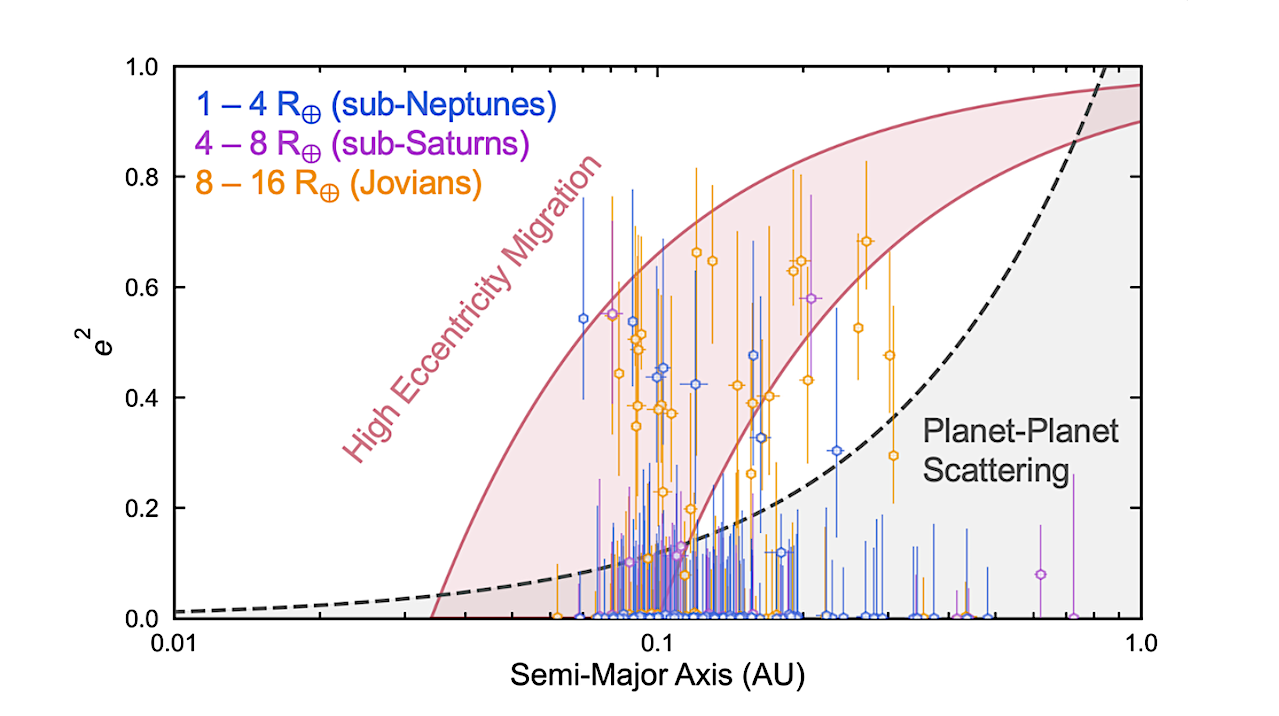
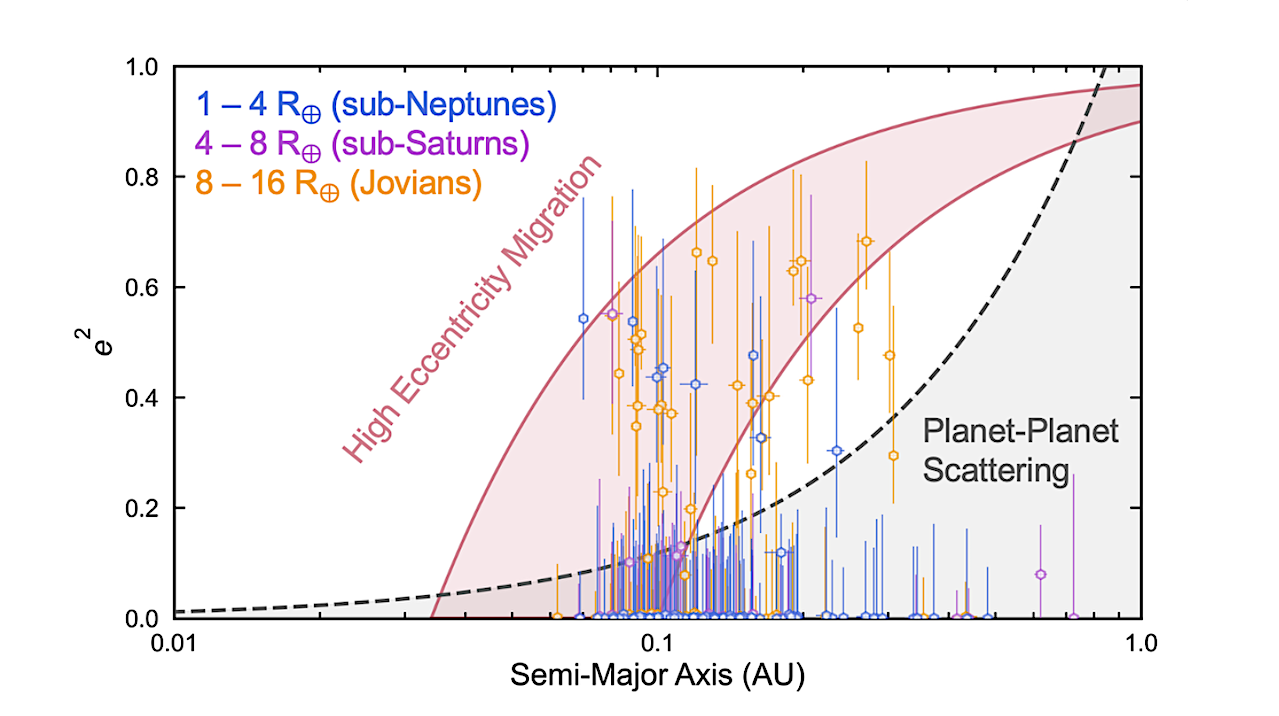
Orbital eccentricity (in e2) versus semi-major axis for the planet sample with eccentricities constrained to better than 40% for clarity (or if e 0.1). Colors denote sub-Neptunes (1–4 R⊕, blue), sub-Saturns (4–8 R⊕, purple), and Jovians (8–16 R⊕, orange). Overlaid curves show theoretical formation channels from R. I. Dawson & J. A. Johnson (2018) for a fiducial planet of ∼6 R⊕ and ∼80 M⊕: high-eccentricity migration (red shaded region) and planet-planet scattering (gray dashed line, gray shaded region). The concentration of larger planets at high eccentricities and small semi-major axes is consistent with high-eccentricity migration. — astro-ph.EP
We characterize the radius-dependent eccentricity distribution of 347 warm (P = 8-200 days) systems with only one transiting planetary candidate identified during Sectors 1-69 of the TESS mission.
Using the “photoeccentric effect” in a hierarchical Bayesian framework, we first model the population using discrete planetary size bins (sub-Neptunes, sub-Saturns, and Jovians). We then develop a continuous mixture model with weights governed by a logistic sigmoid function of radius. We find that the warm-single population is best described by two components: a dominant low-eccentricity mode ( = 0.070-0.068+0.026) and a secondary dynamically excited mode ( = 0.616-0.075+0.091).
The fraction of planets belonging to this high-eccentricity component increases strongly with planet radius, characterized by a transition at a break radius of R_br = 9.8-1.1+1.4 R_e. This trend places warm sub-Saturns predominantly on the same low-eccentricity track as sub-Neptunes.
In contrast, warm Jovians (8–16 R_e) are frequently eccentric, with 59+-13% of the population in the high eccentricity mode. We detect this bimodality at >4sigma, providing statistically significant evidence that warm gas giants are sculpted by two distinct pathways, or a single mechanism with subsequent eccentricity excitation.
Finally, we identify a non-negligible tail of highly eccentric sub-Neptunes (1–4 R_e), which comprise 14.9-6.5+5.1% of the population, consistent with excitation by non-transiting external companions.
Tyler R. Fairnington, Jiayin Dong, Chelsea X. Huang, Emma Nabbie, George Zhou, Duncan Wright, Karen A. Collins, David Ciardi, Jon M. Jenkins, David W. Latham, George Ricker, Samuel N. Quinn, Sara Seager, Avi Shporer, Roland Vanderspek, Joshua N. Winn, Khalid Barkaoui, Allyson Bieryla, Lars Buchhave, Dmitry Cheryasov, Jessie Christiansen, Courtney Dressing, Akihiko Fukui, Alexey Garmash, Steven Giacalone, Eric G. Hintz, Steve B. Howell, Keisuke Isogai, Jerome de Leon, Jorge Lillo-Box, Felipe Murgas, Norio Narita, Louise D. Nielsen, Enric Palle, Markus Rabus, Benjamin V. Rackham, Richard P. Schwarz, Gregor Srdoc, Denise C. Stephens, Gavin Wang, Noriharu Watanabe, Francis P. Wilkin, Joe Williams
Comments: Submitted to ApJ Letters
Subjects: Earth and Planetary Astrophysics (astro-ph.EP)
Cite as: arXiv:2602.20015 [astro-ph.EP](or arXiv:2602.20015v1 [astro-ph.EP] for this version)
https://doi.org/10.48550/arXiv.2602.20015
Focus to learn more
Submission history
From: Tyler Fairnington
[v1] Mon, 23 Feb 2026 16:22:06 UTC (5,414 KB)
https://arxiv.org/abs/2602.20015
Astrobiology,










Related Posts
Stay Informed With the Latest & Most Important News
Previous Post
Next Post
Previous Post
Next Post


Advertisement
-
 01Two Black Holes Observed Circling Each Other for the First Time
 -
 02From Polymerization-Enabled Folding and Assembly to Chemical Evolution: Key Processes for Emergence of Functional Polymers in the Origin of Life
 -
 03Astronomy 101: From the Sun and Moon to Wormholes and Warp Drive, Key Theories, Discoveries, and Facts about the Universe (The Adams 101 Series)
 -
 04True Anomaly hires former York Space executive as chief operating officer
 -
 05Φsat-2 begins science phase for AI Earth images
 -
 06Hurricane forecasters are losing 3 key satellites ahead of peak storm season − a meteorologist explains why it matters
 -
 07Binary star systems are complex astronomical objects − a new AI approach could pin down their properties quickly