
Now Reading: Watch SpaceX Dragon cargo capsule head for home today after historic ISS-boosting mission
-
01
Watch SpaceX Dragon cargo capsule head for home today after historic ISS-boosting mission

Watch SpaceX Dragon cargo capsule head for home today after historic ISS-boosting mission


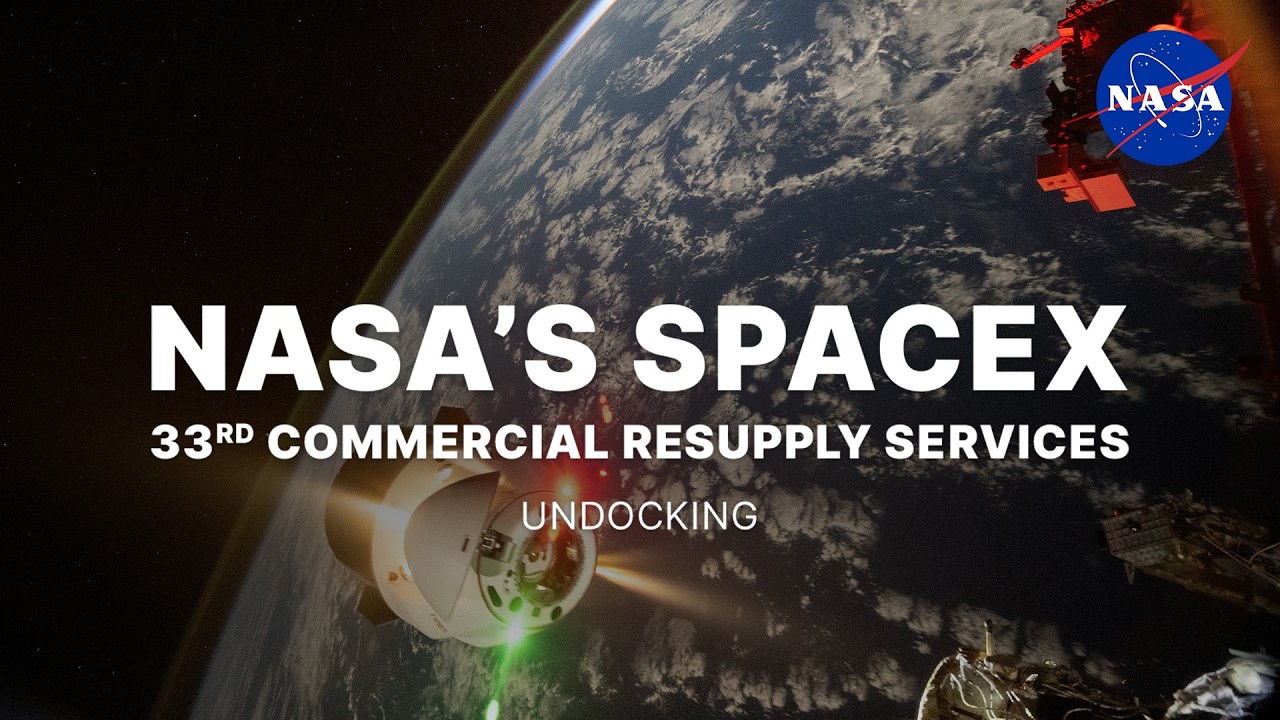
A SpaceX Dragon cargo capsule will undock from the International Space Station today (Feb. 26), and you can watch its departure live.

The Dragon arrived at the International Space Station (ISS) on Aug. 25, delivering about 5,000 pounds (2,270 kilograms) of supplies and scientific gear to the astronauts aboard the orbiting lab. It was the 33rd such robotic cargo run that SpaceX has performed for NASA’s Commercial Resupply Services program.
The capsule has also conducted other useful work during its current mission, which is known as CRS-33.
For example, it “introduced a new capability to reboost the space station, helping maintain its altitude and counter atmospheric drag, which is critical for safe operations and the long-term sustainability of the orbital complex,” NASA officials said in a statement on Monday (Feb. 23).
“During its time docked to the station, Dragon performed six reboosts — five in 2025 and a final maneuver on Jan. 23 — before preparations for its departure began,” they added.
Such reboosts have historically been done by Russia’s Progress freighter. It’s unclear, however, if Russia will remain an ISS partner through the lifetime of the orbiting lab, which is expected to be deorbited in late 2030.
If Russia leaves the consortium early, other reboosting methods will be needed. Dragon just showed it can handle the job, and Northrop Grumman’s Cygnus cargo craft has done so as well.
Progress, Cygnus and Japan’s HTV-X spacecraft — the other currently operational ISS cargo craft — are all designed to burn up in Earth’s atmosphere when their missions are done. But Dragon is reusable, which means it can haul cargo in the downward direction as well. And it’s carrying a lot of gear back to wrap up CRS-33.
For example, Dragon is bringing down experiments from the Euro Material Aging study, “which exposed 141 samples to space for a year to examine how coatings, insulation, and 3D-printed materials degrade,” NASA officials said in the same statement.
It’s also hauling material from Thailand’s Liquid Crystals experiment, which “observed the stability of films used in electronics in microgravity,” they added. “Both could lead to stronger spacecraft, better displays and improved optical devices on future missions.”
The CRS-33 Dragon will splash down under parachutes in the Pacific Ocean off the California coast on Friday (Feb. 27) at around 2:44 a.m. EST (0744 GMT), if all goes according to plan. Its reentry and splashdown will not be livestreamed.










Related Posts


Stay Informed With the Latest & Most Important News
Previous Post
Next Post






Advertisement
-
 01Two Black Holes Observed Circling Each Other for the First Time
 -
 02From Polymerization-Enabled Folding and Assembly to Chemical Evolution: Key Processes for Emergence of Functional Polymers in the Origin of Life
 -
 03Astronomy 101: From the Sun and Moon to Wormholes and Warp Drive, Key Theories, Discoveries, and Facts about the Universe (The Adams 101 Series)
 -
 04True Anomaly hires former York Space executive as chief operating officer
 -
 05Φsat-2 begins science phase for AI Earth images
 -
 06Hurricane forecasters are losing 3 key satellites ahead of peak storm season − a meteorologist explains why it matters
 -
 07Binary star systems are complex astronomical objects − a new AI approach could pin down their properties quickly