
Now Reading: Exploring The Habitability Of The Outer Solar System Icy Moons For The Extremotolerant Yeast Rhodotorula frigidalcoholis
-
01
Exploring The Habitability Of The Outer Solar System Icy Moons For The Extremotolerant Yeast Rhodotorula frigidalcoholis

Exploring The Habitability Of The Outer Solar System Icy Moons For The Extremotolerant Yeast Rhodotorula frigidalcoholis

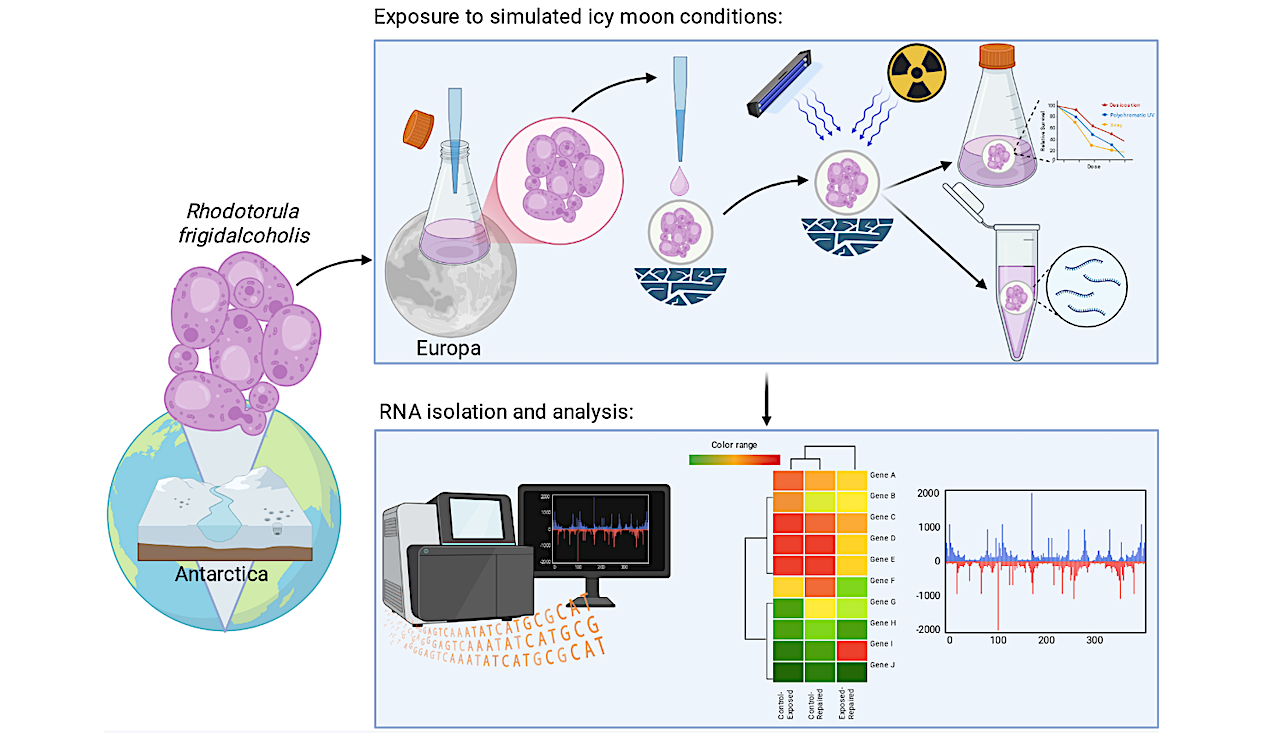
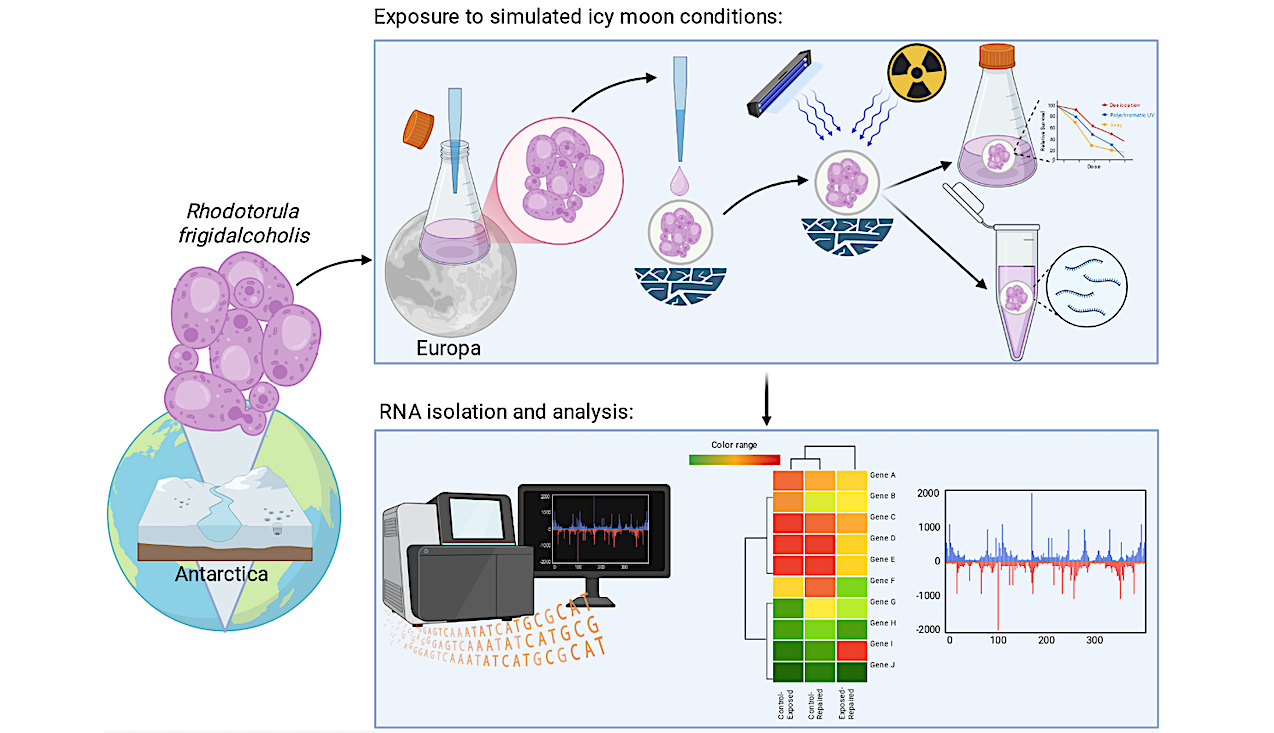
Psychrophilic and psychrotolerant microorganisms have the unique ability to grow below 0°C, which makes them ideal candidates for studying how life could survive on the icy moons of the solar system.
The renewed interest, in view of the JUICE and Europa Clipper missions, to explore these locations has pushed for the identification of organisms which could survive on the icy moons.
In this study we selected the extremophilic yeast Rhodotorula frigidalcoholis given its innate ability to grow between 30°C and −10°C and to survive a range of extreme conditions including x‐ray, UV‐C and polychromatic UV radiation, desiccation at different temperatures, and freeze–thaw cycles.
We report the survival of R. frigidalcoholis under conditions analogous to those found on icy moons. Using transcriptomic approaches, we present novel insights into differential gene expression before, during, and after exposure to combined icy moon conditions.
We also identified the rapid activation of genes involved in catalytic activity and DNA repair during exposure. Our results contribute to a better understanding of the survival mechanisms of psychrotolerant microorganisms in extreme environments and can inform future life‐detection missions on moons such as Enceladus and Europa, also highlighting the need to consider yeasts in planetary protection efforts.
Exploring the Habitability of the Outer Solar System Icy Moons for the Extremotolerant Yeast Rhodotorula frigidalcoholis, Environmental Microbiology via PubMed (open access)
Astrobiology,











Related Posts
Stay Informed With the Latest & Most Important News
Previous Post
Next Post



Advertisement
-
 01Two Black Holes Observed Circling Each Other for the First Time
 -
 02From Polymerization-Enabled Folding and Assembly to Chemical Evolution: Key Processes for Emergence of Functional Polymers in the Origin of Life
 -
 03Astronomy 101: From the Sun and Moon to Wormholes and Warp Drive, Key Theories, Discoveries, and Facts about the Universe (The Adams 101 Series)
 -
 04True Anomaly hires former York Space executive as chief operating officer
 -
 05Φsat-2 begins science phase for AI Earth images
 -
 06Hurricane forecasters are losing 3 key satellites ahead of peak storm season − a meteorologist explains why it matters
 -
 07Binary star systems are complex astronomical objects − a new AI approach could pin down their properties quickly