
Now Reading: Topography-Induced Stationary Waves And The Onset Of Nightside Warming On Rocky Planets Around M-dwarf Stars
-
01
Topography-Induced Stationary Waves And The Onset Of Nightside Warming On Rocky Planets Around M-dwarf Stars

Topography-Induced Stationary Waves And The Onset Of Nightside Warming On Rocky Planets Around M-dwarf Stars

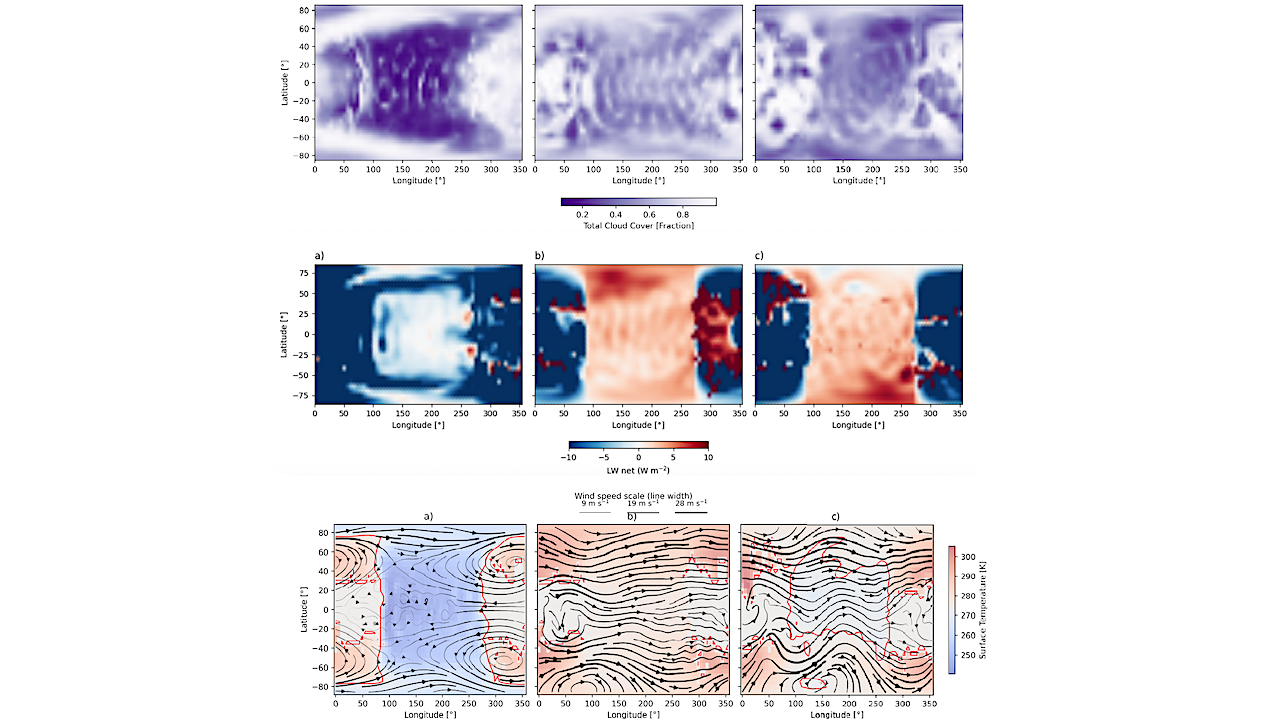
TOP: Time-mean total cloud cover. The panels shown are for: (Left) Baseline, (center ) Steep Uplift, and (right) Plateau. Orography enhances ascent and cloudiness along the day–night boundary in the Steep Uplift run, producing a broader, darker band of clouds across the western terminator and nightside mid-latitudes. MIDDLE: Net longwave flux at the planetary surface. Panels: (a) Baseline, (b) Steep Uplift, (c) Plateau. Topography enhances nightside cloud cover, increasing downwelling longwave flux and warming the surface. Unlike the clear-sky Baseline, both the Steep Uplift and Plateau cases exhibit broader warming centered near the anti-stellar point. The Steep Uplift case alone shows a distinct “red-tongue” warming feature, driven by a stationary Rossby wave that channels moist air eastward.l. BOTTOM: Global wind velocity streamlines for the three topographic configurations. Black streamlines show timemean horizontal flow at 100 hPa, with line width proportional to wind speed (see scale bar). Red contours outline the 273 K temperature curve. The panels shown are for: (Left) Baseline, (center) Steep Uplift, and (right) Plateau. In this regime, the Steep Uplift and Plateau cases exhibit intensified stationary waves and cross-terminator flow, while the Baseline yields a more zonally symmetric and weaker circulation. — astro-ph.EP
Among potentially habitable worlds, rocky planets orbiting M dwarfs offer the most favorable prospects for atmospheric characterization, yet their climates may differ substantially from those of Earth analogs.
In the tidally locked limit, the nightside’s tendency to radiatively cool and potentially trap volatiles as permanent ice introduces a strong dependence of habitability on the planet’s surface and atmospheric boundary conditions.
We perform a suite of synchronously rotating experiments spanning a wide range of topographic and orographic realizations with different mean elevations and landmass distributions. Across a grid of pN2=0.5-8 bar and F⋆=1200-1700 Wm−2, we find that surface relief breaks the flow symmetry, replacing the circumpolar vortices with mechanically forced stationary waves.
Steep orography produces standing Rossby gyres that strengthen the cross-terminator jet and align vertical uplift with the day–night boundary. These new circulation regimes enhance moisture transport, increasing the infrared optical depth and promoting additional nightside cloud formation, which produces a stronger cloud-greenhouse feedback and lower the critical fluxes required for global planetary deglaciation.
Broad, elevated plateaus drive a similarly fragmented but slightly weaker circulation, yielding less effective moisture transport. These results show that the relief and spatial distribution of landmasses, parameters unconstrained for most exoplanets, can exert strong controls on the climatic bifurcations of tidally locked M-dwarf exoplanets.
Howard Chen, Aida Ildirimzade, Evelyn Macdonald
Comments: 15 pages, 11 figures, 1 table; accepted to ApJ; comments welcome prior to final proofs
Subjects: Earth and Planetary Astrophysics (astro-ph.EP)
Cite as: arXiv:2602.20155 [astro-ph.EP] (or arXiv:2602.20155v1 [astro-ph.EP] for this version)
https://doi.org/10.48550/arXiv.2602.20155
Focus to learn more
Submission history
From: Howard Chen
[v1] Mon, 23 Feb 2026 18:59:15 UTC (7,719 KB)
https://arxiv.org/abs/2602.20155
Astrobiology,











Related Posts
Stay Informed With the Latest & Most Important News




Advertisement
-
 01Two Black Holes Observed Circling Each Other for the First Time
 -
 02From Polymerization-Enabled Folding and Assembly to Chemical Evolution: Key Processes for Emergence of Functional Polymers in the Origin of Life
 -
 03Astronomy 101: From the Sun and Moon to Wormholes and Warp Drive, Key Theories, Discoveries, and Facts about the Universe (The Adams 101 Series)
 -
 04True Anomaly hires former York Space executive as chief operating officer
 -
 05Φsat-2 begins science phase for AI Earth images
 -
 06Hurricane forecasters are losing 3 key satellites ahead of peak storm season − a meteorologist explains why it matters
 -
 07Binary star systems are complex astronomical objects − a new AI approach could pin down their properties quickly