
Now Reading: Space Force opens secretive space tracking to commercial firms
-
01
Space Force opens secretive space tracking to commercial firms


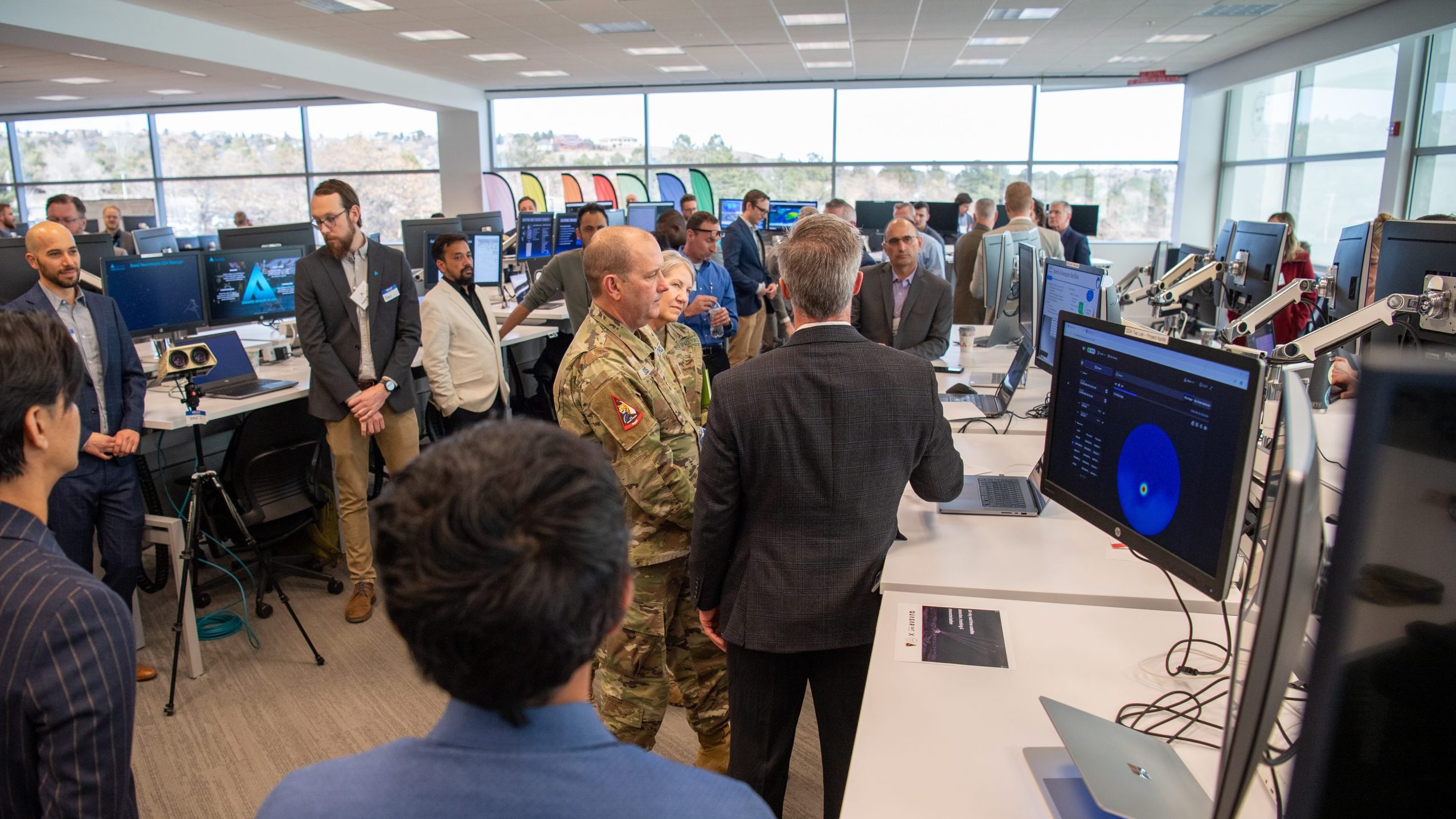

WASHINGTON — One of the U.S. Space Force’s most sensitive missions — tracking foreign satellites and predicting whether they could threaten American spacecraft — is increasingly drawing on commercial data and artificial intelligence.
The work falls under what the military calls battle management, command and control, the systems that allow operators to see what is happening in orbit, assess potential threats and decide how to respond. Historically, that mission relied heavily on classified intelligence streams. Now, a growing share of insight comes from private companies that specialize in space situational awareness and machine learning.
The pathway runs through the Space Domain Awareness Tools, Applications and Processing Lab, or SDA TAP Lab, in Colorado Springs. The lab hosts three-month accelerator cohorts that give companies access to defined government problem sets while allowing the Space Force to examine their data, software and algorithms.
More than 400 companies have participated over the past two years, according to Lt. Col. Collin Greiser, system program manager for advanced space battle management at Space Systems Command.
“You just get so much more speed out of that, because you just get ideas that you’re not normally going to consider,” Greiser said during a recent SpaceNews virtual event. While similar collaboration can occur in classified environments, he said, it does not happen “at the same sense of scale that we get with the lab.”
Greiser oversees a program known as Kronos, which aims to deliver a modernized suite for space battle management and intelligence. The effort is designed to fuse data in real time, support planning and deconfliction, and provide shared awareness for U.S. and allied operators.
To facilitate the connection between experimentation and acquisition, Space Systems Command recently moved the TAP Lab under the Kronos program.
The goal is to “encourage and build more of an intentional pathway to a program of record” so technologies can be used operationally, Greiser said. “And so by moving the lab underneath Kronos, that has really started that transition.”
The shift is intended to speed the movement of unclassified commercial tools into some of the Space Force’s most guarded intelligence workflows. “In the short term my goal is really to boost the amount of capability that we’re taking from the lab and putting it in my program,” Greiser said.
Industry executives say the lab lowers barriers that once kept smaller firms out of the defense space business.
Understanding what the government needs
Tim Bode, senior space solutions architect at Leidos, said the TAP Lab helps companies understand what the government needs before entering a formal procurement process.
“If you go out to the TAP lab website, there are 61 problems detailed,” he said. “Five years ago, it would have been a blank screen.” For a small company with a niche capability, he said, that visibility is significant.
Leidos provides software engineering, data integration and systems support to the lab, helping ingest and visualize tracking data. Bode described the link between TAP and Kronos as a “huge change” in how quickly prototypes can move toward acquisition. “They’re getting solutions that can be more vetted,” he said.
In military planning, officials often refer to disrupting an adversary’s “kill chain” — the sequence of steps required to carry out an attack, from finding and tracking a target to striking it and assessing the result. In the space domain, satellites often enable those steps by providing surveillance, communications and navigation.
By improving space domain awareness — the ability to monitor and interpret activity in orbit — the Space Force hopes to interrupt that sequence before an attack can succeed.
“We have to be able to deny, degrade, damage and destroy their kill chain so that they cannot target our warfighters,” Lt. Gen. Douglas Schiess, deputy chief of space operations for operations, said last week at the Air & Space Forces Association’s Warfare Symposium. The service’s strategy calls for avoiding “operational surprise,” he said. “I want as much space domain awareness as there is.”
A ‘demand driven’ environment
Maj. Sean Allen, chief of the SDA TAP Lab, said the lab operates as a “demand driven environment where we publicly articulate all the problem statements on our website.” The assumption, he said, is that industry already has most of the code required and can adapt it quickly.
One focus is distinguishing normal satellite maneuvers from hostile intent. “Then my ability to make predictions about intent is sped up 10x or 100x,” Allen said. If potentially threatening behavior is identified and incorporated into automated systems, those tools can begin recommending courses of action, compressing decision timelines.
Over successive cohorts, Allen said, the lab has built a catalog of commercial capabilities that operators can draw upon when specific needs arise.
Siamak Hesar, chief executive of Kayhan Space, which has participated in the lab, said it gives the government access to “a large pool of applications and capabilities” that are tested and validated on the unclassified side. Many of the newest tools rely on large language models and other AI techniques. “We are building capabilities that are AI first,” Hesar said. “And we are still learning what this technology is capable of.”
The TAP Lab is also expanding geographically. In addition to its Colorado base and activity in Maui, Hawaii, a new node is being established at the University of Texas at Austin. The Texas Space Commission approved about $9.3 million to support the buildout, including secure infrastructure, operator training and six cohort cycles.










Related Posts
Stay Informed With the Latest & Most Important News
Previous Post
Next Post

Advertisement
-
 01Two Black Holes Observed Circling Each Other for the First Time
 -
 02From Polymerization-Enabled Folding and Assembly to Chemical Evolution: Key Processes for Emergence of Functional Polymers in the Origin of Life
 -
 03Astronomy 101: From the Sun and Moon to Wormholes and Warp Drive, Key Theories, Discoveries, and Facts about the Universe (The Adams 101 Series)
 -
 04True Anomaly hires former York Space executive as chief operating officer
 -
 05Φsat-2 begins science phase for AI Earth images
 -
 06Hurricane forecasters are losing 3 key satellites ahead of peak storm season − a meteorologist explains why it matters
 -
 07Binary star systems are complex astronomical objects − a new AI approach could pin down their properties quickly