
Now Reading: Open Cosmos unveils vision for imagery-linked sovereign satellite connectivity
-
01
Open Cosmos unveils vision for imagery-linked sovereign satellite connectivity



TAMPA, Fla. — Open Cosmos shed more light on its proposed sovereign broadband constellation for Europe March 2, branding the Ka-band network ConnectedCosmos while leaving how it will meet mid-2026 deployment deadlines in the dark.
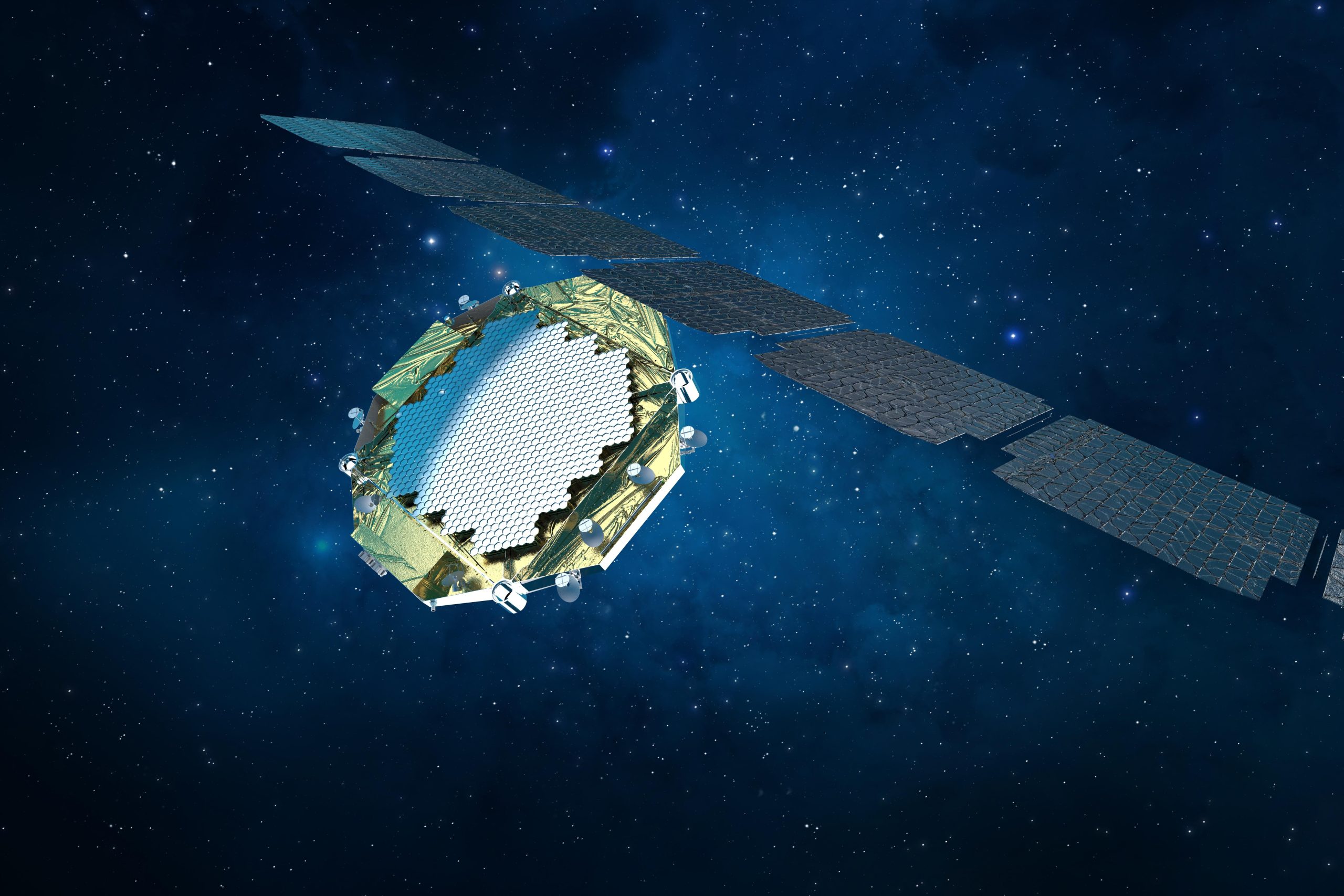
The British small satellite specialist announced at Mobile World Congress in Barcelona, Spain, that the network would combine point-to-point broadband links and direct-to-device connectivity for Internet of Things (IoT) devices, targeting growing demand for secure communications from low Earth orbit (LEO).
ConnectedCosmos would use optical inter-satellite links to reduce reliance on terrestrial gateways and subsea cables, while directly connecting to Earth observation spacecraft operating under its OpenConstellation shared infrastructure initiative.
“Historically, Earth Observation satellites have operated in isolation, capturing high-value data, but relying on ground station passes to transmit it, which can introduce delays of several hours,” Open Cosmos founder and CEO Rafel Jordà Siquier told SpaceNews.
“With our inter-satellite links across the constellation, that bottleneck disappears. Data captured by our cameras and sensors can be transmitted instantly across the network in orbit, enabling near real-time delivery to users on the ground.”
According to Siquier, unifying broadband, IoT connectivity and Earth observation would enable customers to receive integrated data streams in near real time, rather than separate imagery and connectivity services, to support faster operational responses.
“That fundamentally changes decision-making, whether it’s for disaster response, infrastructure monitoring or security operations,” he said.
“It’s the convergence of sensing and connectivity that sets this apart, and to our knowledge, no one else has fused these capabilities together in this way.”
Racing regulatory deadlines
The announcement follows the Jan. 22 launch of two prototype satellites by Rocket Lab to activate the Ka-band spectrum filings, which Liechtenstein reassigned to Open Cosmos from Rivada Space Networks.
Under International Telecommunication Union rules, operators must deploy satellites and begin using assigned frequencies within defined milestones or risk losing priority rights.
The Liechtenstein filings cover 576 satellites in total, and Open Cosmos remains tied to deployment milestones previously associated with Rivada’s plans: 144 satellites must be in orbit by June and another 144 by September under the 50% deployment milestone.
Open Cosmos has not detailed how many satellites it plans to deploy as it works to secure financing ahead of these deadlines, which will determine the constellation’s ultimate size under the filings.
The company has deployed 15 satellites to date and said nine remain in orbit, spanning Earth observation and telecommunications missions. It did not specify how many are part of OpenConstellation, which envisaged a 25-satellite network when the initiative was announced in 2022, including partner spacecraft.
As well as providing regulatory anchors for the constellation, Siquier said the two recently launched satellites are also serving as technical pathfinders for performance it has yet to disclose.
“The in-orbit learning they generate is already feeding directly into the optimization of our next production batch,” he continued, “refining both hardware configurations and our overarching service architecture.”
He said the next generation of satellites would support initial IoT and broadband pilot services.
“Our satellites are in advanced stages of production at our new industrial facility and will be ready for launch on time,” Siquier said, adding that “the team is in place, and we’ve been working closely with our partners to move to deployment. Execution is the priority now — and soon we will turn capability into operational reality.”
European autonomy in a Starlink era
ConnectedCosmos would enter a LEO broadband market dominated by SpaceX’s Starlink, which has rapidly scaled into the world’s largest satellite constellation and secured major government and defense customers worldwide.
European policymakers have increasingly emphasized a need to reduce reliance on foreign infrastructure for critical services, amid growing geopolitical tensions and concerns about resilience against jamming, cyberattacks and cable disruptions.
Siquier framed ConnectedCosmos as a complementary layer to the European Union’s planned IRIS² sovereign multi-orbit broadband system, due to enter service around the end of the decade and backed by national satellite champions SES, Eutelsat and Hispasat.
“Europe cannot afford to be over-reliant on transcontinental megaconstellations for critical services,” he added.
“While those systems play an important global role, strategic autonomy in connectivity is becoming increasingly important, particularly for government, security, civil protection, and critical infrastructure users.”
The push for sovereign alternatives is also fueling other non-U.S. LEO broadband efforts aimed at government and enterprise users, including Canada’s Telesat Lightspeed, which is due to begin operational deployments next year and has been positioned as an IRIS² stopgap.










Related Posts



Stay Informed With the Latest & Most Important News
Previous Post
Next Post




Advertisement
-
 01Two Black Holes Observed Circling Each Other for the First Time
 -
 02From Polymerization-Enabled Folding and Assembly to Chemical Evolution: Key Processes for Emergence of Functional Polymers in the Origin of Life
 -
 03Astronomy 101: From the Sun and Moon to Wormholes and Warp Drive, Key Theories, Discoveries, and Facts about the Universe (The Adams 101 Series)
 -
 04True Anomaly hires former York Space executive as chief operating officer
 -
 05Φsat-2 begins science phase for AI Earth images
 -
 06Hurricane forecasters are losing 3 key satellites ahead of peak storm season − a meteorologist explains why it matters
 -
 07Binary star systems are complex astronomical objects − a new AI approach could pin down their properties quickly