
Now Reading: Stunning Mars image highlights one of Red Planet’s oldest cratered regions
-
01
Stunning Mars image highlights one of Red Planet’s oldest cratered regions


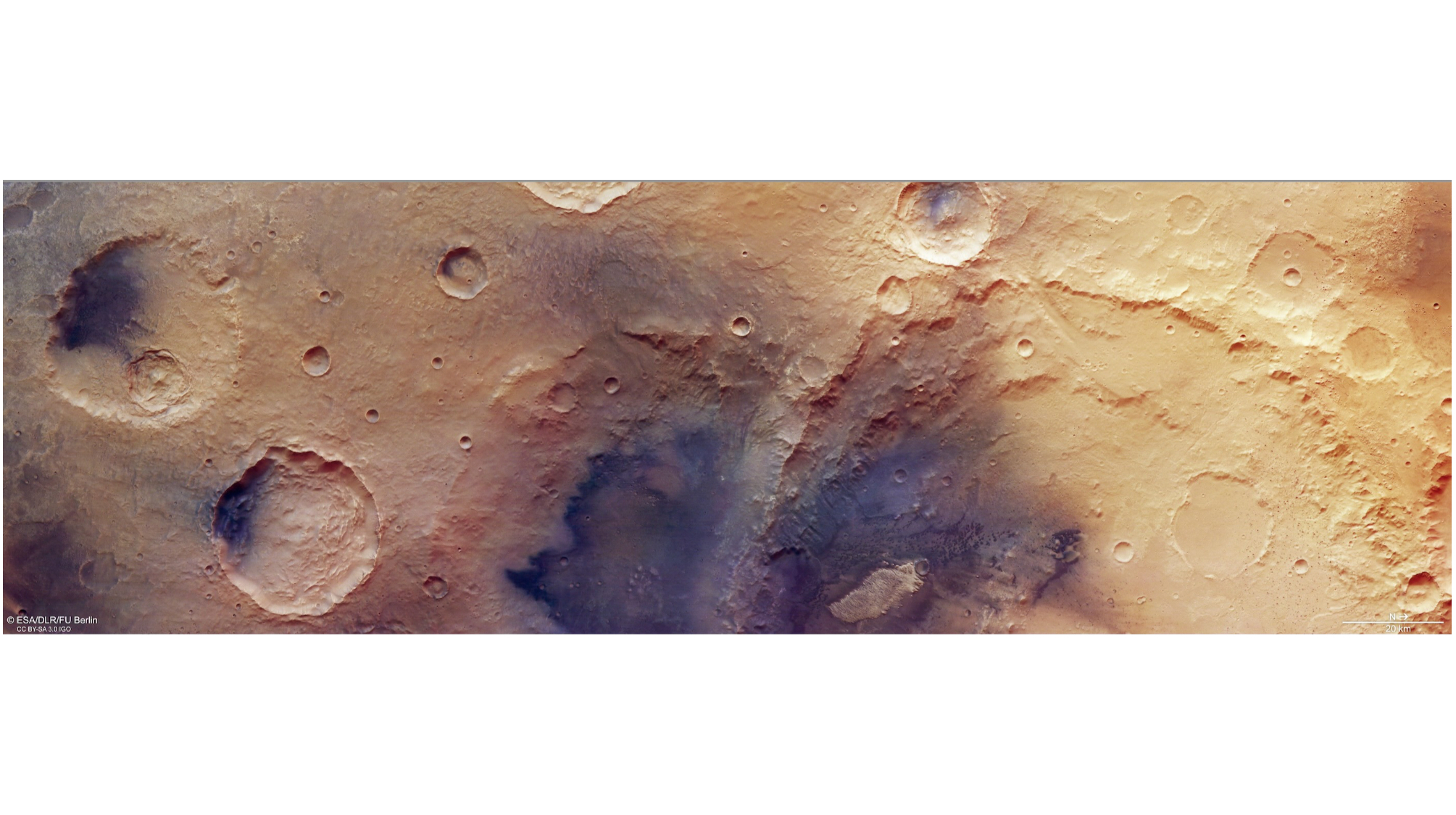
Newly released Mars images offer a detailed look at one of the Red Planet’s oldest, most heavily cratered regions, highlighting a landscape shaped by billions of years of impacts, volcanism and erosion.
The European Space Agency (ESA) shared images of a region known as Arabia Terra, a sprawling, ancient region in Mars’ northern hemisphere thought to be more than 3.7 billion years old. The images were taken by ESA’s long-running Mars Express orbiter on Oct. 12, 2024, during its 26,233rd orbit of the planet. But the shots were only recently processed into a richly detailed color and topographic view, according to a statement from the space agency.

Just to the left of Trouvelot lies another large basin that appears even older and more heavily eroded, with its rim almost completely worn away. Trouvelot cuts into this degraded crater, indicating that the neighboring basin formed first.
Its floor is nearly entirely covered in dark, mineral-rich rock — known as mafic material — containing magnesium, iron and minerals such as pyroxine and olivine. Scientists think these volcanic rocks may have been excavated by impact events and later redistributed by wind and gravity, a process seen in many craters across Arabia Terra.
The image was taken with Mars Express’ High Resolution Stereo Camera (HRSC), which has been mapping the planet since the spacecraft arrived in 2003. Rather than representing a brand-new snapshot, the release highlights the continuing scientific value of reprocessing archived data — extracting new detail and context from observations made months or even years ago, according to the statement.
Across the frame, dark streaks and patches likely mark volcanic materials, while crescent-shaped barchan dunes trace the direction of Martian winds that still sculpt the surface today. A light-toned mound about 12 miles (20 km) long, etched with ridges and grooves, may expose minerals that formed or were altered in the presence of water, which, as a result, typically appear much lighter than the surrounding terrain. Together, these features illustrate the processes that have shaped Arabia Terra over billions of years.
After more than two decades in orbit, Mars Express continues to provide valuable views of the Red Planet’s surface. The newly released images are a reminder that even well-studied regions of the Red Planet can yield fresh scientific insights when older observations are revisited with improved processing and analysis.










Related Posts


Stay Informed With the Latest & Most Important News





Advertisement
-
 01Two Black Holes Observed Circling Each Other for the First Time
 -
 02From Polymerization-Enabled Folding and Assembly to Chemical Evolution: Key Processes for Emergence of Functional Polymers in the Origin of Life
 -
 03Astronomy 101: From the Sun and Moon to Wormholes and Warp Drive, Key Theories, Discoveries, and Facts about the Universe (The Adams 101 Series)
 -
 04True Anomaly hires former York Space executive as chief operating officer
 -
 05Φsat-2 begins science phase for AI Earth images
 -
 06Hurricane forecasters are losing 3 key satellites ahead of peak storm season − a meteorologist explains why it matters
 -
 07Binary star systems are complex astronomical objects − a new AI approach could pin down their properties quickly