
Now Reading: Water Enrichment Of Forming Sub-Neptune Envelopes Limited By Oxygen Exhaustion
-
01
Water Enrichment Of Forming Sub-Neptune Envelopes Limited By Oxygen Exhaustion


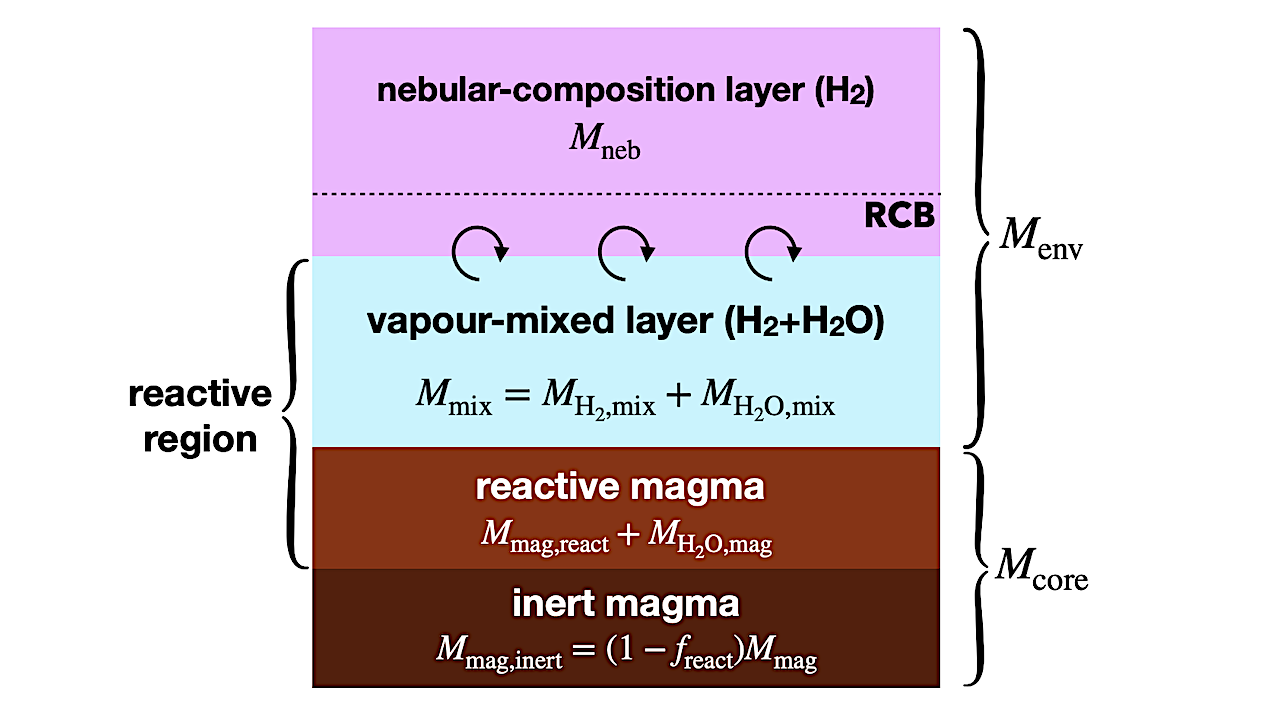

Schematic structure of the planet in our model. From top to bottom, the planet consists of four layers: a nebular-composition envelope (pure H2), a vapor-mixed envelope (H2 + H2O), a reactive magma layer, and a non-reactive (inert) magma layer. Only the vapor-mixed envelope and the reactive magma are assumed to interact. If the radiative–convective boundary (RCB) lies within the nebular– composition layer, its convective part is assumed to mix with the vapor-mixed layer. — astro-ph.EP
The interaction between a magma ocean and a primordial atmosphere is increasingly recognized as a key process in shaping planetary envelope compositions.
This coupling should strongly influence gas accretion, yet its role during the disk-embedded stage remains poorly constrained. We develop a time-dependent model that couples solid accretion, nebular-gas accretion, and water enrichment and partitioning through magma-atmosphere interactions, along with post-disk thermal evolution and escape.
We find that, for super-Earth-mass planets, water production is generally limited by the magma oxygen budget and typically ceases before disk dispersal. Subsequent nebular-gas accretion dilutes the envelope toward hydrogen-dominated compositions, largely independent of the initial magma redox state.
This establishes an upper bound on the envelope water fraction — the oxygen exhaustion limit — primarily set by the reactive-oxygen inventory and the planet mass. After disk dispersal, degassing increases the water fraction only in Earth-mass planets undergoing strong escape, while super-Earths exhibit little change because surface pressures are hardly affected by escape.
Magma-atmosphere coupling alone therefore cannot maintain water-rich envelopes in sub-Neptunes and produces a strong mass-composition relation imposed by the oxygen exhaustion limit. Highly enriched sub-Neptunes would therefore imply additional mechanisms such as late volatile delivery or post-disk giant impacts.
The relation between planetary radius and envelope composition offers a means to infer magma properties, providing a pathway to connect present-day observables with early formation histories.
Tadahiro Kimura, Tim Lichtenberg
Comments: 18 pages, 9 figures, accepted for ApJ
Subjects: Earth and Planetary Astrophysics (astro-ph.EP)
Cite as: arXiv:2603.02423 [astro-ph.EP] (or arXiv:2603.02423v1 [astro-ph.EP] for this version)
https://doi.org/10.48550/arXiv.2603.02423
Focus to learn more
Submission history
From: Tadahiro Kimura
[v1] Mon, 2 Mar 2026 22:08:03 UTC (1,185 KB)
https://arxiv.org/abs/2603.02423
Astrobiology,










Related Posts
Stay Informed With the Latest & Most Important News
Previous Post
Next Post


Advertisement
-
 01Two Black Holes Observed Circling Each Other for the First Time
 -
 02From Polymerization-Enabled Folding and Assembly to Chemical Evolution: Key Processes for Emergence of Functional Polymers in the Origin of Life
 -
 03Astronomy 101: From the Sun and Moon to Wormholes and Warp Drive, Key Theories, Discoveries, and Facts about the Universe (The Adams 101 Series)
 -
 04True Anomaly hires former York Space executive as chief operating officer
 -
 05Φsat-2 begins science phase for AI Earth images
 -
 06Hurricane forecasters are losing 3 key satellites ahead of peak storm season − a meteorologist explains why it matters
 -
 07Binary star systems are complex astronomical objects − a new AI approach could pin down their properties quickly