
Now Reading: Smart telescope buying made easy: Your guide to Unistellar, ZWO, Celestron, Dwarflab, and Vaonis
-
01
Smart telescope buying made easy: Your guide to Unistellar, ZWO, Celestron, Dwarflab, and Vaonis

Smart telescope buying made easy: Your guide to Unistellar, ZWO, Celestron, Dwarflab, and Vaonis

Smart telescopes have taken the astronomy world by storm over the past six years, with all manner of models now on the market catering to all budgets and expertise levels. They have transformed astrophotography, bringing distant nebulae and galaxies into the range of the average person in high-definition, full-color images for the first time.
These ingenious devices are simple to use. Simply download the relevant app onto your smartphone, hook it up to the telescope via Wi-Fi, set your location, run through any automatic setup routines the telescope might require and away you go. There’s no visual eyepiece to look through — your smart telescope is essentially a telescopic camera, and the image builds up in 10-second increments on your phone screen.
Gone are the times of straining your eyesight through an eyepiece on a traditional telescope to try and catch a glimpse of a faint fuzzy — smart telescopes present the universe in wonderful technicolor.
Article continues below
How to choose the right smart telescope for you
Unistellar smart telescopes

One of the first manufacturers of smart telescopes to get their product to market was the French company Unistellar, with their eVscope reaching customers in 2020.
With a Newtonian design, the eVscope’s aperture is 4.5-inches (114 mm), which, as far as smart telescopes go, is quite large. Its focal length is 450mm, and it has a 1.3MP Sony IMX224 CMOS color imaging sensor. However, this model has since been largely superseded by the eVscope 2, which has the same aperture and focal length, but a much improved 7.7MP Sony IMX347 CMOS sensor and an exclusive link-up with Nikon to produce an electronic eyepiece. This eyepiece is different to a regular eyepiece on a normal telescope. Rather than the telescope focusing the light to the eyepiece, the Nikon eyepiece on the eVscope 2 is an OLED micro-display — a tiny electronic screen that mimics the immersive experience of looking through a real telescope eyepiece by projecting the digitized image to infinity.

eVscope 2 specs
Aperture: 114mm
Focal length: 450mm
Field of view: 34 x 45.6 arcminutes
Imaging sensor: Sony IMX347 chip with Nikon eyepiece technology
Weight: 7 kg
Price: $4999

Odyssey specs
Aperture: 85mm
Focal length: 320mm
Field of view: 33.6 x 45 arcminutes
Imaging sensor: Sony IMX415 chip
Weight: 4 kg
Price: $2499
The eVscope 2 has a field of view of 34 x 47 arcminutes, which is just a little wider than the angular diameter of the full Moon (approximately 30 arcminutes, or half a degree). Therefore, it is suitable for imaging the Moon (or the Sun with the addition of a suitable solar filter, available separately) or large deep-sky objects such as the Andromeda Galaxy, the Orion Nebula, and the North America Nebula. It is not suited to imaging the planets, which will appear very small in the field of view. At best, it is capable of just about resolving Saturn’s rings and seeing the gap between the planet and the rings. Comets with long tails will, however, be suitable quarry to chase down with the eVscope 2.
Meanwhile, the eQuinox range is of a similar design to their eVscope, but lacks the Nikon eyepiece and has a slightly smaller CMOS sensor (6.2MP), but trades this in for longer battery life (11 hours compared to 9 hours) and a lower price.

Odyssey Pro specs
Aperture: 85mm
Focal length: 320mm
Field of view: 33.6 x 45 arcminutes
Imaging sensor: Sony IMX415 chip with Nikon eyepiece technology
Weight: 4 kg
Price: $4499

eQuinox 2 specs
Aperture: 114mm
Focal length: 450mm
Field of view: 34 x 47 arcminutes
Imaging sensor: Sony IMX347 chip
Weight: 7 kg
Price: $2799
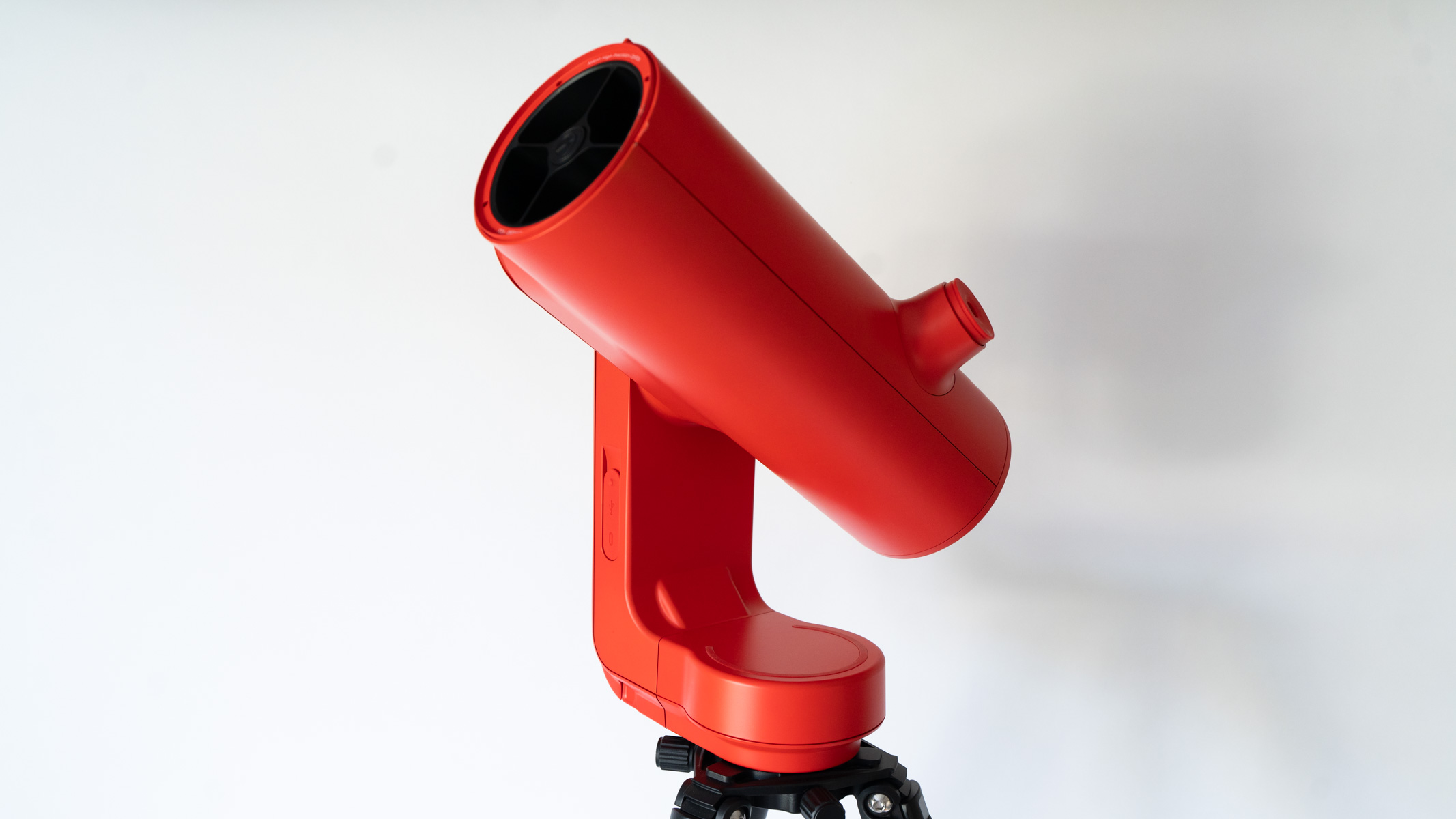
Then there’s Unistellar’s Odyssey range, comprised of the Odyssey and the Odyssey Pro. The Odyssey smart telescopes are aimed more at beginners and, therefore, are simpler to use and more lightweight than their heavy-duty cousins, the eVscope and eQuinox, weighing just 8.8 lbs (4 kg) compared to 15.5 lbs (7 kg). This makes the Odyssey more portable and suitable for taking on holiday, to a dark-sky site or a local stargazing event. However, their battery life of five hours is a limitation. The Odyssey smart telescopes are smaller, however, with 3.3-inch (85mm) apertures and 320mm focal lengths, though the Odyssey Pro is equipped with the Nikon eyepiece technology, and its imaging sensor is a Sony IMX415 chip with 8MP. There’s even a limited edition version in bright red.
The Odyssey range has a field of view of 33.6 x 45 arcminutes, so a little smaller than the eVscope and eQuinox, but it actually frames smaller deep-sky objects much better. It is still not best suited to solar system imaging, though.
Given their prices are in excess of $2500, going up to $4999, Unistellar is definitely operating at the premium end of the market.
Vaonis smart telescopes

Another French smart telescope company is Vaonis, who have quickly established themselves as a leader of the field. They currently have three models on the market: The Vespera II, the Vespera X and the Vespera Pro.
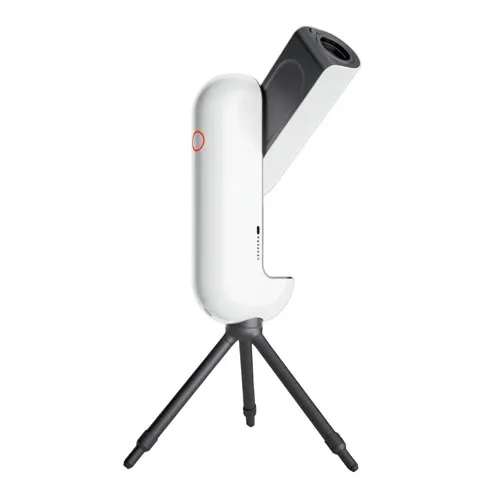
The Vespera II, as the name suggests, is an upgrade of Vaonis’ original smart telescope, the Vespera. Its white, ovoid shape is unmistakable, and costing $1750, it is firmly in the mid-price range.
At 2-inches (50mm), its aperture and focal length (250mm) are far smaller than those of the Unistellar smart telescopes, but its Sony IMX585 color CMOS sensor at 8.3MP still out-punches the Unistellar’s imaging chips. It has a much larger field of view, too, of 2.5 x 1.4 degrees (150 x 84 arcminutes), which means that objects inevitably look much smaller in the vast field of view compared to the Unistellar models. This effectively rules out solar system imaging. Battery life is also not great, at just four hours.

Vespera II specs
Aperture: 50mm
Focal length: 250mm
Field of view: 2.5 x 1.4 degrees
Imaging sensor: Sony IMX585 chip
Weight: 5 kg
Price: $1750

Vespera X specs
Aperture: 50mm
Focal length: 250mm
Field of view: 2.5 x 1.4 degrees
Imaging sensor: Sony IMX585 chip
Weight: 5 kg
Price: $2290
Vespera Pro specs
Aperture: 50mm
Focal length: 250mm
Field of view: 1.6 x 1.6 degrees
Imaging sensor: Sony IMX676 chip
Weight: 5 kg
Price: $2490
The Vespera X is a limited edition that is the same basic smart telescope as the Vespera II, but with a see-through casing so that you can see the electronics inside, and a carbon high tripod. Only 150 have been made and cost $2290, so get yours while you can!
The Vespera Pro is the real upgrade. Its aperture and focal length are still 50mm and 250mm, but it sports a more advanced Sony IMX676 12.5MP imaging sensor and a smaller field of view of 1.6 x 1.6 degrees (96 x 96 arcminutes), with a resolution of 1.6 arcsecond per pixel, an improvement on the Vespera II’s 2.39 arcseconds per pixel, leading to greater clarity in its images. The Vespera Pro also has a dramatically improved battery life of 11 hours, meaning you can spend the long nights of winter happily imaging from dusk til dawn. For these improvements, it will set you back $2490.
Again, the Vaonis smart telescopes are not suitable for solar-system imaging, but lunar, solar and large deep-sky objects are all within its grasp.
All the Vaonis smart telescopes are operated via Vaonis’s Singularity app, which is functional and easy to use.
ZWO smart telescopes

This Chinese company have been operating in astronomical products since 2011, and had already developed a shining reputation for their high-end refractors, CCDs, mounts and their revolutionary wireless astrophotography controller, the ASIAIR, when in 2023 they made their first foray into the smart telescope market with the SeesStar S50, cornering the market for low-budget smart telescopes. They followed up on the S50 (which, as the name suggests, has an aperture of 2-inches/50mm) with the smaller SeeStar S30 (with an aperture of 30mm) and lately the S30 Pro, which boasts ultra high definition in its images.
The S50 boasts a Sony IMX462 sensor and a field of view of 0.73 x 1.29 degrees (44 x 77 arcminutes), making it perfect for imaging the Sun, the Moon and large deep-sky objects such as the Orion Nebula, but again, the solar system’s planets, which are just arcseconds in angular diameter, will only appear as points of light. The S50 has solar and lunar modes to aid with tracking their motion across the sky, and even a scenery mode with a telephoto lens for daytime imaging. The S50 weighs 2.5 kg.

SeeStar S50 specs
Aperture: 50mm
Focal length: 250mm
Field of view: 0.73 x 1.29 degrees
Imaging sensor: Sony IMX462 chip
Imaging modes: Stargaze, scenery, solar, lunar
Weight: 2.5 kg
Price: $499

SeeStar S30 specs
Aperture: 30mm
Focal length: 150mm
Field of view: 2.1 x 1.2 degrees
Imaging sensor: Sony IMX662 chip
Imaging modes: Stargaze, scenery, solar system
Weight: 1.65 kg
Price: $399

SeeStar S30 Pro specs
Aperture: 30mm
Focal length: 160mm
Field of view: 4.6 degrees (tele) 63 degrees (wide)
Imaging sensor: Sony IMX585 chip (tele) Sony IMX586 chip (wide)
Weight: 1.65 kg
Price: $599
The S30 has a Sony IMX662 imaging sensor. The S30’s smaller aperture and focal length lead to a wider field of view than the S50, of 2.1 x 1.2 degrees (126 x 71 arcminutes), making it even less suited to smaller objects. So the Andromeda Galaxy or the Flame and Horsehead region of Orion fill the field nicely, but the Whirlpool Galaxy or the Owl Nebula, for example, appear tiny. However, at just 1.65 kg, the S30 is easily transportable, even in a rucksack.
The S30 Pro has two imaging sensors, an IMX585 for telephoto viewing and a wide-angle IMX586, and a slightly longer focal length than the regular S30, giving the S30 Pro greater versatility, capturing the night sky in 4K Ultra HD.
SeeStar’s telescopes also have a mosaic mode, allowing very wide views of the Milky Way over a landscape to be captured. The solar and lunar modes are self-explanatory and automatically switch on tracking.
Compared to their competitors, the SeeStar smart telescopes are highly affordable. The S30 retails at $399, the S30 Pro costs $599 and the S50 is just $499. Their price, coupled with being extremely easy to use via the SeeStar app, makes ZWO’s smart telescopes extremely attractive to beginners and more advanced observers alike.
Celestron smart telescopes

The telescope giants might have been a little late to the smart telescope party, but when it finally arrived in 2024, their offering of the Celestron Origin was worth the wait.
Employing Celestron’s characteristic Rowe-Ackermann Schmidt Astrograph (RASA) optics, the Origin comes in with a huge 6-inch (152mm) aperture, dwarfing all its smart telescope competitors. It uses a Sony STARVIS IMX178 color CMOS 8.3MP sensor and a built-in Raspberry Pi computer running AI algorithms to process its images. And unlike the dinky little tabletop tripods of the other smart telescopes, the Celestron Origin comes with a NexStar Evolution-style mount and tripod. Celestron calls the Origin an ‘intelligent home observatory’, and it’s easy to see why. It’s certainly a mighty piece of kit, weighing a total of 41.6 lbs (18.87 kg).
The Origin’s field of view is 1.32 x 0.75 degrees (79 x 45 arcminutes), so like all the other smart telescopes, it’s very much optimized for deep-sky, lunar and solar observing. However, its optics are of superior quality to its competitors, but that quality will leave a hole in your wallet, as the Origin costs $3999.
Their most recent release, the Celestron Origin Mark II, has many of the same specs but has been upgraded with a Sony IMX678-AAQR image sensor, allowing for higher resolution images. It also offers less read noise, making for sharper images. Both Origin Smart telescopes are controlled by Celestron’s standard SkySafari app.

Celestron Origin specs
Aperture: 152mm
Focal length: 335mm
Field of view: 1.32 x 0.75 degrees
Imaging sensor: Sony IMX678 chip
Weight: 41.6 lbs (total system with mount and tripod)
Price: $3999

Celestron Origin MarK II specs
Aperture: 152mm
Focal length: 335mm
Field of view: 1.32 x 0.75 degrees
Imaging sensor: Sony IMX678-AAQR1, color, back-illuminated
Weight: 41.6 lbs (total system with mount and tripod)
Price: $4299
DwarfLab smart telescopes

Competing with ZWO for the title of best budget smart telescope is Dwarflab’s Dwarf 3 and Dwarf Mini, with modest price tags of $549 and $399, respectively.
The Dwarf 3 has a unique appearance, and is not only suitable for astronomy, but for landscape photography and bird-watching too, so it is extremely versatile. There’s even a setting for creating billion-pixel panoramas.
The Dwarf 3 is lightweight and designed to be easy to use, and can be taken anywhere, weighing an amazing 1.3 kg and measuring just 14 cm along its long axis. It has six different shooting modes, including video and timelapse. Though its aperture is small, with the telephoto lens at just 35mm (and can reduce to a mere 3.4mm for wide shots), and its focal length is 150mm, it still packs a visual punch thanks to its Sony Starvis 2 IMX678 imaging sensor. The telephoto lens has a field of view of 2.93 x 1.65 degrees (176 x 99 arcminutes), and the wide lens for landscape imaging is a whopping 45 degrees. As with the other smart telescopes, the Dwarf 3 is really only suited for solar, lunar and large deep-sky objects.
The Dwarf Mini is even more pocket-sized. Its appearance is different to the Dwarf 3: instead, it adopts the unfolding arm design of the SeeStar and Vaonis smart telescopes. Yet it weighs just 1.85 lbs (840 g). It has a 30mm aperture lens, drawing comparisons with the SeeStar S30, and has a field of view of 2.45 x 2.14 degrees (147 x 128 arcminutes). Like the Dwarf 3, the Dwarf Mini is easy to use — Dwarflab claim that it can be shooting the stars within three minutes of unboxing it. One downside is its battery lifetime of just four hours and while the Dwarf mini is portable, you wouldn’t want to take it too far from a charging point.

Dwarf 3 specs
Aperture: 35mm
Focal length: 150mm (tele) 6.7mm (wide)
Field of view: 3.38 x 2.95 degrees (tele) 50.6 x 40.5 degrees (wide)
Imaging sensor: Sony IMX 678 chip
Imaging modes: Photo, video, astro, burst, time-lapse
Weight: 1.35 kg
Price: $549

Dwarf Mini specs
Aperture: 30mm
Focal length: 150mm (tele) 6.7mm (wide)
Field of view: 2.45 x 2.14 degrees (tele) 50.6 x 45 degrees (wide)
Imaging sensor: Sony IMX662 chip
Imaging modes: Photo, video, astro, burst, time-lapse; EQ mode with max 90-second exposure
Weight: 840 g
Price: $399
Summary
All smart telescopes have something to offer. If you’re looking for an instrument that has most of the trappings of a regular telescope, such as a mount and a large sturdy tripod, then choose Celestron’s Origin. If you want something that is portable, then the Dwarf Mini is the smart telescope for you. When it comes to price, the Dwarf and SeeStar smart telescopes are the choice for the budget-conscious, while Vaonis’ Vespera range are excellent mid-price options and Unistellar competes with Celestron as a high-end option.
As for a choice of target, no one has yet made a smart telescope designed for the planetary imager — fields of view are still large, designed to take in the wide canvas of the night sky.
But whichever smart telescope you choose, have fun letting it take you far and wide across the universe!










Related Posts


Stay Informed With the Latest & Most Important News
Previous Post
Next Post





Advertisement
-
 01Two Black Holes Observed Circling Each Other for the First Time
 -
 02From Polymerization-Enabled Folding and Assembly to Chemical Evolution: Key Processes for Emergence of Functional Polymers in the Origin of Life
 -
 03Astronomy 101: From the Sun and Moon to Wormholes and Warp Drive, Key Theories, Discoveries, and Facts about the Universe (The Adams 101 Series)
 -
 04True Anomaly hires former York Space executive as chief operating officer
 -
 05Φsat-2 begins science phase for AI Earth images
 -
 06Hurricane forecasters are losing 3 key satellites ahead of peak storm season − a meteorologist explains why it matters
 -
 07Binary star systems are complex astronomical objects − a new AI approach could pin down their properties quickly