
Now Reading: Jupiter’s moons leave cold ‘footprints’ in the planet’s auroras, James Webb Space Telescope finds
-
01
Jupiter’s moons leave cold ‘footprints’ in the planet’s auroras, James Webb Space Telescope finds

Jupiter’s moons leave cold ‘footprints’ in the planet’s auroras, James Webb Space Telescope finds

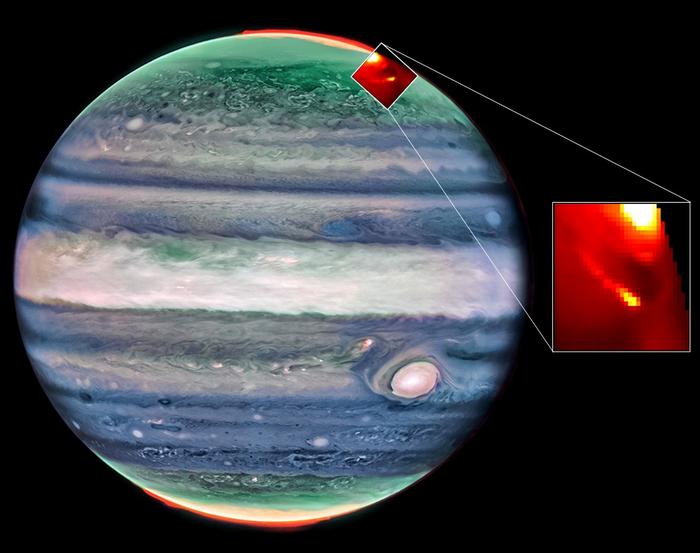
Jupiter’s moons can have surprising effects on the world’s displays of auroral lights by “stomping down” on the planet’s gigantic magnetic environment.
These surprising effects, detected in observations from the James Webb Space Telescope (JWST), include a cold spot in Jupiter’s atmosphere, and a rapid increase in the density of charged particles.
Article continues below
Jupiter’s auroral lights are created in similar fashion to Earth’s as charged particles riding on the solar wind slam into Jupiter’s magnetic field and are funneled down towards the gas giant’s poles. When they enter the atmosphere, they collide with atoms and molecules, causing them to glow. However, by interacting with Jupiter’s magnetic field, its four largest moons — the Galilean moons Io, Europa, Ganymede and Callisto — can leave an imprint on the aurora.
The footprints are exacerbated by a phenomenon known as the Io Plasma Torus. Io is the solar system‘s most volcanic body, and its volcanoes spew out tons of charged particles that drift into orbit around Jupiter, forming the plasma torus that is held in place by Jupiter’s magnetic field. As the Galilean moons orbit Jupiter, they interact with the plasma torus and the magnetic field, and drive ions towards Jupiter’s atmosphere, contributing to the aurora and generating electrical currents that influence how bright the auroral footprints are.
Previous multi-wavelength measurements have tracked how bright the aurora, and these footprints, can become. However, in September 2023, Northumbria’s Henrik Melin and Tom Stallard used the to take snapshots of the area on Jupiter’s where auroral events rotated into view. By watching the edge of Jupiter’s disk, the JWST was able to probe the side profile of Jupiter’s atmosphere directly beneath an aurora.

When Knowles analyzed that data, she found something unexpected.
The JWST took five snapshots, and in four of them, everything looked normal. But in one snapshot, a cold spot appeared in the atmosphere below an aurora connected to Io’s footprint. While the rest of the aurora was at a steady temperature of 919 degrees Fahrenheit (493 degrees Celsius), the cold spot was a “mere” 509 degrees Fahrenheit (265 degrees Celsius).
The density of ions streaming into the upper atmosphere to power the aurora around the cold spot was also far higher than had ever been measured before. One particularly abundant ion present was the trihydrogen cation (H3+) and the ion density was, on average, three times greater than the rest of the aurora. Moreover, within the cold spot, densities could vary by up to 45 times in just that small region.
“We found extreme variability in both temperature and density within Io’s auroral footprint that happened on the timescale of minutes,” said Knowles. “This tells us that the flow of high-energy electrons crashing into Jupiter’s atmosphere is changing incredibly rapidly.”
Jupiter’s auroral lights are the most powerful in the solar system, but they are not the only auroral lights present in our corner of the neighborhood. Of course, there are Earth’s auroral lights — but Earth’s moon does not leave a footprint on our planet’s aurora because it does not interact with Earth’s magnetic field strongly enough. However, Saturn‘s moon Enceladus, which is spewing particles into space via its water geysers, does impact the aurora on the ringed planet. It is therefore possible that this cold spot phenomenon also happens there.
“This work opens up entirely new ways of studying not just Jupiter and its other Galilean moons, but potentially other giant planets and their moon systems,” said Knowles. “We’re seeing Jupiter’s atmosphere respond to its moons in real-time, which gives us insights into processes that occur throughout our solar system and perhaps further afar.”
However, questions remain.
For instance, the cold spot was only seen in one image. How often do they occur, what causes them to switch on and off, and how are they influenced by conditions in Jupiter’s magnetic environment?
Knowles is already searching for answers. In January 2026 she was awarded time on NASA’s Infrared Telescope Facility on Mauna Kea in Hawaii to track the various auroral footprints over six nights as they rotate with the planet, and she is currently analyzing the data.
The JWST observations are described in a paper published on March 3 in the journal Geophysical Research Letters.










Related Posts
Stay Informed With the Latest & Most Important News



Advertisement
-
 01Two Black Holes Observed Circling Each Other for the First Time
 -
 02From Polymerization-Enabled Folding and Assembly to Chemical Evolution: Key Processes for Emergence of Functional Polymers in the Origin of Life
 -
 03Astronomy 101: From the Sun and Moon to Wormholes and Warp Drive, Key Theories, Discoveries, and Facts about the Universe (The Adams 101 Series)
 -
 04True Anomaly hires former York Space executive as chief operating officer
 -
 05Φsat-2 begins science phase for AI Earth images
 -
 06Hurricane forecasters are losing 3 key satellites ahead of peak storm season − a meteorologist explains why it matters
 -
 07Binary star systems are complex astronomical objects − a new AI approach could pin down their properties quickly