
Now Reading: Suspended NOAA satellite chief warns of threats to federal science programs
-
01
Suspended NOAA satellite chief warns of threats to federal science programs


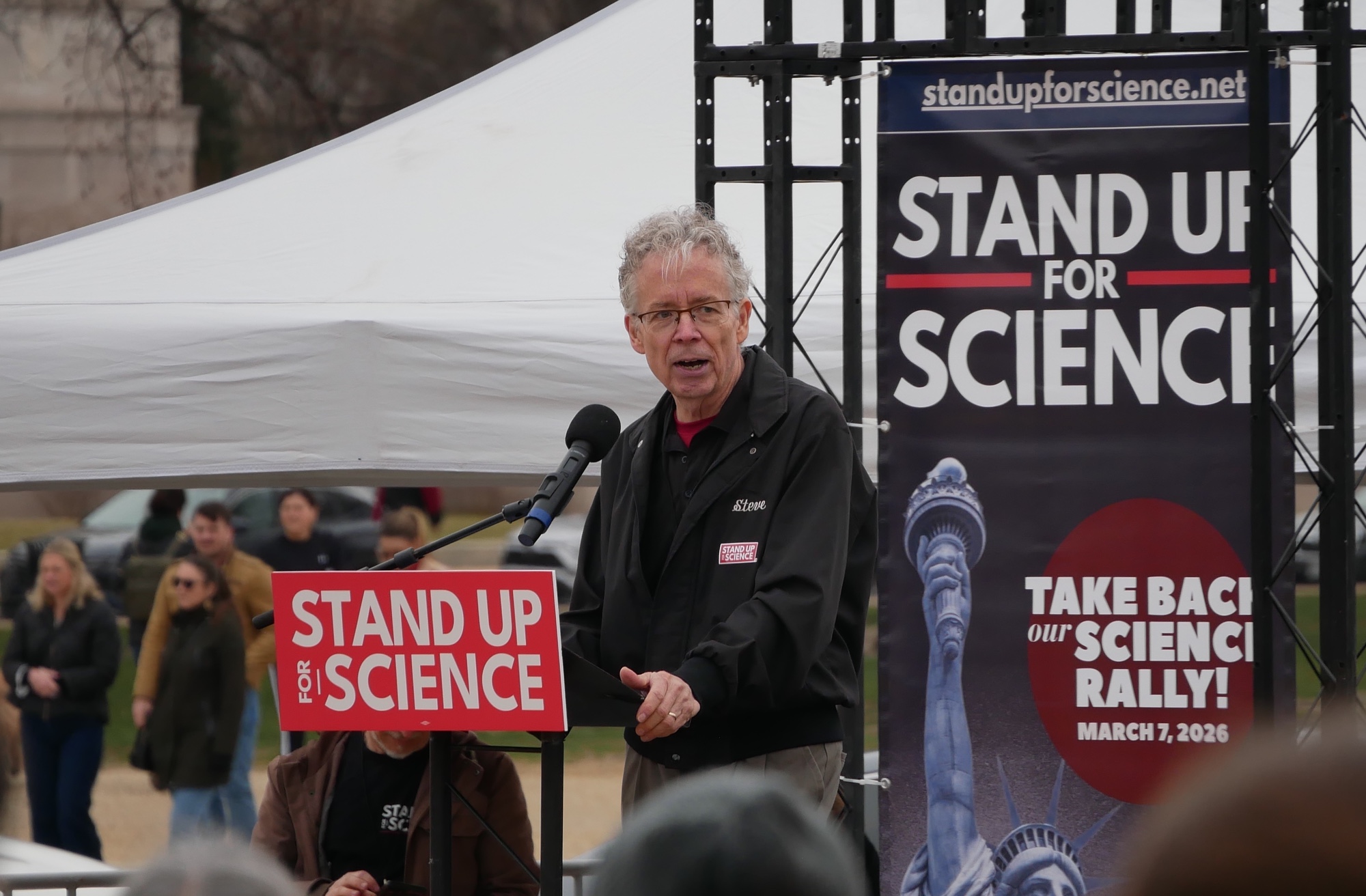

WASHINGTON — The head of NOAA’s satellite division, on administrative leave for more than half a year, warned that workforce reductions and cuts to science programs have “lobotomized” the federal government.
Speaking at the “Stand Up for Science” rally on the National Mall March 7, Stephen Volz offered his sharpest public criticism to date of policies by the current administration that he argues have reduced the ability of agencies to study weather and climate and threaten the public.
“What is at risk is our ability to make reasoned, informed decisions. That has been hijacked,” he said. “The separation of 95,000 federal science positions in the past year, including 10,000 STEM Ph.D.s, has lobotomized the federal government.”
Volz has been associate administrator for satellite and information services at NOAA since 2014, leading the National Environmental Satellite, Data, and Information Service, or NESDIS, which acquires and operates weather satellites. However, he was placed on administrative leave last July for reasons NOAA did not disclose, even to Volz.
Volz and another NOAA official were placed on leave as the Senate was advancing the nomination of Neil Jacobs to become NOAA administrator. Some in Congress interpreted the moves as retaliation for an investigation in the first Trump administration, when Jacobs was acting administrator.
In a recent interview with SpaceNews, Volz said he had “no insight” into why he was placed on leave last July.
“No one at NOAA or the Department of Commerce has reached out to share with me the results of their investigation,” he said. “As far as I know, I’m still the assistant administrator of NESDIS.”
Jacobs, in a presentation to NOAA’s Science Advisory Board lasting more than an hour March 10, did not discuss the status of Volz or NESDIS. He said little about satellite programs during the meeting but said the morale of the NOAA workforce was a priority.
“My top priority is morale. I think the agency is in a much better place than it was a couple of months ago,” he said, but did not elaborate on that assessment.
At the rally, Volz was critical of the actions NOAA has taken since he was put on leave.
“Since my ousting, planned instruments that would measure air quality, water quality and the like have been canceled, all without congressional approval,” he said. “Our organization is undergoing a massive restructuring, but not focused on replacing the tens of thousands of scientists and engineers who either retired, took the buyout, were pushed out or encouraged to leave.”
“An effort is underway to divert significant federal funds from our government systems to for-profit companies that can make money on them and on the information that we should be getting as a privilege, as a right,” he added.
He said he was concerned about a “great silencing” across the government as members of the workforce who remain at science agencies find their ability to speak out and share information restricted.
“People want to do their work, but they’re not allowed to,” he said. “The public only hears alternative facts, and we will all be hurt by this.”
Beyond Volz’s speech, NOAA and NASA were mentioned only in passing during the two-hour rally, which featured speakers ranging from scientists to members of Congress and drew an audience of a few hundred people.
Some speakers noted that proposed severe cuts to science programs in the White House’s fiscal year 2026 budget, such as a nearly 50% cut to NASA’s science directorate, were overridden by Congress. A final 2026 appropriations bill largely restored NASA science funding to 2025 levels.
“We were able to push back and reject those cuts in the budget we passed on Capitol Hill,” said Sen. Chris Van Hollen, D-Md., ranking member of the commerce, justice and science appropriations subcommittee, at the rally.
However, he warned that more cuts may be on the way in the upcoming fiscal year 2027 budget proposal.
“We are not out of the woods yet,” he said, citing comments by Russell Vought, director of the Office of Management and Budget, about seeking to inflict “trauma” on federal employees. “We do need to keep pushing back.”
“I’m no longer leading the satellite program, and I’m sad about that, but I am talking to experts in the scientific diaspora every day,” Volz said at the rally. “We work to protect and sustain the knowledge of what has been lost or is at risk, and we’re working to reconstruct a new and better global observing system.”










Related Posts

Stay Informed With the Latest & Most Important News
Previous Post
Next Post


Advertisement
-
 01Two Black Holes Observed Circling Each Other for the First Time
 -
 02From Polymerization-Enabled Folding and Assembly to Chemical Evolution: Key Processes for Emergence of Functional Polymers in the Origin of Life
 -
 03Astronomy 101: From the Sun and Moon to Wormholes and Warp Drive, Key Theories, Discoveries, and Facts about the Universe (The Adams 101 Series)
 -
 04True Anomaly hires former York Space executive as chief operating officer
 -
 05Φsat-2 begins science phase for AI Earth images
 -
 06Hurricane forecasters are losing 3 key satellites ahead of peak storm season − a meteorologist explains why it matters
 -
 07Binary star systems are complex astronomical objects − a new AI approach could pin down their properties quickly