
Now Reading: Black hole and neutron star mergers push the laws of physics with their odd orbits
-
01
Black hole and neutron star mergers push the laws of physics with their odd orbits


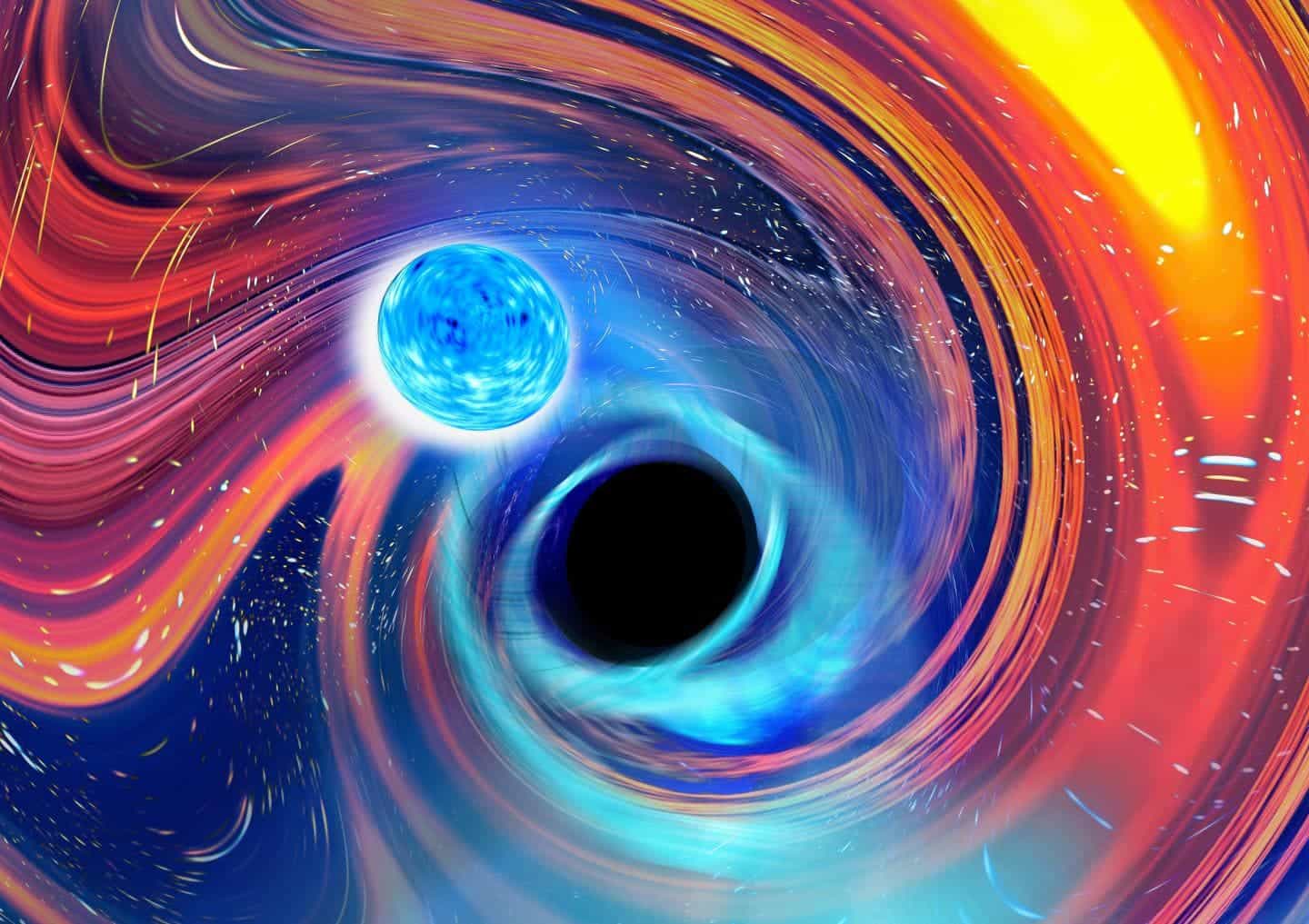
Scientists have discovered that before black holes collide with neutron stars and merge, these extreme stellar remnants can swirl around each other in oval orbits rather than in circular orbits. The revelation demonstrates another way in which black holes and neutron stars push the laws of physics, and casts doubt on assumptions regarding the formation and evolution of these mixed binary systems.
A team of scientists challenged assumptions that black holes and neutron stars approach each other in circular orbits when they studied ripples in spacetime, or gravitational waves, that rang out from just such a “mixed merger.” The signal from this merger, dubbed GW200105, was detected by the gravitational wave detectors Laser Interferometer Gravitational-wave Observatory (LIGO) and Virgo. The merger occurred around 910 million light-years away, resulting in the creation of a daughter black hole with around 13 times the mass of the sun.
Article continues below
Key to the team’s discovery was a new model of gravitational waves developed at the University of Birmingham’s Institute of Gravitational Wave Astronomy, which allowed Schmidt and colleagues to determine the orbits of the progenitor objects.
This included calculating how much the black hole and neutron star that collided to create this gravitational wave signal were wobbling, or “precessing,” before their merger. The calculations revealed a lack of precession prior to the merger.
This marks the first time these characteristics have been measured for a “mixed merger” between a black hole and a neutron star, both of which are stellar remnants created when massive stars “die” and undergo gravitational collapse. The results hint at the influence of an unseen third object in this system.
“The orbit gives the game away. Its elliptical shape just before merger shows this system did not evolve quietly in isolation but was almost certainly shaped by gravitational interactions with other stars, or a third companion,” Schmidt continued.
Previously, when a circular orbit had been considered for the progenitor objects beyond this merger, researchers had underestimated the mass of the black hole as being around 9 times the mass of the sun, and the neutron star having a mass of around 2 solar masses.
“This is convincing proof that not all neutron star–black hole pairs share the same origin,” team member Gonzalo Morras, from the Universidad Autónoma de Madrid, Spain, said. “The eccentric orbit suggests a birthplace in an environment where many stars interact gravitationally.”

The scientists’ results indicate that there are likely multiple ways in which black hole-neutron star mergers can proceed, rather than there being one dominant formation channel.
This could help explain why astronomers are increasingly seeing diversity in merging stellar remnant binaries.The team’s results were published on Wednesday (March 11) in the Astrophysical Journal Letters.










Related Posts

Stay Informed With the Latest & Most Important News




Advertisement
-
 01Two Black Holes Observed Circling Each Other for the First Time
 -
 02From Polymerization-Enabled Folding and Assembly to Chemical Evolution: Key Processes for Emergence of Functional Polymers in the Origin of Life
 -
 03Astronomy 101: From the Sun and Moon to Wormholes and Warp Drive, Key Theories, Discoveries, and Facts about the Universe (The Adams 101 Series)
 -
 04True Anomaly hires former York Space executive as chief operating officer
 -
 05Φsat-2 begins science phase for AI Earth images
 -
 06Hurricane forecasters are losing 3 key satellites ahead of peak storm season − a meteorologist explains why it matters
 -
 07Binary star systems are complex astronomical objects − a new AI approach could pin down their properties quickly