
Now Reading: Low-Energy and Low-Thrust Exploration Tour of Saturnian Moons with Full Lunar Surface Coverage
-
01
Low-Energy and Low-Thrust Exploration Tour of Saturnian Moons with Full Lunar Surface Coverage

Low-Energy and Low-Thrust Exploration Tour of Saturnian Moons with Full Lunar Surface Coverage

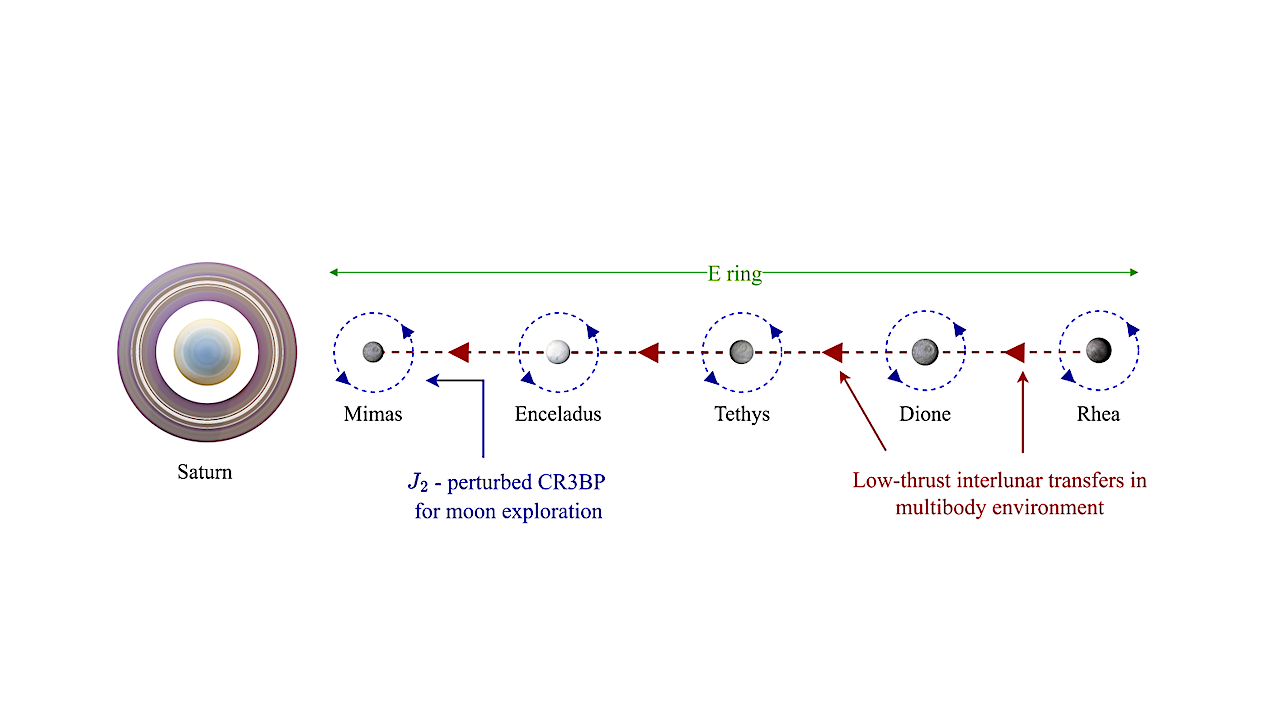
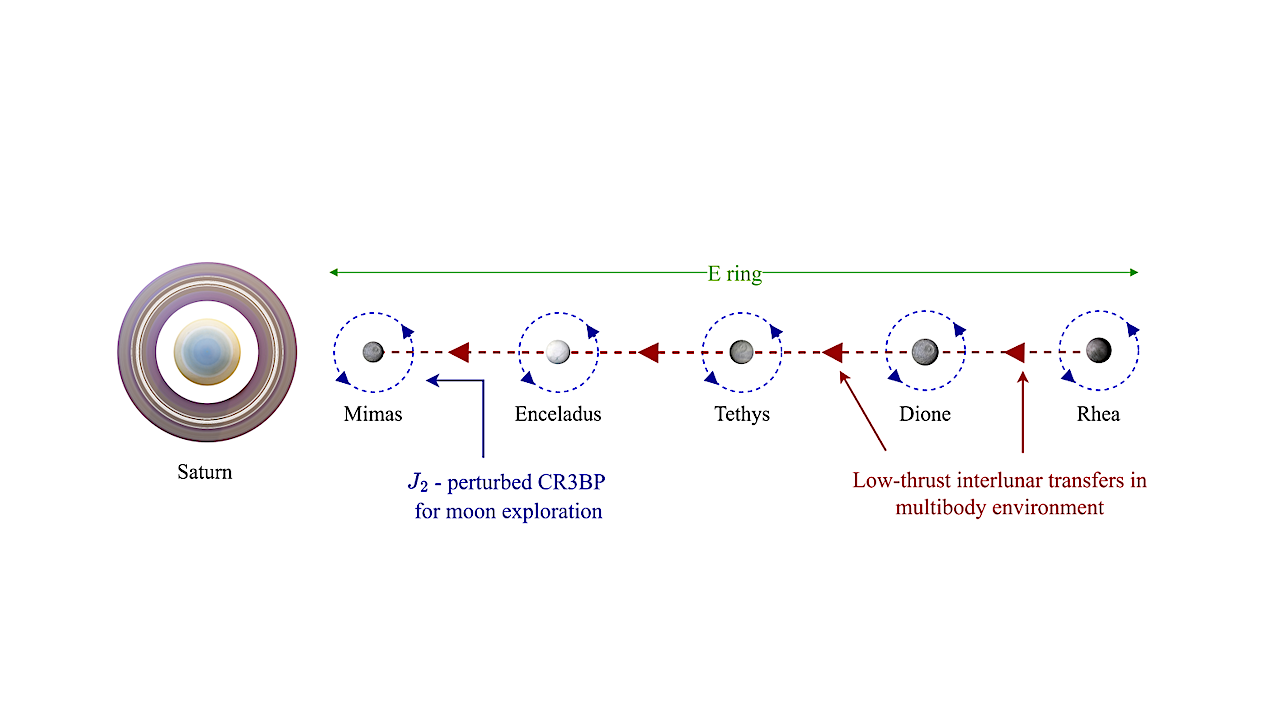
Sketch of the MT strategy, highlighting the dynamical models used in the distinct phases of the tour. — math.DS
This study presents the trajectory design for a mission touring Saturn’s Inner Large Moons (Rhea, Dione, Tethys, Enceladus, and Mimas) engineered to meet observational requirements, including full surface coverage, while ensuring low fuel consumption and compatibility with current power and propulsion technologies (radioisotope thermoelectric generators and Hall effect thrusters).
The tour begins at Rhea and ends at Mimas, using a trajectory concept that alternates between extended observation phases around each moon and Saturn centered low-thrust spiral arcs to transition efficiently to the next target.
The J2-perturbed Circular Restricted Three-Body Problem is adopted to design exploration paths, with halo orbits serving as staging points for heteroclinic and homoclinic loops that enable prolonged, repeated, and comprehensive surface reconnaissance (including critical regions such as Enceladus poles, where geological activity produces intense plumes).
Stable and unstable hyperbolic invariant manifolds of the halo orbits act as departure and arrival gateways for propelled inter-moon transfers, modeled in an ephemeris-based framework including gravitational perturbations from the moons, the Sun, and Saturn’s oblateness. The dynamical model setup is guided by a rigorous perturbation analysis to maximize computational efficiency while maintaining high fidelity trajectory design.
A locally optimal guidance law minimizes propellant consumption. The proposed tour offers an alternative to traditional flyby missions, providing comparable total duration but greater observing time and reduced fuel requirements, and advances previous work by achieving both complete lunar surface coverage and high-fidelity modeling.
Chiara Pozzi, Mauro Pontani, Alessandro Beolchi, Hadi Susanto, Elena Fantino
Comments: Early access: https://www.sciencedirect.com/science/article/abs/pii/S0094576526001566?dgcid=author
Subjects: Dynamical Systems (math.DS); Earth and Planetary Astrophysics (astro-ph.EP)
Cite as: arXiv:2603.07085 [math.DS] (or arXiv:2603.07085v1 [math.DS] for this version)
https://doi.org/10.48550/arXiv.2603.07085
Focus to learn more
Journal reference: Acta Astronautica 245, 321-328 (2026)
Related DOI:
https://doi.org/10.1016/j.actaastro.2026.03.002
Focus to learn more
Submission history
From: Elena Fantino Dr
[v1] Sat, 7 Mar 2026 07:45:14 UTC (39,095 KB)
https://arxiv.org/abs/2603.07085
Astrobiology,










Related Posts
Stay Informed With the Latest & Most Important News
Previous Post
Next Post


Advertisement
-
 01Two Black Holes Observed Circling Each Other for the First Time
 -
 02From Polymerization-Enabled Folding and Assembly to Chemical Evolution: Key Processes for Emergence of Functional Polymers in the Origin of Life
 -
 03Astronomy 101: From the Sun and Moon to Wormholes and Warp Drive, Key Theories, Discoveries, and Facts about the Universe (The Adams 101 Series)
 -
 04True Anomaly hires former York Space executive as chief operating officer
 -
 05Φsat-2 begins science phase for AI Earth images
 -
 06Hurricane forecasters are losing 3 key satellites ahead of peak storm season − a meteorologist explains why it matters
 -
 07Binary star systems are complex astronomical objects − a new AI approach could pin down their properties quickly