
Now Reading: China launches new highly retrograde Yaogan satellite, KZ-11 rideshare deploys 8 satellites
-
01
China launches new highly retrograde Yaogan satellite, KZ-11 rideshare deploys 8 satellites

China launches new highly retrograde Yaogan satellite, KZ-11 rideshare deploys 8 satellites

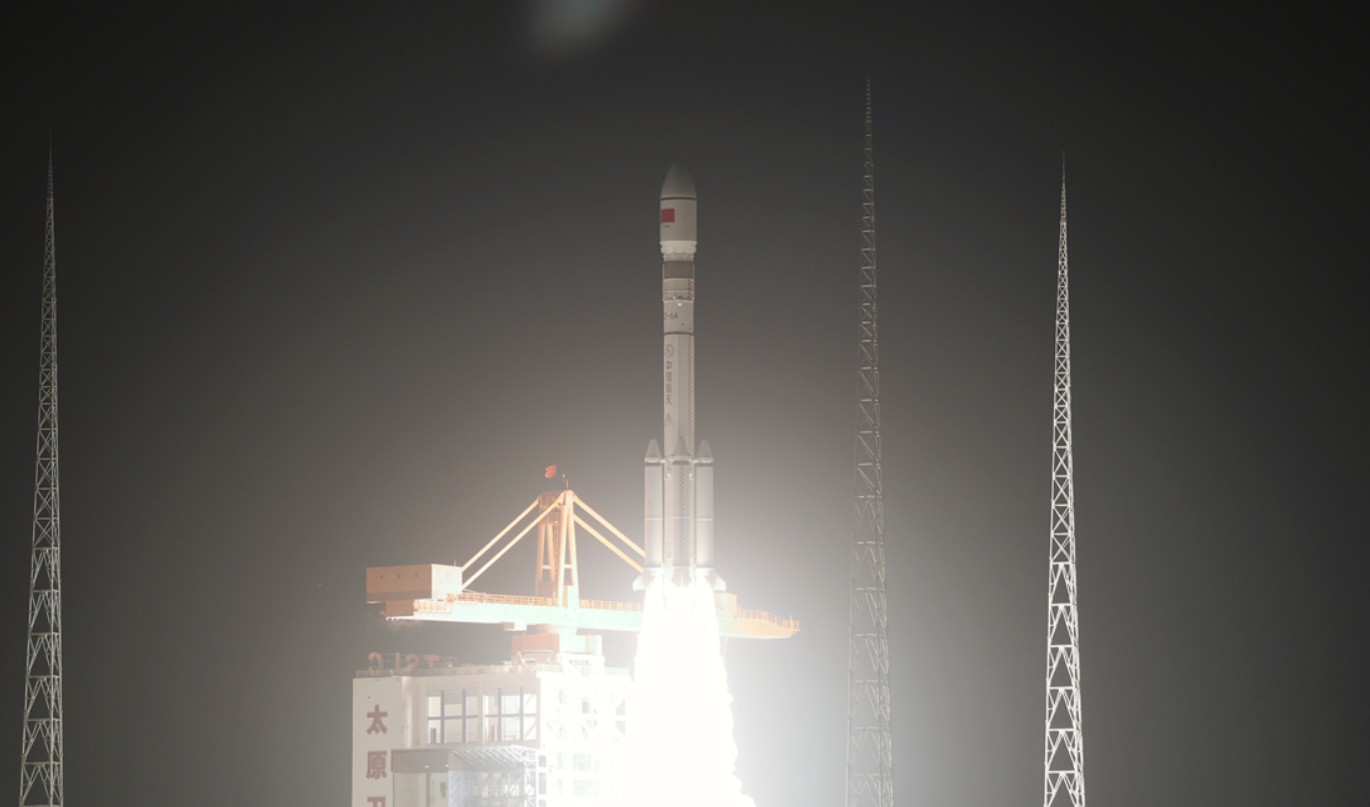

HELSINKI — China conducted a pair of launches Sunday, sending a second Yaogan-50 satellite into a highly retrograde orbit and completing a Kuaizhou-11 solid rocket rideshare mission.
The country is once again accelerating its orbital launch activities following a near month-long hiatus for the Chinese New Year holidays and annual political sessions in Beijing, with the launches being the third and fourth since March 12.
A Long March 6A rocket lifted off at 8:22 a.m. Eastern (1322 UTC) March 15 from Taiyuan Satellite Launch Center in north China. Airspace closure notices indicated the launch would be inserting a satellite into a highly retrograde orbit.
The China Aerospace Science and Technology Corporation (CASC) announced launch success, revealing the payload to be Yaogan-50 (02) satellite, joining the Yaogan-50 (01) satellite, launched in January, in a highly retrograde orbit.
That satellite initially entered 701 by 944-kilometer-altitude orbit with an inclination of 142 degrees—a highly retrograde orbit, or opposite to the Earth’s rotation—before circularizing the orbit with an altitude of 952 kilometers. Such launches incur a performance penalty, as the launch vehicle must achieve orbital velocity without benefiting from Earth’s rotational speed.
The mid-latitude orbit sees Yaogan-50 satellites pass over China and surrounding areas, with the retrograde orbit offering different groundtrack patterns for remote sensing than for prograde or sun-synchronous orbits. Later orbital data for Yaogan-50 (02) will reveal how it is orbiting in relation to the first satellite, and provide clues as to how many further satellites in the series.
While Yaogan-50 (01) was developed by the Shanghai Academy of Spaceflight Technology (SAST), the 02 satellite was developed by the China Academy of Space Technology (CAST), another major CASC subsidiary.
Yaogan satellites are described by China in generic, civilian terms. Yaogan-50 (02) is stated to be “primarily used for national land surveys, crop yield estimation, and disaster prevention and mitigation.” Outside analysts assess Yaogan satellites to be part of China’s intelligence, surveillance and reconnaissance assets, including spacecraft with synthetic aperture radar, optical and signals intelligence payloads.
The Long March 6A uses a kerolox core stage with solid side boosters, and is China’s first liquid-solid combination launch vehicle. It was the 21st launch of the rocket, all of which have been successful. However, earlier launches saw a number of upper stages fragment in orbit, creating debris.
Kuaizhou-11 launch
China’s second launch of the day came late on Sunday, with a Kuaizhou-11 solid rocket lifting off at 11:12 p.m. Eastern (0412 UTC, March 16) from Jiuquan Satellite Launch Center in northwest China.
The China Aerospace Science and Industry Corporation (CASIC), a state-owned space defense giant and sister company to the aforementioned CASC, China’s main space contractor, announced launch success, revealing the launch carried eight payloads. These were stated to be Juntian-1 (04A), Dongpo-11, Dongpo-12, Dongpo-16, Weitong-1 (01), Yuxing-3 (05), Yuxing-3 (06) and Xiguang-1 (06).
Juntian-1-04A is an X-band synthetic aperture radar (SAR) satellite developed by Beijing Juntian Aerospace Technology Co., Ltd., while Dongpo-11 (Nongjiao Center-1), Dongpo-12 (Chengdian-1) and Dongpo-16 (Jinjiang Xingyuan) “high-precision” remote sensing satellites were developed under the leadership of Huantian Wisdom Technology Co., Ltd.
Yuxing-3 (06), also known as Hunan University of Science and Technology-2, carries a flexible robotic arm. The spacecraft appears designed to test a range of in-orbit servicing and manipulation technologies, including simulated refueling operations using a flexible robotic arm and force-compliant manipulation tasks intended to evaluate precision control during contact operations.
Additionally, near the end of its mission, the satellite will conduct an accelerated deorbit experiment using a deployable drag-augmentation sphere, demonstrating a potential method for reducing orbital lifetime and mitigating space debris.
Yuxing-3-05 (Kechuang-1), developed by Zhejiang Xingmu Tanyu Technology Co., Ltd., carries: an optical camera and image-processing payload, a space plant-growing payload, and a navigation augmentation payload. Xiguang-1-06 is stated to be a hyperspectral remote-sensing satellite developed by Xi’an CAS Xiguang Aerospace Technology Co., Ltd..
The launch was the fifth of the Kuaizhou-11 and fourth success, following the failure of the debut launch in July 2020. The mission also included a partnership with Baidu. It was the 38th launch overall for the Kuaizhou solid rocket family, which includes the smaller Kuaizhou-1A rocket series. These are manufactured by Expace, a subsidiary of CASIC.
The launches were China’s 13th and 14th orbital launch attempts of 2026, following separate Guowang megaconstellation and Shiyan-30 technology demonstration missions launched March 12. While China has not released detailed plans for 2026, it is likely that the country will attempt to surpass the 100 launch mark in a calendar year for the first time.










Related Posts


Stay Informed With the Latest & Most Important News
Previous Post
Next Post



Advertisement
-
 01Two Black Holes Observed Circling Each Other for the First Time
 -
 02From Polymerization-Enabled Folding and Assembly to Chemical Evolution: Key Processes for Emergence of Functional Polymers in the Origin of Life
 -
 03Astronomy 101: From the Sun and Moon to Wormholes and Warp Drive, Key Theories, Discoveries, and Facts about the Universe (The Adams 101 Series)
 -
 04True Anomaly hires former York Space executive as chief operating officer
 -
 05Φsat-2 begins science phase for AI Earth images
 -
 06Hurricane forecasters are losing 3 key satellites ahead of peak storm season − a meteorologist explains why it matters
 -
 07Binary star systems are complex astronomical objects − a new AI approach could pin down their properties quickly