
Now Reading: Astronomers Discover Unconventional Exoplanet L 98-59 d with Molten Rock Ocean and Sulfur Atmosphere
-
01
Astronomers Discover Unconventional Exoplanet L 98-59 d with Molten Rock Ocean and Sulfur Atmosphere

Astronomers Discover Unconventional Exoplanet L 98-59 d with Molten Rock Ocean and Sulfur Atmosphere

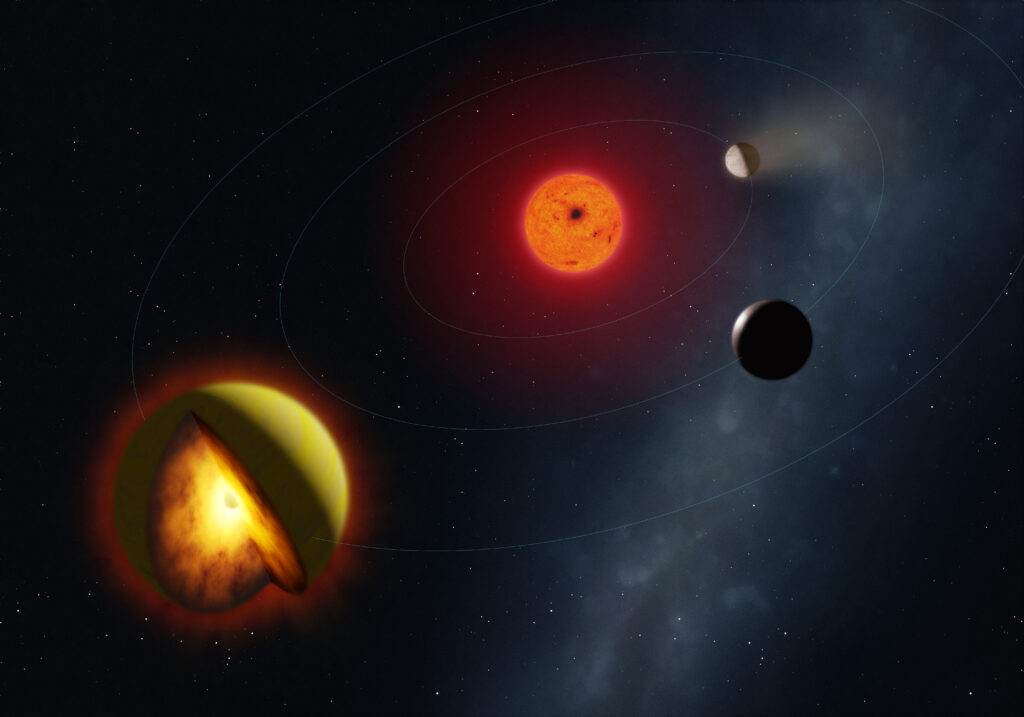
Astronomers may have encountered a groundbreaking type of exoplanet characterized by a massive ocean of molten rock beneath a sulfur-rich atmosphere. The planet, designated L 98-59 d, is situated approximately 35 light-years from Earth and is about 1.6 times the size of our planet. Unlike typical classifications for small exoplanets, scientists have found that this celestial body does not conform to existing categories of either hydrogen-rich “gas dwarfs” or water-heavy ocean worlds.
Recent observations from ground-based telescopes and the James Webb Space Telescope, coupled with advanced computer simulations, have unveiled the planet’s unique characteristics. Researchers suggest that L 98-59 d might possess a semi-molten interior containing significant amounts of sulfur, which plays an important role in determining the chemical makeup of its atmosphere.
If validated, L 98-59 d could mark the emergence of an entirely new classification of planets, indicating that additional unusual worlds may lie ahead in future explorations. This planet orbits a red dwarf star and is part of a compact system that includes several other planets, each with distinct characteristics. Notably, L 98-59 d exhibits a low density despite its larger-than-Earth size, along with an atmosphere confirmed to contain sulfur-bearing gases, as revealed by observations from the James Webb Space Telescope.
Harrison Nicholls from the University of Oxford, who leads the study published in Nature Astronomy, emphasized that traditional classifications do not adequately capture L 98-59 d’s profile. The planet’s lower density, measured at approximately two grams per cubic centimeter, stands in stark contrast to Earth’s average density of 5.5 grams per cubic centimeter, suggesting a substantial atmosphere is partially to blame for this anomaly.
Computer models suggest that the planet harbors a global magma ocean that could be integral to the dynamic exchange of volatile elements between its molten interior and atmosphere over eons. Notably, sulfur gases, such as hydrogen sulfide, detected in the upper atmosphere, may be linked to the processes occurring deep within L 98-59 d.
The persistence of the planet’s molten state presents an intriguing puzzle for researchers, especially considering its estimated age of five billion years, comparable to the Sun. However, factors such as its thick atmosphere, which effectively retains heat through a potent greenhouse effect, may explain the prolonged warmth of its interior. Additionally, gravitational interactions with nearby planets could generate frictional heat, similarly to the volcanic activity seen on Jupiter’s moon Io.
The diverse planetary characteristics within systems like that of L 98-59 d provide valuable insights into how different worlds evolve, highlighting that planets may not fit into neat classifications but rather exist on a spectrum of evolutionary outcomes. Nicholls pointed out that this diversity suggests previous definitions may not encompass the full range of planetary types.
As research continues, upcoming missions like the European Space Agency’s Ariel and PLATO are expected to broaden our understanding of planetary systems and potentially reveal more planets that challenge existing categories. Nicholls described the current exploration climate as a “wild west,” indicating that ongoing data collection could lead to the discovery of more exotic planetary families.
L 98-59 d might represent just the beginning of a vast array of unique planetary types waiting to be uncovered, as astronomers delve deeper into the cosmos in search of new worlds.










Related Posts
Stay Informed With the Latest & Most Important News
Previous Post
Next Post


Advertisement
-
 01Two Black Holes Observed Circling Each Other for the First Time
 -
 02From Polymerization-Enabled Folding and Assembly to Chemical Evolution: Key Processes for Emergence of Functional Polymers in the Origin of Life
 -
 03Astronomy 101: From the Sun and Moon to Wormholes and Warp Drive, Key Theories, Discoveries, and Facts about the Universe (The Adams 101 Series)
 -
 04True Anomaly hires former York Space executive as chief operating officer
 -
 05Φsat-2 begins science phase for AI Earth images
 -
 06Hurricane forecasters are losing 3 key satellites ahead of peak storm season − a meteorologist explains why it matters
 -
 07Binary star systems are complex astronomical objects − a new AI approach could pin down their properties quickly