
Now Reading: 2 seconds that changed the world: Robert Goddard launched the 1st liquid-fueled rocket 100 years ago today
-
01
2 seconds that changed the world: Robert Goddard launched the 1st liquid-fueled rocket 100 years ago today

2 seconds that changed the world: Robert Goddard launched the 1st liquid-fueled rocket 100 years ago today

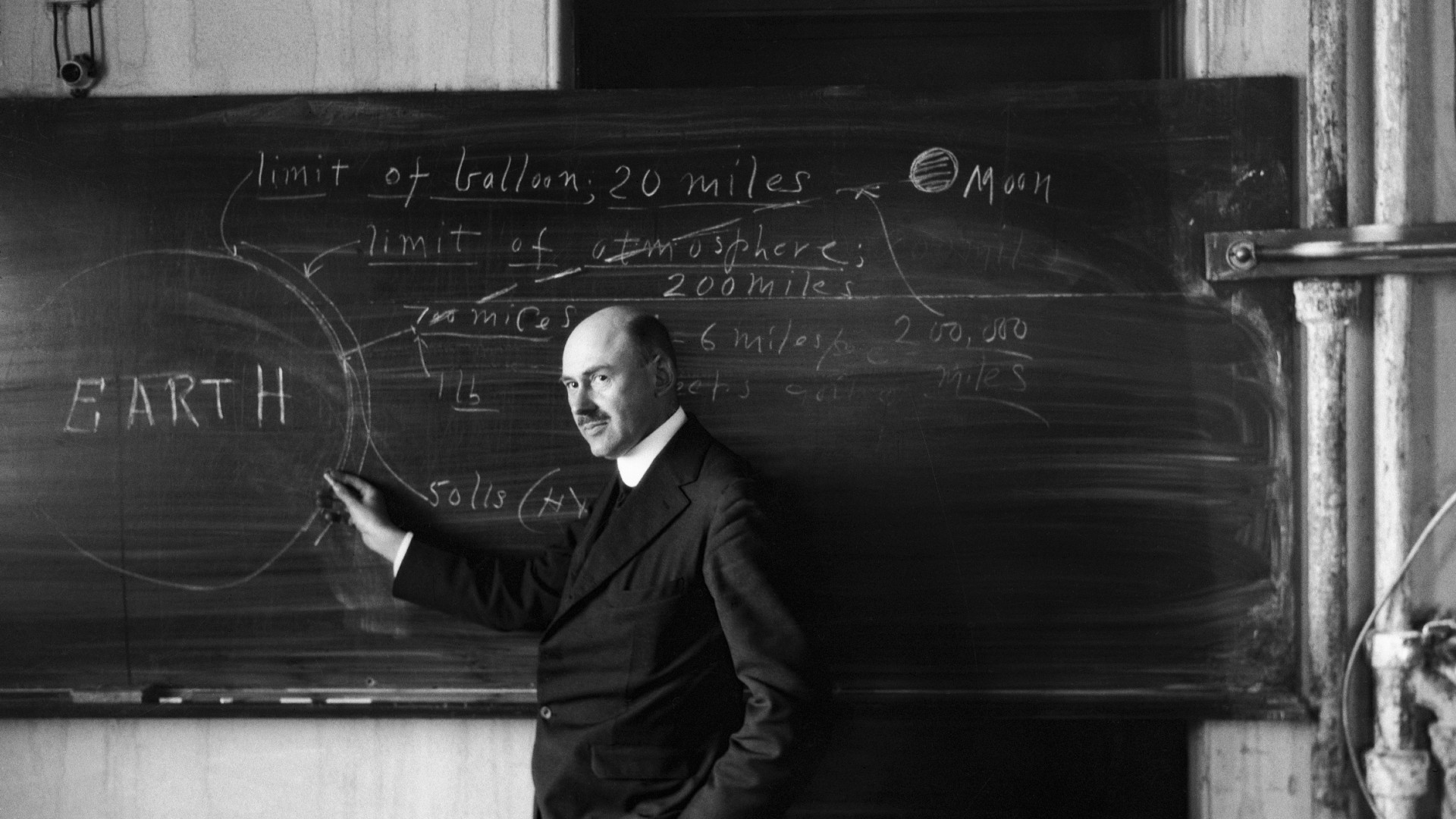
It’s been a century since a two-second rocket flight in Massachusetts kicked off the liquid-rocket-fuel revolution. Robert H. Goddard (1882-1945), who directed the flight, is widely considered to be one of the founders of modern rocketry, along with Hermann Oberth in Germany and Konstantin Tsiolkovsky in Russia. Goddard most notably designed, built and tested the first flown liquid-fuel rocket—with launch 100 years ago on March 16, 1926.
And as we’ll explore in more detail later, much of Goddard’s rocket work was supported and promoted (including for four decades, posthumously) by his wife, Esther — who kept the records, put out literal launch fires, and diligently kept after the patent office for dozens of filings.
“With this first flight — while it was, by today’s standards, it would seem to be quite unimpressive to a lot of people — [it proved] the idea that you could control a liquid-powered rocket,” Erin Gregory, curator of aviation and space with the Canada Aviation and Space Museum in Ottawa, told Space.com. “That was the proving ground; it could be done. Obviously there were adjustments that needed to be made, but the fact [was] that it could be done.”
Article continues below
From science fiction to reality
Goddard was inspired by science fiction, having read H.G. Wells and Jules Verne (among others) while growing up in Worcester, Mass. “Goddard’s story is one of inspiration, of relentlessly pursuing one’s dreams and turning them into reality,” Kevin Schindler, a historian and public information officer at Lowell Observatory in Flagstaff, Arizona, told Space.com in an e-mail.
“Then, at age 17 and while up in a cherry tree trimming its branches, [he was] experiencing a dreamlike experience that inspired him for the rest of his life to developing a means of traveling to space,” added Schindler, who recently published “Robert Goddard’s Massachusetts” with Charles Slatkin (Arcadia Publishing, March 3, 2026).
Goddard’s early powder rocket work took place in association with Clark University, where he got a masters and a doctorate. His first powder rocket launched there at his own expense in 1915, although he did eventually receive financial support from the Smithsonian Institution and Clark University, among others, and his work was published in 1919.
As for his liquid rocket research, one of Goddard’s most noteworthy designs, which is still used today, was allowing very cold liquid oxygen to cool a rocket combustion chamber while the oxygen was leaving the fuel tank. His historic 1926 flight in Auburn, Mass. saw a liquid oxygen-gasoline rocket fly 41 feet in altitude and come back to Earth in about 2.5 seconds.
Goddard subsequently received financial support from aviator Charles Lindbergh, the Guggenheim family and the U.S. military, and he also moved to Roswell, New Mexico—as it was then sparsely populated in the 1930s, that was better for rocket flights. He launched more than two dozen rockets before he died of throat cancer in 1945, 12 years before Sputnik was the first satellite to reach space—not incidentally, on a liquid-fueled rocket. Goddard’s name was later attached to NASA’s Goddard Space Flight Center in Maryland, among other honors.

Robert Goddard rocketry
Some of the innovations Goddard was noted for include:
- Using science fiction and thought experiments: Many scientists draw their designs from imagination, often inspired by the things they are reading or by playing with the physics (sometimes by trying to model the ridiculous, into the practical). In other words, Gregory pointed out, Goddard was “really influenced by science fiction, but thinking about that in a very scientific way.” For example, Goddard ruled out launching methods by 1908 including “magnetic, atomic, cannon, flywheel and solid fuels” the American Institute of Aeronautics and Astronautics (AIAA) pointed out. Discarding the cannon idea (as it produces ridiculous G-forces on astronauts) was particularly noteworthy, added Gregory, because it was famously used to launch astronauts to the moon in Jules Vernes’ 1865 science fiction book “From the Earth to the Moon” — a key science-fiction touchstone for Goddard’s generation.
- Experimenting with rocket stability: For his first liquid-fueled rocket flight, Goddard tried putting the engine on top of the fuel and oxidizer tanks in a belief it would create more stability, according to NASA. Following flight tests, Goddard moved the engines underneath the propellant tanks, which “simplified the overall design”, and instead for stability added moveable vanes to the engine exhaust and gyroscopes. “He was one of the very first people to take the theoretical ideas around rocketry, and actually turn them into an experiment and really apply the scientific methods and experimentation,” Gregory said. Not only that, she pointed out, Goddard was “very methodical about that, putting that into practice.”
- Developing the concept of multi-stage rockets: It sounds simple and obvious today, as it’s a staple of the rocket industry, but multi-stage rockets were heavily investigated by Goddard back when the idea was novel. “This involved multiple fuel tanks rather than a single tank,” Schindler said. “As fuel was used up in a tank, it would be discarded, thus shedding the rocket of heavy but empty tanks. The lighter rocket was thus carrying less weight and could achieve longer and higher flight.”
- Engine-cooling techniques. “Goddard found that combustion chambers tended to overheat and melt, so he developed a couple of engine-cooling techniques to prevent this,” Schindler said. “The first method he called curtain cooling, also known as a type of film cooling, This technique involved spraying fuel—Goddard used gasoline—on the inside walls of the chamber, thus creating a protective cooler layer that lessened the chances of the chamber overheating. This method wasn’t reliable, and Goddard later developed a second technique, known as regenerative cooling. This involves pumping a propellant through cavities in the walls of the chamber before it enters the chamber. This has the dual result of cooling the chamber walls and thus reducing the chances of the walls overheating and melting, while prewarming the propellant, which results in more efficient combustion.”
- Other experiments to prove out design: This included demonstrations showing a rocket will work in a vacuum (1916) and launching the first rocket with a scientific payload (1929), Schindler said. Goddard’s work also included improving guidance and control, and developing propellent-feeding systems: “In Goddard’s early liquid-fuel rockets, he fed propellant into the combustion chamber with a pressure-fed system. Gas pressure—at first, Goddard used liquid oxygen—forced the propellants into the chamber. Later, as Goddard developed larger rockets, this technique couldn’t supply enough pressure, so he then experimented with centrifugal rocket pumps—predecessor to today’s massive turbopumps—that used energy generated from a rapidly rotating disc to force the propellant into the chamber.”

Robert Goddard’s legacy
Goddard was able to overcome many obstacles in his career, mostly related to funding and lack of modern-day rocket materials we are used to. He worked in a small shop with just a few employees, doing most of the design and testing himself. “Goddard generally didn’t want to collaborate with anyone outside his little circle. If he had, he would have had access to other ideas, materials, and facilities, which probably would have sped up his rocket development efforts,” Schindler said. That said, Goddard did face ridicule for some of his early ideas (most famously being mocked by the New York Times in a 1920 editorial only retracted during Apollo 11 in 1969), so that may have played into his decision to work alone.
Technical obstacles arose, often due to lack of material or cost. Schindler said Goddard could not use lightweight structures, or the propellant he preferred (liquid hydrogen) due to availability and cost. Fuel pumps were also difficult to engineer, mostly due to (again) the material problem. “His engines often exploded or burned due to uneven combustion,” Schindler said.
That said, Schindler paid tribute to Goddard’s innovation, which is still used today: “Engineers have taken his ideas, as well as developed their own, as well as taken advantage of materials not available to Goddard, to build today’s advanced rockets,” he said. And the early space explorers knew that, Schindler said, as no less a person than Buzz Aldrin—the second person to walk on the moon, during Apollo 11—took an autobiography of Robert Goddard with him to the lunar surface in July 1969.
Esther Goddard: Chronicler, photographer, patent-filer for Robert Goddard
Goddard’s legacy also rests heavily on the work of his wife, Esther. “Esther deciphered his notes—which she alone could read—photographed his work, stamped out the brush fires that were the results of his launchings, kept his account books, sewed the parachutes he used in his launchings and never wavered in her lifelong relationship of support,” the Goddard Memorial Association stated.
It was also thanks to Esther that we have pictures of Robert and his rocketry. “The vast majority of these photographs were taken by Esther herself. Esther was an avid camerawoman and photographer, and during Robert’s lifetime she meticulously documented his career in rocketry—from experiments and instruments, to processes and workspaces,” Clark University stated of her work.

After Robert died, his wife continued to champion his legacy, which became important as the Space Age began. Attention shifted, in large part, to German rocket scientists who were active in the Second World War and went on to assist both the early Soviet and American space programs. “She was just making sure that his legacy was not forgotten after the Second World War, which it kind of would have been because — of course —the German scientists sort of take center stage after that in terms of rocketry,” Gregory said.
Esther donated more than 60 objects to the Smithsonian Institution, organized his papers and filed posthumous patents of his work, the Smithsonian’s National Air and Space Museum stated. In fact, the Goddard Memorial Association notes, Esther secured the vast majority after Robert died: Esther got approval for 131 during this period, of 214 overall.
Gregory said the 100th anniversary is a good time not only to reflect on Robert, but the team he had with his wife who made the work possible. Citing Esther’s name helps to counteract the “Matilda effect”, Gregory said, which is a term named by historian Margaret Rossiter referring to how women’s contributions are often overlooked in history. (“Matilda” is a reference to suffragist Matilda Joslyn Gage.)
Citing the larger teams behind famous scientific figures, Gregory said, often is an opportunity to bring newer voices into the spotlight. “I hope that that’s starting to be rectified for many of them. A little bit of vindication,” she said.










Related Posts


Stay Informed With the Latest & Most Important News




Advertisement
-
 01Two Black Holes Observed Circling Each Other for the First Time
 -
 02From Polymerization-Enabled Folding and Assembly to Chemical Evolution: Key Processes for Emergence of Functional Polymers in the Origin of Life
 -
 03Astronomy 101: From the Sun and Moon to Wormholes and Warp Drive, Key Theories, Discoveries, and Facts about the Universe (The Adams 101 Series)
 -
 04True Anomaly hires former York Space executive as chief operating officer
 -
 05Φsat-2 begins science phase for AI Earth images
 -
 06Hurricane forecasters are losing 3 key satellites ahead of peak storm season − a meteorologist explains why it matters
 -
 07Binary star systems are complex astronomical objects − a new AI approach could pin down their properties quickly