
Now Reading: Aurora alert! Powerful geomagnetic storm could spark northern lights as far south as Illinois on March 19
-
01
Aurora alert! Powerful geomagnetic storm could spark northern lights as far south as Illinois on March 19

Aurora alert! Powerful geomagnetic storm could spark northern lights as far south as Illinois on March 19

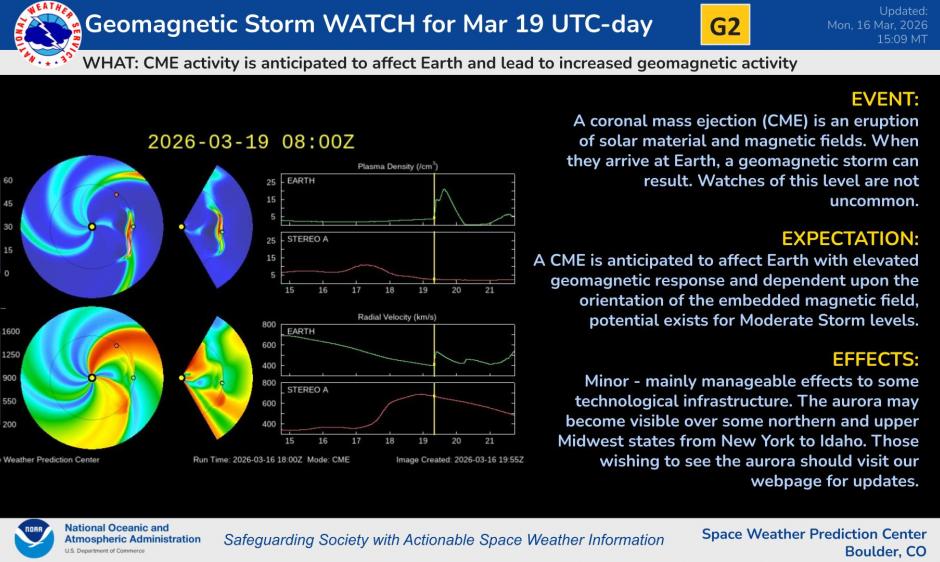
The National Oceanic and Atmospheric Administration’s (NOAA) Space Weather Prediction Center (SWPC) has issued a G2 geomagnetic storm warning for March 19 due to possible impact from a coronal mass ejection (CME). Geomagnetic storms are classified using a G-scale, which ranks their intensity from G1 (minor) to G5 (extreme).
This is great news for aurora chasers as the predicted G2-level storm could bring northern lights as far south as New York and Idaho, but NOAA’s SWPC says there is a chance that G3 levels could be reached, which could lead to aurora sightings deep into mid-latitudes such as Illinois and Oregon.
Article continues below
Seasonal boost to auroras
This week’s storm watch comes at an especially exciting time for aurora hunters, with many regarding March as one of the best months to see the northern lights.
Around the spring and autumn equinoxes, Earth’s orientation in space makes it easier for its magnetic field to connect with the magnetic field carried by the solar wind and incoming CMEs. This seasonal boost in geomagnetic activity is known as the Russell-McPherron effect, first described by geophysicists Christopher Russell and Robert McPherron in 1973.
During the equinoxes, the sun shines directly over Earth’s equator, giving both hemispheres equal day and night. This geometry also helps incoming solar wind interact more effectively with Earth’s magnetic field.
For most of the year, Earth‘s tilt reduces this interaction, helping to deflect some of the incoming charged particles. But around the equinoxes, that natural shield becomes more open to incoming solar wind. As a result, space weather events such as fast solar wind from coronal holes or CMEs can deliver a stronger impact, increasing the chances of auroras.

Stay tuned!
Keep up to date with the latest space weather news with our aurora forecast live blog. For real-time forecasts based on your location, consider using a space weather app. A great option is “My Aurora Forecast & Alerts” (available for iOS and Android). For a deeper dive into space weather conditions, “Space Weather Live” is another excellent choice (available for iOS and Android)
Northern Hemisphere aurora forecast courtesy of the U.K. Met Office










Related Posts
Stay Informed With the Latest & Most Important News



Advertisement
-
 01Two Black Holes Observed Circling Each Other for the First Time
 -
 02From Polymerization-Enabled Folding and Assembly to Chemical Evolution: Key Processes for Emergence of Functional Polymers in the Origin of Life
 -
 03Astronomy 101: From the Sun and Moon to Wormholes and Warp Drive, Key Theories, Discoveries, and Facts about the Universe (The Adams 101 Series)
 -
 04True Anomaly hires former York Space executive as chief operating officer
 -
 05Φsat-2 begins science phase for AI Earth images
 -
 06Hurricane forecasters are losing 3 key satellites ahead of peak storm season − a meteorologist explains why it matters
 -
 07Binary star systems are complex astronomical objects − a new AI approach could pin down their properties quickly