
Now Reading: The TOLIMAN Mission: A Low-cost Space Telescope For High Precision Narrow-angle Astrometry
-
01
The TOLIMAN Mission: A Low-cost Space Telescope For High Precision Narrow-angle Astrometry

The TOLIMAN Mission: A Low-cost Space Telescope For High Precision Narrow-angle Astrometry

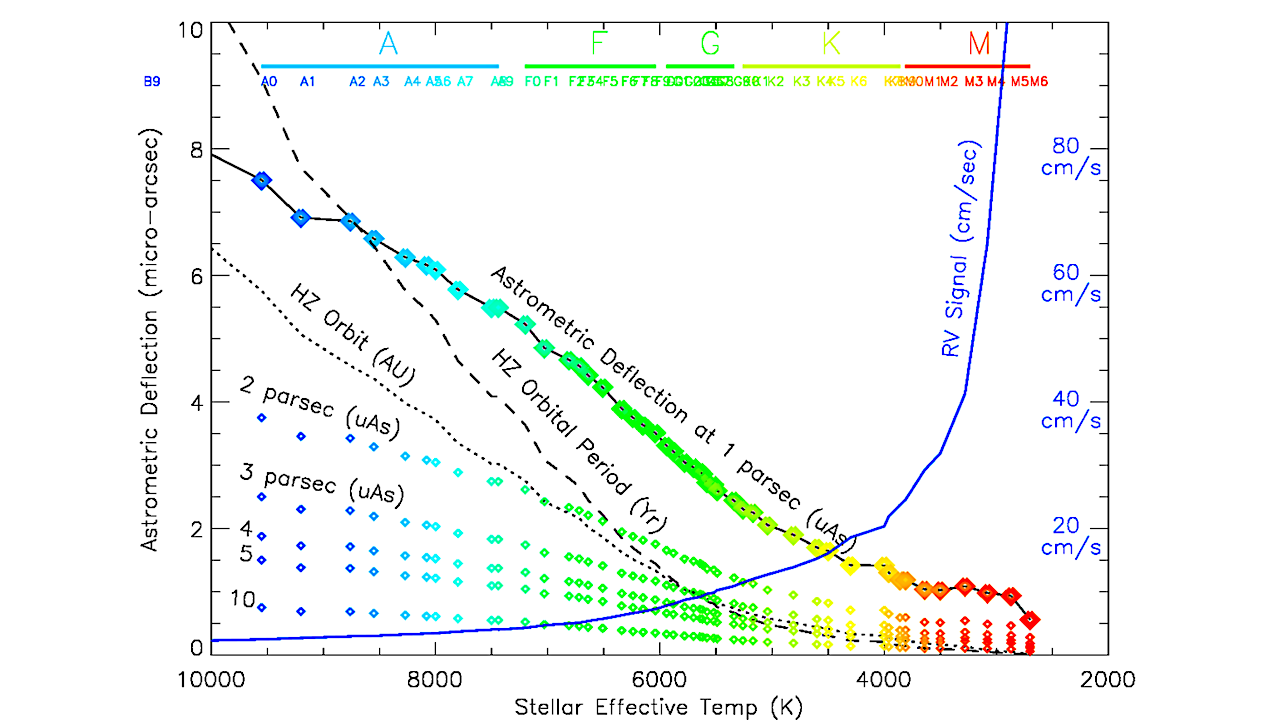
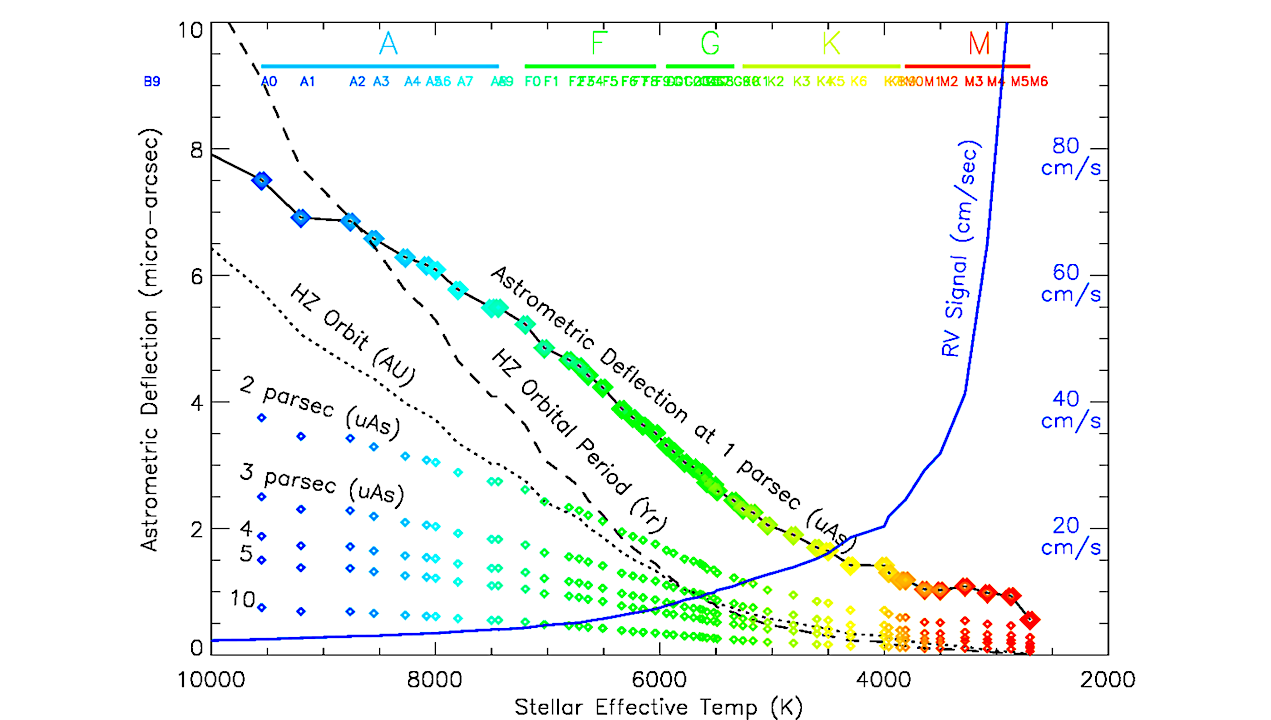
The strength of indirect detection signals from an Earth-like exoplanet as a function of stellar effective temperature. Bands encompassing main sequence spectral classes A through M color coded by temperature are indicated at the top. Here, Earth-like is defined as a 1-Earth mass object in an orbit receiving irradiance equivalent to 1 AU from our Sun (the solar constant). Radial Velocity signals (solid blue line) are seen to exhibit a rapid rise in signal strength (given on the right-hand abscissa) for cooler, M dwarf systems where they become detectable with present submeter per second RV precision. On the other hand, astrometric deflection signals (colored diamond symbols) rise with host star temperature, and decline linearly with distance from values of up to several microarcseconds for the nearest stars. For convenience the plot also indicates the size of the temperate orbit modeled (in AU, left abscissa) and its corresponding orbital period (in years, also left abscissa). — astro-ph.IM
The TOLIMAN project is engaged with the construction, launch and operation of a low-cost space telescope of unorthodox optical design. Its primary science goal targets an exhaustive search for temperate-orbit rocky planets around either star in the alpha Centauri AB binary within our nearest-neighbor star system.
Despite their favorable proximity and brightness, the detection of terrestrial exoplanets around such nearby Sun-like stars remains problematic for contemporary instrumental approaches.
By performing narrow-angle astrometric monitoring of binary stars at extreme precision, any exoplanets will betray their presence by way of gravitationally-induced perturbations on the binary orbit. Recovery of this signal is challenging for it amounts to only a few microarcseconds of angular deflection (at best), and so is normally thought to require a large (meter-class) instrument. By implementing an innovative optical and signal encoding architecture, the TOLIMAN space telescope aims to recover such signals with a telescope aperture of only 12.5cm.
This paper gives an overview of key features of the mission; in particular the concepts underlying the optics to enable image registration at the extreme levels of precision required. An outline is also provided, sketching further mission components and systems incorporated into the 16U CubeSat spacecraft bus in which the science payload is housed – all of which are now under construction.
Peter Tuthill, Christopher Betters, Max Charles, Fred Crous, Donald G. Dansereau, Conaire Deagan, Louis Desdoigts, Mark George, Thomas Holland, Connor J. Langford, Milo Langker, Kieran Larkin, Clarissa Luk, Jack Nelson, Benjamin Pope, Grace Piroscia, Angus Rutherford, David Sweeney, Adam Taras, Karel Valenta, Tim White, Alison Wong, Eduardo Bendek, David Doelman, Kyran Grattan, Olivier Guyon, Peter Klupar, Benjamin T. Montet, Jeffrey Smith, Douglas Caldwell, Frans Snik, Simon P. Worden
Comments: 27 pages , 7 figures. To be published in JATIS (Journal of Astronomical Telescopes, Instruments, and Systems)
Subjects: Instrumentation and Methods for Astrophysics (astro-ph.IM); Earth and Planetary Astrophysics (astro-ph.EP); Solar and Stellar Astrophysics (astro-ph.SR)
Cite as: arXiv:2603.14683 [astro-ph.IM](or arXiv:2603.14683v1 [astro-ph.IM] for this version)
https://doi.org/10.48550/arXiv.2603.14683
Focus to learn more
Submission history
From: Peter Tuthill
[v1] Mon, 16 Mar 2026 00:40:04 UTC (19,729 KB)
https://arxiv.org/abs/2603.14683
Astrobiology, exoplanet,










Related Posts
Stay Informed With the Latest & Most Important News
Previous Post
Next Post


Advertisement
-
 01Two Black Holes Observed Circling Each Other for the First Time
 -
 02From Polymerization-Enabled Folding and Assembly to Chemical Evolution: Key Processes for Emergence of Functional Polymers in the Origin of Life
 -
 03Astronomy 101: From the Sun and Moon to Wormholes and Warp Drive, Key Theories, Discoveries, and Facts about the Universe (The Adams 101 Series)
 -
 04True Anomaly hires former York Space executive as chief operating officer
 -
 05Φsat-2 begins science phase for AI Earth images
 -
 06Hurricane forecasters are losing 3 key satellites ahead of peak storm season − a meteorologist explains why it matters
 -
 07Binary star systems are complex astronomical objects − a new AI approach could pin down their properties quickly