
Now Reading: The Efficient Delivery Of Highly-siderophile Elements To The Core Creates A Mass Accretion Catastrophe For The Earth
-
01
The Efficient Delivery Of Highly-siderophile Elements To The Core Creates A Mass Accretion Catastrophe For The Earth

The Efficient Delivery Of Highly-siderophile Elements To The Core Creates A Mass Accretion Catastrophe For The Earth

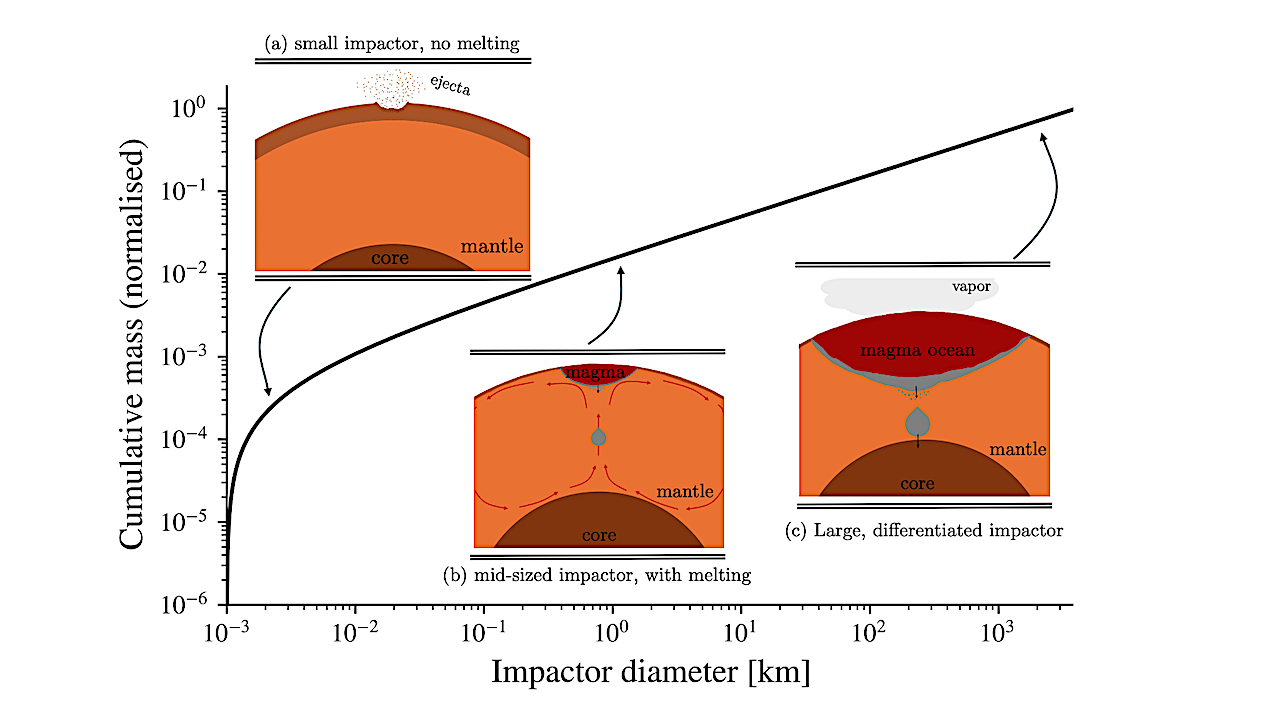
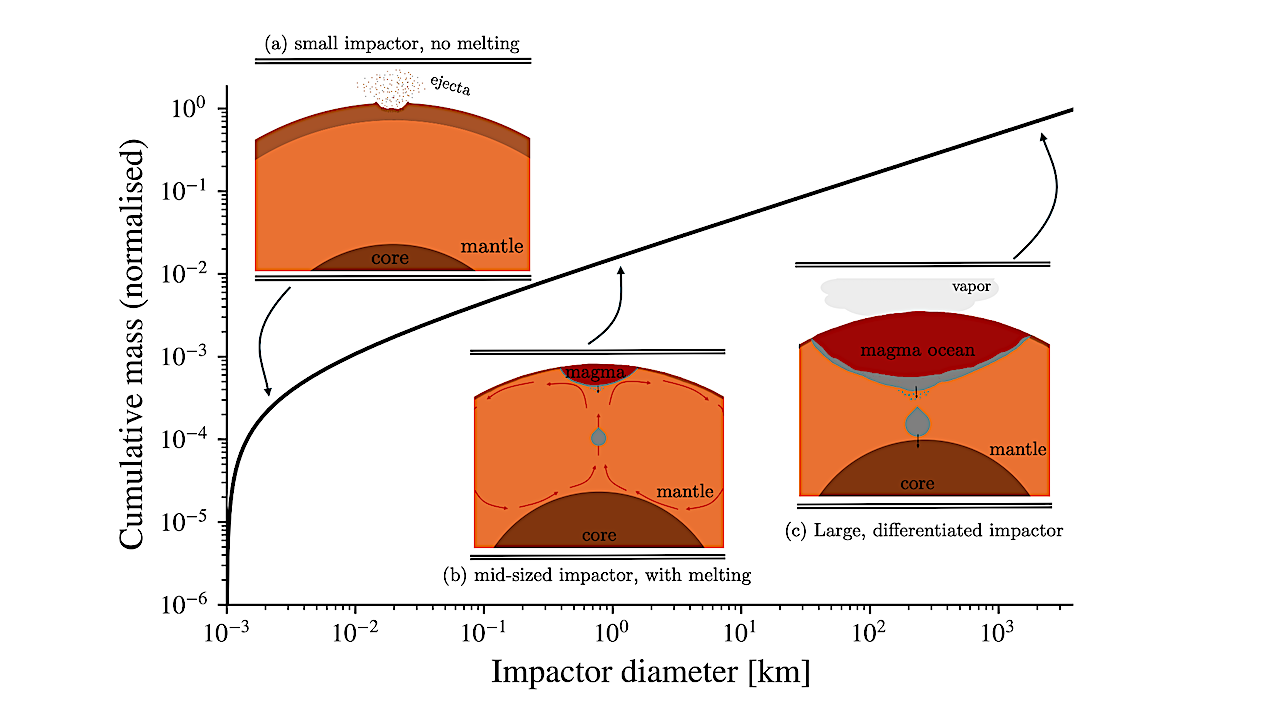
Collisions between leftover planetesimals drives the redistribution of mass between bodies of different sizes, generating a so-called collisional size-frequency distribution (SFD) dominated, in number, by the smallest bodies. The Earth will therefore, unavoidably, accrete planetesimals of a wide range of sizes during the late veneer. For the canonical collisional SFD (Dohnanyi, 1969), total mass is concentrated in the largest planetesimals (plotted above). The geodynamical processes responsible for the delivery of HSEs to the mantle, are controlled, primarily, by the size of the impactor, and therefore have the capacity to dramatically bias estimates of total mass accretion during the late veneer. We identify three possible regimes of HSE delivery, with illustrative schematic diagrams inset above. (a) Small impactors at low velocity will generate little melt, and are expected to fragment into millimetric pieces (see §2.1). The ability of these impactors to affect mantle geochemistry will depend on whether the tectonic regime of the planet enables them to be recycled into the mantle. (b) Small impactors at high velocity will generate significant melt, from both the target and impactor (Melosh, 1989). We expect metal diapirs to quickly enter the solid mantle (§2.2), bringing with them the impactor’s HSEs. The ability of these impactors to affect mantle geochemistry will depend on whether the frictional force resisting diapir descent is larger than the negative buoyancy. (c) Large, differentiated impactors will generate large volumes of melt. Unless impactor core material can be fragmented into very small droplets, large diapirs will enter the solid mantle, and quickly sink to Earth’s core (§2.3). — astro-ph.EP
The excess abundance of highly siderophile elements (HSEs), as inferred for the terrestrial planets and the Moon, is thought to record a `late veneer’ of impacts after the giant impact phase of planet formation.
Estimates for total mass accretion during this period typically assume all HSEs delivered remain entrained in the mantle. Here, we present an analytical discussion of the fate of liquid metal diapirs in both a magma pond and a solid mantle, and show that metals from impactors larger than approximately 1 km will sink to Earth’s core, leaving no HSE signature in the mantle.
However, by considering a collisional size distribution, we show that to deliver sufficient mass in small impactors to account for Earth’s HSEs, there will be an implausibly large mass delivered by larger bodies, the metallic fraction of which lost to Earth’s core.
There is therefore a contradiction between observed concentrations of HSEs, the geodynamics of metal entrainment, and estimates of total mass accretion during the late veneer. To resolve this paradox, and avoid such a mass accretion catastrophe, our results suggest that large impactors must contribute to observed HSE signatures.
For these HSEs to be entrained in the mantle, either some mechanism(s) must efficiently disrupt impactor core material into ≤0.01 mm fragments, or alternatively Earth accreted a significant mass fraction of oxidised (carbonaceous chondrite-like) material during the late veneer.
Estimates of total mass accretion accordingly remain unconstrained, given uncertainty in both the efficiency of impactor core fragmentation, and the chemical composition of the late veneer.
Richard J. Anslow, Maylis Landeau, Amy Bonsor, Jonathan Itcovitz, Oliver Shorttle
Comments: Accepted for publication in JGR: Planets
Subjects: Earth and Planetary Astrophysics (astro-ph.EP)
Cite as: arXiv:2603.17961 [astro-ph.EP] (or arXiv:2603.17961v1 [astro-ph.EP] for this version)
https://doi.org/10.48550/arXiv.2603.17961
Focus to learn more
Submission history
From: Richard Anslow
[v1] Wed, 18 Mar 2026 17:31:17 UTC (1,407 KB)
https://arxiv.org/abs/2603.17961
Astrobiology,










Related Posts
Stay Informed With the Latest & Most Important News
Previous Post
Next Post


Advertisement
-
 01Two Black Holes Observed Circling Each Other for the First Time
 -
 02From Polymerization-Enabled Folding and Assembly to Chemical Evolution: Key Processes for Emergence of Functional Polymers in the Origin of Life
 -
 03Astronomy 101: From the Sun and Moon to Wormholes and Warp Drive, Key Theories, Discoveries, and Facts about the Universe (The Adams 101 Series)
 -
 04True Anomaly hires former York Space executive as chief operating officer
 -
 05Φsat-2 begins science phase for AI Earth images
 -
 06Hurricane forecasters are losing 3 key satellites ahead of peak storm season − a meteorologist explains why it matters
 -
 07Binary star systems are complex astronomical objects − a new AI approach could pin down their properties quickly