
Now Reading: T-20 days: Smile to launch on 9 April
-
01
T-20 days: Smile to launch on 9 April



20/03/2026
225 views
7 likes
The Smile mission is set to launch on a Vega-C rocket from Europe’s Spaceport in French Guiana on Thursday 9 April at 08:29 CEST/07:29 BST/03:29 local time. Follow along as we communicate on the final preparations for launch. Journalists are invited to join online media briefings in English, French, Spanish, Italian and German.
Smile is a collaboration between the European Space Agency (ESA) and the Chinese Academy of Sciences (CAS). It will reveal how Earth responds to the streams of particles and bursts of radiation from the Sun, using an X-ray camera to make the first X-ray observations of Earth’s magnetic field, and an ultraviolet camera to watch the northern lights non-stop for 45 hours at a time.
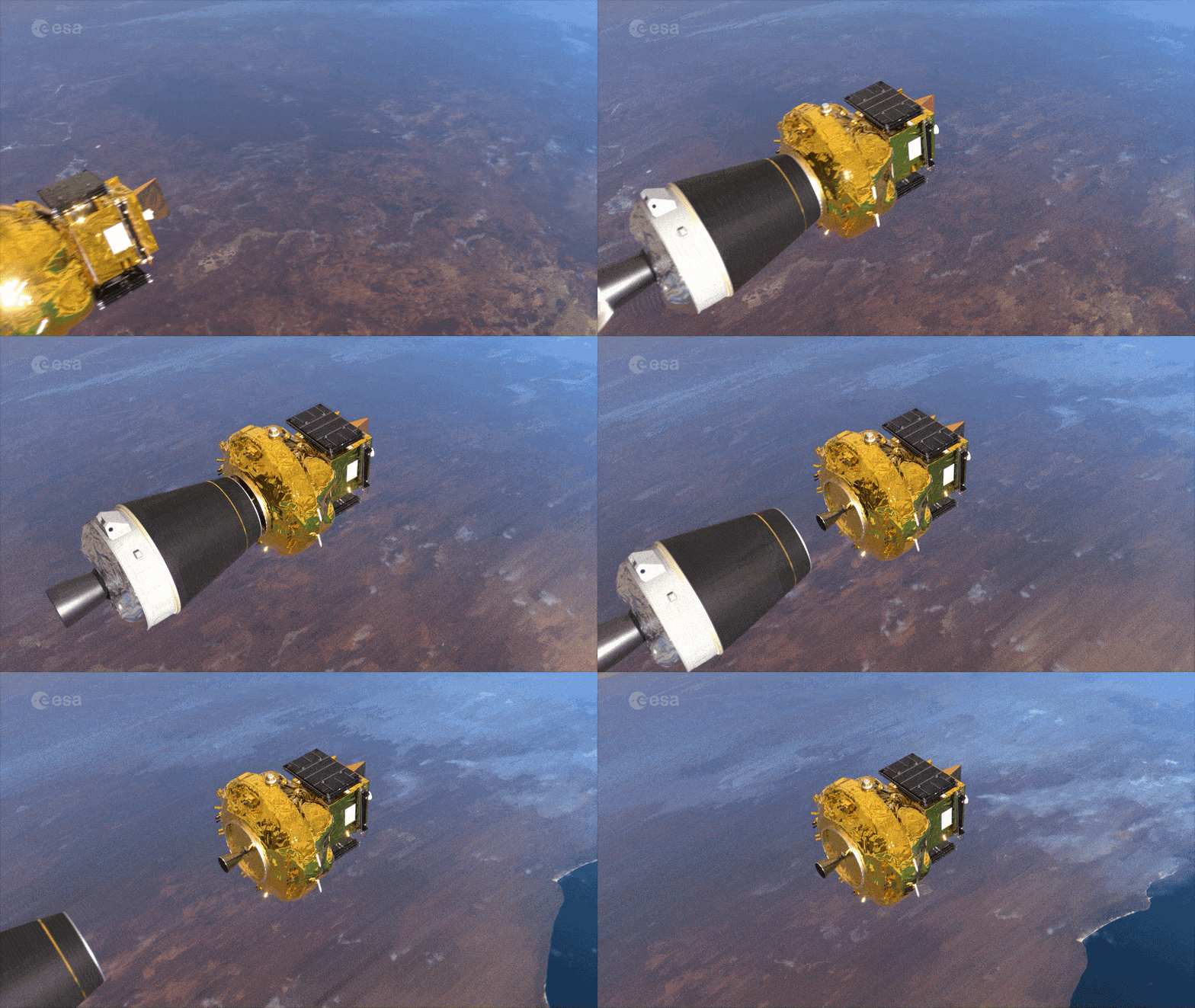
During the launch, the four stages of the Vega-C rocket will separate one by one, before finally releasing Smile after 57 minutes. Smile’s solar panels will unfold after 63 minutes – the milestone that confirms launch success.
The launch will drop Smile off into a low-Earth orbit. From there, the spacecraft will take over to bring itself to its final, egg-shaped orbit that goes 121 000 km above the North Pole to collect data, before coming 5000 km above the South Pole to deliver it to waiting ground stations.
Launch preparations are progressing well, with the spacecraft and all rocket parts having now arrived at Europe’s Spaceport. The four rocket stages are stacked, ready and waiting for Smile on the launch pad.
For the latest updates, visit our dedicated page and follow @science.esa.int and @transport.esa.int (Bluesky) and @esascience and @ESA_transport (X).
Our Smile launch kit is a set of infographics providing an overview of the mission, its science goals and the launch timeline. It is available in English, French, German, Spanish, Italian and Dutch.
Our mission minisite gives an overview of all-things-Smile.
Online media briefings in five languages
Media are invited to join online media briefings in several languages ahead of the launch.
Interested journalists should register by 17:00 CET on Monday 23 March by choosing the appropriate form here. Only registered media will be able to attend and ask questions.
The briefing in English will be livestreamed via ESA Web TV on Thursday 26 March at 14:00 CET for anybody to watch.
Wednesday 25 March
10:30: Briefing in Italian
Participants:
Stefano Bianchi, Head of Flight Programmes, ESA
Massimo Falcolini, Smile Product Assurance Manager, ESA
Domenico Trotta, Internal Research Fellow, ESA
13:30: Briefing in German
Participants:
Walfried Raab, Smile Lead Payload Engineer, ESA
Marcus Kirsch, Smile Ground Segment and Operations Support Manager, ESA
Manfred Steller, Senior engineer for Space Research Institute, Austrian Academy of Science
14:30: Briefing in French
Participants:
Toni Tolker-Nielsen, Director of Space Transportation, ESA
Philippe Escoubet, Smile Project Scientist, ESA
Sylvain Vey, Smile Instrument and Operations Engineer, ESA
Dimitra Koutroumpa, Chargée de Recherche CNRS, LATMOS
Thursday 26 March
13:00-14:00: Briefing in Spanish
Participants:
Rocío Guerra, Smile Science Operations Development Manager, ESA
Ignasi Pardos, Vega Launch System and Engineering Manager, ESA
Jaione Martinez Cengotitabengoa, PAZ-2 Programme Manager, Airbus Defence and Space
Jenny Carter, Dorothy Hodgkin Research Fellow, Leicester University
Raquel González Sola (General Director of Airbus Spain)
14:00: Briefing in English (also livestreamed via ESA Web TV)
Participants:
Carole Mundell, Director of Science, ESA
David Agnolon, Smile Project Manager, ESA
Ignasi Pardos, Vega Launch System and Engineering Manager, ESA
Colin Forsyth, Associate Professor in the Space Plasma Physics Group at the UCL Mullard Space Science Laboratory
Jing Li, Smile Project Manager, CAS
About Smile
Smile (the Solar wind Magnetosphere Ionosphere Link Explorer) is a joint mission between the European Space Agency (ESA) and the Chinese Academy of Sciences (CAS).
Smile will use four science instruments to study how Earth responds to the solar wind from the Sun. In doing so, Smile will improve our understanding of solar storms, geomagnetic storms and the science of space weather.
ESA is responsible for providing Smile’s payload module (which carries three of the four science instruments), one of the spacecraft’s four science instruments (the soft X-ray imager, SXI), the launcher, and the Assembly Integration and Testing facilities and services. ESA contributes to a second science instrument (the ultraviolet imager, UVI) and the mission operations once Smile is in orbit.
CAS provides the other three science instruments and the spacecraft platform, and is responsible for operating the spacecraft in orbit.
Smile is part of ESA’s Cosmic Vision programme, principally contributing to answering the question ‘How does the Solar System work?’
For more information, visit: https://www.esa.int/Science_Exploration/Smile
About Vega-C
Europe’s Vega-C rocket can launch 2300 kg into space, such as small scientific and Earth observation spacecraft. At 35 m tall, Vega-C weighs 210 tonnes on the launch pad and reaches orbit with three solid-propellant-powered stages before the fourth liquid-propellant stage takes over for precise placement of satellites into their desired orbit around Earth.
Complementing the Ariane family to launch all types of payloads into their desired orbits, Vega-C ensures that Europe has versatile and independent access to space. ESA leads the Vega-C programme, working with Avio as prime contractor and design authority. For this launch Avio is also launch service operator.
For more information, visit: https://www.esa.int/Enabling_Support/Space_Transportation/Vega/Vega-C










Related Posts

Stay Informed With the Latest & Most Important News
Previous Post
Next Post

Advertisement
-
 01Two Black Holes Observed Circling Each Other for the First Time
 -
 02From Polymerization-Enabled Folding and Assembly to Chemical Evolution: Key Processes for Emergence of Functional Polymers in the Origin of Life
 -
 03Astronomy 101: From the Sun and Moon to Wormholes and Warp Drive, Key Theories, Discoveries, and Facts about the Universe (The Adams 101 Series)
 -
 04True Anomaly hires former York Space executive as chief operating officer
 -
 05Φsat-2 begins science phase for AI Earth images
 -
 06Hurricane forecasters are losing 3 key satellites ahead of peak storm season − a meteorologist explains why it matters
 -
 07Binary star systems are complex astronomical objects − a new AI approach could pin down their properties quickly