
Now Reading: Kayhan targets investors, insurers with expanded orbital intelligence platform
-
01
Kayhan targets investors, insurers with expanded orbital intelligence platform


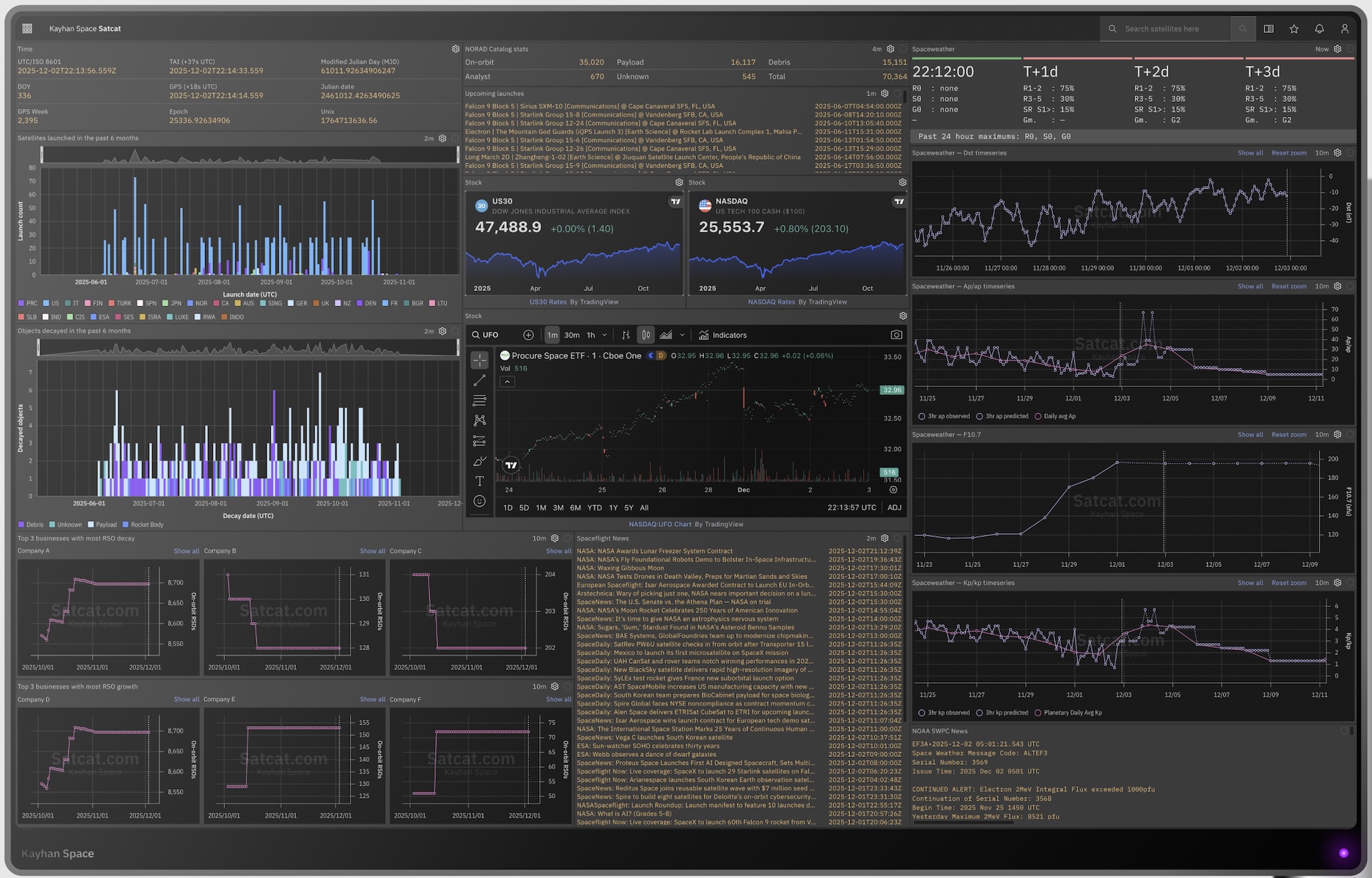

TAMPA, Fla. — Kayhan Space is branching out from providing orbital intelligence used to coordinate satellite fleets with a new software platform that turns that data into business insights for investors and insurers.
The Colorado-based venture unveiled its Satcat Terminal March 20, akin to the Bloomberg Terminal widely used by finance professionals for real-time market data and analytics.
The move comes as retail and institutional investor interest in space businesses grows ahead of a potential SpaceX stock market debut this year, while insurers face rising exposure in an increasingly congested orbital environment.
“Space has quickly become one of the most significant infrastructure investment categories of our time, yet the financial and insurance communities have been operating largely blind,” Kayhan CEO and cofounder Siamak Hesar told SpaceNews.
“They are making billion-dollar decisions without the kind of data-backed intelligence they’d expect in any other asset class. This gap has always existed, but the scale of capital flowing into the sector now makes it impossible to ignore.”
Satcat Terminal uses an AI-driven interface that lets users query orbital activity in plain language, such as whether a constellation is expanding on schedule or if there have been unusual events around a specific satellite.
The platform draws on Kayhan’s catalog of more than 36,000 tracked space objects, including over 11,000 satellites with daily refreshed trajectories, using publicly available and partner-sourced data.
Hesar said Satcat Terminal builds on a dataset that now reflects activity across more than 90% of active low Earth orbit (LEO) spacecraft through Kayhan’s base of more than 50 satellite operator customers.
“For years, our focus has been on the day-to-day operational intelligence that satellite operators need to keep their spacecraft safe, such as conjunction analysis, close-approach events, real-time trajectory data,” he said via email.
“That work hasn’t changed, but the volume and depth of data we’ve accumulated now allows us to layer on longer-term, higher-level analytics and inferences that are far more relevant to investors, insurers and financial professionals.”
Early customer traction
Hesar said accessing comparable insights previously required specialized astrodynamics expertise and piecing together fragmented data sources, leaving much of the financial sector reliant on analyst reports, operator disclosures or word of mouth.
“Across the Satcat platform we’re also seeing more than 3,500 visitors every day, a clear signal of just how broad the demand for this kind of orbital intelligence has become,” he added.
According to Hesar, Satcat Terminal is already drawing strong early interest from the insurance sector following initial outreach.
“Insurers are fundamentally in the business of quantifying risk, and on-orbit risk has been nearly impossible to quantify with any rigor until now,” he said.
While Hesar said it is too early to quantify the opportunity, Kayhan is forecasting strong growth alongside its core business, including from satellite operators whose executives could use Satcat Terminal to gain higher-level visibility into their own fleets and the broader industry.










Related Posts

Stay Informed With the Latest & Most Important News
Previous Post
Next Post
Previous Post
Next Post



Advertisement
-
 01Two Black Holes Observed Circling Each Other for the First Time
 -
 02From Polymerization-Enabled Folding and Assembly to Chemical Evolution: Key Processes for Emergence of Functional Polymers in the Origin of Life
 -
 03Astronomy 101: From the Sun and Moon to Wormholes and Warp Drive, Key Theories, Discoveries, and Facts about the Universe (The Adams 101 Series)
 -
 04True Anomaly hires former York Space executive as chief operating officer
 -
 05Φsat-2 begins science phase for AI Earth images
 -
 06Hurricane forecasters are losing 3 key satellites ahead of peak storm season − a meteorologist explains why it matters
 -
 07Binary star systems are complex astronomical objects − a new AI approach could pin down their properties quickly