
Now Reading: TOI-4552 b: A New Ultra-short Period Rocky World Revealed By NIRPS And TESS
-
01
TOI-4552 b: A New Ultra-short Period Rocky World Revealed By NIRPS And TESS


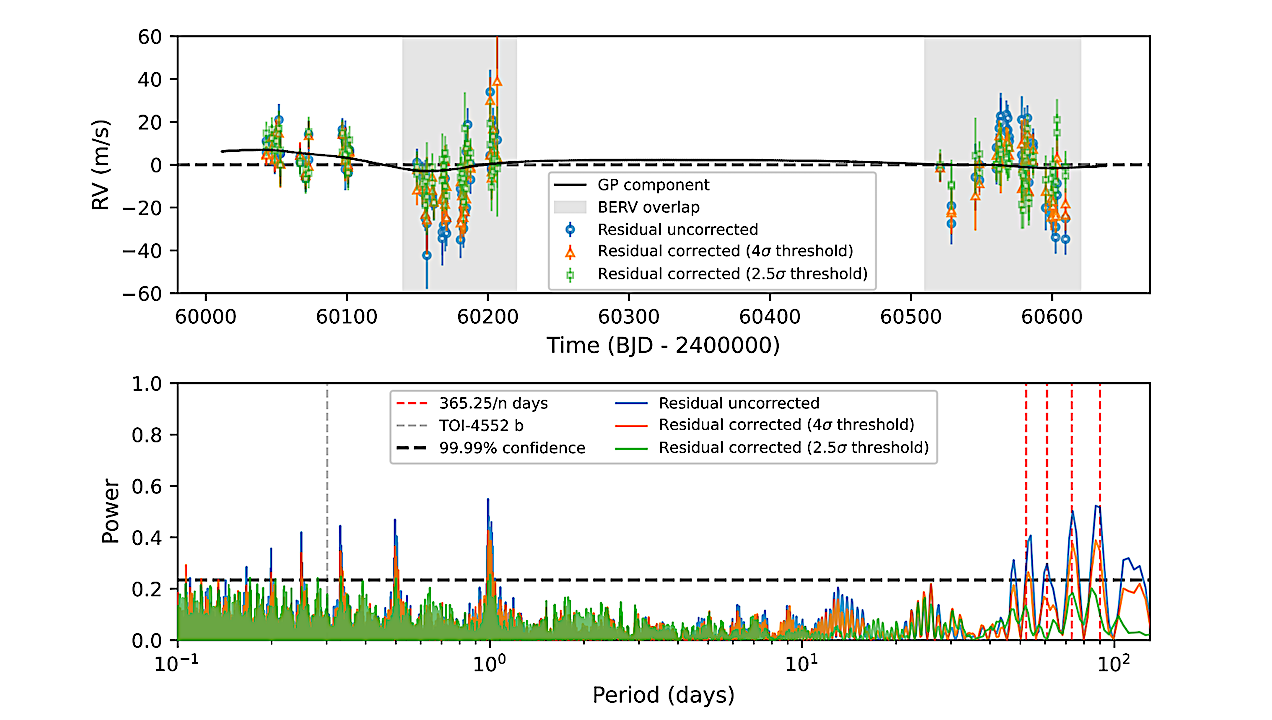
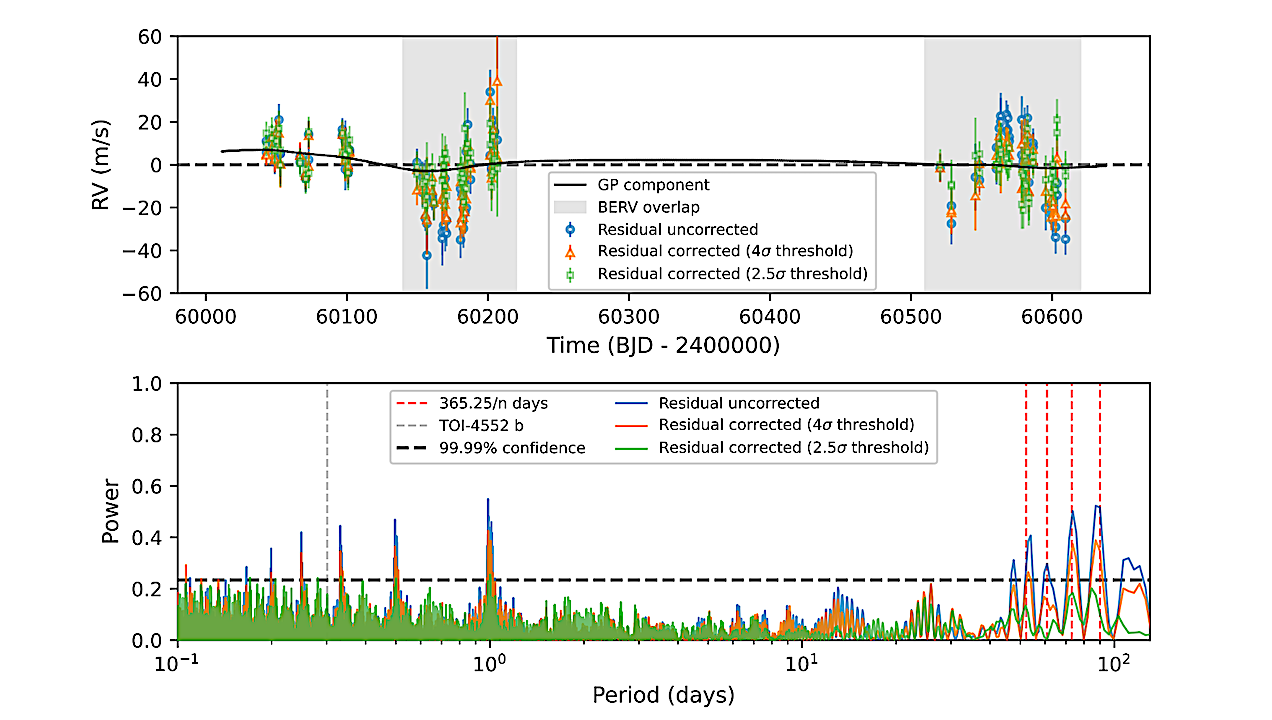
NIRPS RV timeseries of TOI-4552 (top) along with the corresponding periodograms (bottom). Due to the BERV overlap issue discussed in Section 4.2, we masked a small number of pixels from each frame that contained stellar lines severely affected by under-corrected tellurics. Outlier pixels were identified using a σ-clipping threshold, such that any deviations from the median stellar spectrum exceeding the threshold were masked. We present here the unmasked (Residual uncorrected) and masked (Residual corrected) time series at 4σ and 2.5σ thresholds, along with their corresponding periodograms. After applying the 2.5-σ threshold, the peaks associated with harmonics of Earth’s rotation (365.24/n days) fall below the confidence level, indicating that the telluric signals have been effectively suppressed. The telluric residual corrected time series (green) is adopted for our final analysis. — astro-ph.EP
A particularly intriguing subclass of rocky exoplanets are the ultra-short period (USP) worlds that orbit their host stars in less than a day. These planets are particularly rare around M dwarf stars, with so far only ten that have a constrained mass and radius.
We present the validation and characterization of the ultra-short period (0.3-days), Earth-sized planet TOI-4552 b orbiting a nearby (27.26-pc away) M4.5V dwarf. Complementing the TESS photometry, ground-based transit observations from LCO, ExTrA and SPECULOOS validated the planetary radius and cleared the field of any contaminants.
Speckle imaging with Zorro (Gemini-S) rules out false positive scenarios caused by eclipsing binary sources. Spectroscopic observations with NIRPS and HARPS were used to obtain stellar abundances, constrain the planetary mass, and, in conjunction with the transit observations, estimate the orbital parameters.
TOI-4552 is a quiet star exhibiting no short-term stellar variations seen in photometric or radial velocity data that can be associated to stellar rotation. TOI-4552 b (Mp=1.83±0.47Me, Rp=1.11±0.04Re) lies between the Earth-like and iron-rich composition tracks on the Mass-Radius diagram. The EXOPIE interior structure model, without constraints from refractory abundance ratio, yields a core mass fraction (CMF) of 0.54 and a bulk density of 7.74g/cm3.
Since the CMF spans a wide range due to the large uncertainty on the mass, the definitive interior composition cannot be determined with the current dataset. TOI-4552 b hints as being marginally more iron-rich compared to the Earth but confirmation of its status requires additional, precise radial velocity measurements.
Combined with its high emission spectroscopic metric (ESM=19.5), negligible stellar activity and short orbital period, TOI-4552 b emerges as a compelling target for atmospheric and surface composition studies with JWST.
Avidaan Srivastava, René Doyon, François Bouchy, Étienne Artigau, Charles Cadieux, Nicole Gromek, Elisa Delgado-Mena, Yuri S. Messias, Xavier Bonfils, Roseane de Lima Gomes, Susana C. C. Barros, Björn Benneke, Marta Bryan, Ryan Cloutier, Nicolas B. Cowan, Eduardo Cristo, Xavier Delfosse, Xavier Dumusque, David Ehrenreich, Jonay I. González Hernández, David Lafrenière, Izan de Castro Leão, Christophe Lovis, Alejandro Suárez Mascareño, Bruno L. Canto Martins, Jose Renan De Medeiros, Lucile Mignon, Christoph Mordasini, Francesco Pepe, Rafael Rebolo, Jason Rowe, Nuno C. Santos, Damien Ségransan, Stéphane Udry, Diana Valencia, Gregg Wade, Jose Manuel Almenara, Karen A. Collins, Dennis M. Conti, George Dransfield, Elsa Ducrot, Zahra Essack, Dasaev O. Fontinele, Thierry Forveille, Marziye Jafariyazani, Pierrot Lamontagne, Alexandrine L’Heureux, Khaled Al Moulla, Ares Osborn, Léna Parc, David R. Rodriguez, Richard P. Schwartz, Madison G. Scott, Avi Shporer, Atanas K. Stefanov, Mathilde Timmermans, Amaury H.M.J. Triaud, Joost P. Wardenier, Drew Weisserman, Sebastián Zúñiga-Fernández
Comments: 20 pages total: 12 pages main text + 8 pages appendix. Abstract shortened to fit character limit. Accepted to A&A on March 16, 2025
Subjects: Earth and Planetary Astrophysics (astro-ph.EP)
Cite as: arXiv:2603.18233 [astro-ph.EP] (or arXiv:2603.18233v1 [astro-ph.EP] for this version)
https://doi.org/10.48550/arXiv.2603.18233
Focus to learn more
Submission history
From: Avidaan Srivastava
[v1] Wed, 18 Mar 2026 19:38:14 UTC (5,088 KB)
https://arxiv.org/abs/2603.18233
Astrobiology, exoplanet,










Related Posts

Stay Informed With the Latest & Most Important News
Previous Post
Next Post



Advertisement
-
 01Two Black Holes Observed Circling Each Other for the First Time
 -
 02From Polymerization-Enabled Folding and Assembly to Chemical Evolution: Key Processes for Emergence of Functional Polymers in the Origin of Life
 -
 03Astronomy 101: From the Sun and Moon to Wormholes and Warp Drive, Key Theories, Discoveries, and Facts about the Universe (The Adams 101 Series)
 -
 04True Anomaly hires former York Space executive as chief operating officer
 -
 05Φsat-2 begins science phase for AI Earth images
 -
 06Hurricane forecasters are losing 3 key satellites ahead of peak storm season − a meteorologist explains why it matters
 -
 07Binary star systems are complex astronomical objects − a new AI approach could pin down their properties quickly