
Now Reading: Exploring The Surface Of HD 189733 via Doppler Shadow Analysis Of Planetary Transits
-
01
Exploring The Surface Of HD 189733 via Doppler Shadow Analysis Of Planetary Transits

Exploring The Surface Of HD 189733 via Doppler Shadow Analysis Of Planetary Transits

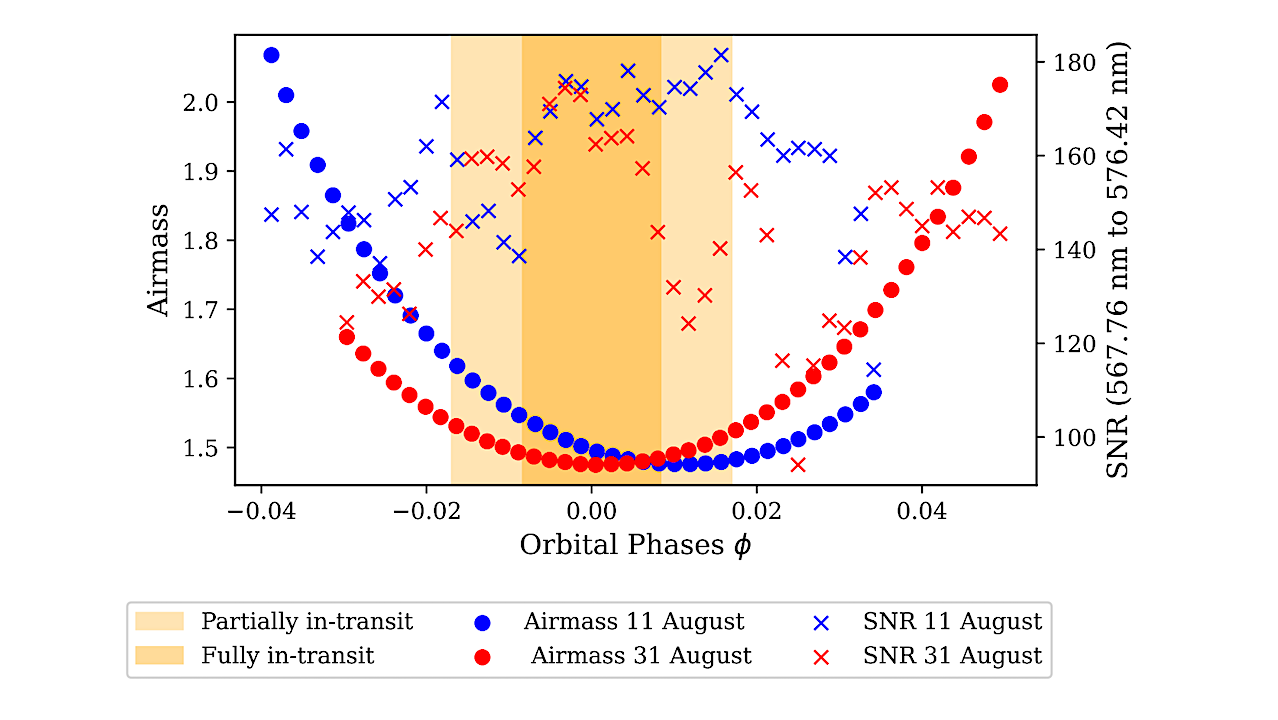

Airmass variation and S/N of an ESPRESSO spectral order covering wavelengths from 567.76 nm to 576.42 nm, chosen as a midpoint in the selected Fe i spectral lines, as a function of the orbital phase of HD 189733 b. Blue points correspond to observations from 11 August 2021, and red points to those from 31 August 2021. The darker shaded region marks the phases where the planet is fully in transit, with lighter shading indicating the ingress and egress phases. — astro-ph.SR
Transmission spectroscopy has greatly advanced the study of exoplanet atmospheres, but stellar surface heterogeneities can contaminate transit spectra. Characterising how stellar spectra vary across the stellar disc is therefore essential to disentangle stellar and planetary contributions.
Transit observations can probe the local stellar spectra along the planet’s transit chord. We study centre-to-limb variations of line profiles across the surface of HD 189733 using the ESPRESSO spectrograph. Building on previous work, we assess the feasibility of applying the Doppler shadow technique with ESPRESSO and compare the results with solar observations and numerical simulations.
We analyse spectra obtained during two transits of HD 189733 b. Each spectrum was cross-correlated with two masks of selected Fe I lines, producing four sets of cross-correlation functions (CCFs). Using a Doppler shadow methodology, we retrieved local stellar profiles along the transit chord. These were compared with previous studies, with disc-resolved solar spectra from IAG ATLAS and with transit simulations generated using SOAPv4 and synthetic spectra from Turbospectrum based on MARCS stellar atmosphere models under LTE and NLTE conditions.
For three Fe I CCF sets we detect a statistically significant increase in line depth from stellar limb to centre, consistent with Turbospectrum predictions, although solar data show a weaker gradient. For one CCF set we also find that line widths decrease from limb to centre, consistent with solar observations but not reproduced by the simulations. These results demonstrate the capability of ESPRESSO to measure centre-to-limb variations of spectral line profiles on other stars.
While the local CCF profiles of HD 189733 agree with solar data, discrepancies in line widths suggest that additional physical processes are required to reproduce the observed profiles.
E. C. Gonçalves, E. Cristo, W. Dethier, N. C. Santos, S. G. Sousa, P. T. P. Viana, T. Azevedo Silva, R. Allart, V. Bourrier
Subjects: Solar and Stellar Astrophysics (astro-ph.SR); Earth and Planetary Astrophysics (astro-ph.EP)
Cite as: arXiv:2603.13463 [astro-ph.SR] (or arXiv:2603.13463v1 [astro-ph.SR] for this version)
https://doi.org/10.48550/arXiv.2603.13463
Focus to learn more
Submission history
From: Eduardo Cristo
[v1] Fri, 13 Mar 2026 17:29:22 UTC (3,472 KB)
https://arxiv.org/abs/2603.13463
Astrobiology, Astronomy, exoplanet,










Related Posts
Stay Informed With the Latest & Most Important News
Previous Post
Next Post




Advertisement
-
 01Two Black Holes Observed Circling Each Other for the First Time
 -
 02From Polymerization-Enabled Folding and Assembly to Chemical Evolution: Key Processes for Emergence of Functional Polymers in the Origin of Life
 -
 03Astronomy 101: From the Sun and Moon to Wormholes and Warp Drive, Key Theories, Discoveries, and Facts about the Universe (The Adams 101 Series)
 -
 04True Anomaly hires former York Space executive as chief operating officer
 -
 05Φsat-2 begins science phase for AI Earth images
 -
 06Hurricane forecasters are losing 3 key satellites ahead of peak storm season − a meteorologist explains why it matters
 -
 07Binary star systems are complex astronomical objects − a new AI approach could pin down their properties quickly