
Now Reading: Narrowband Radio Technosignature Search Toward 3I/ATLAS With FAST
-
01
Narrowband Radio Technosignature Search Toward 3I/ATLAS With FAST


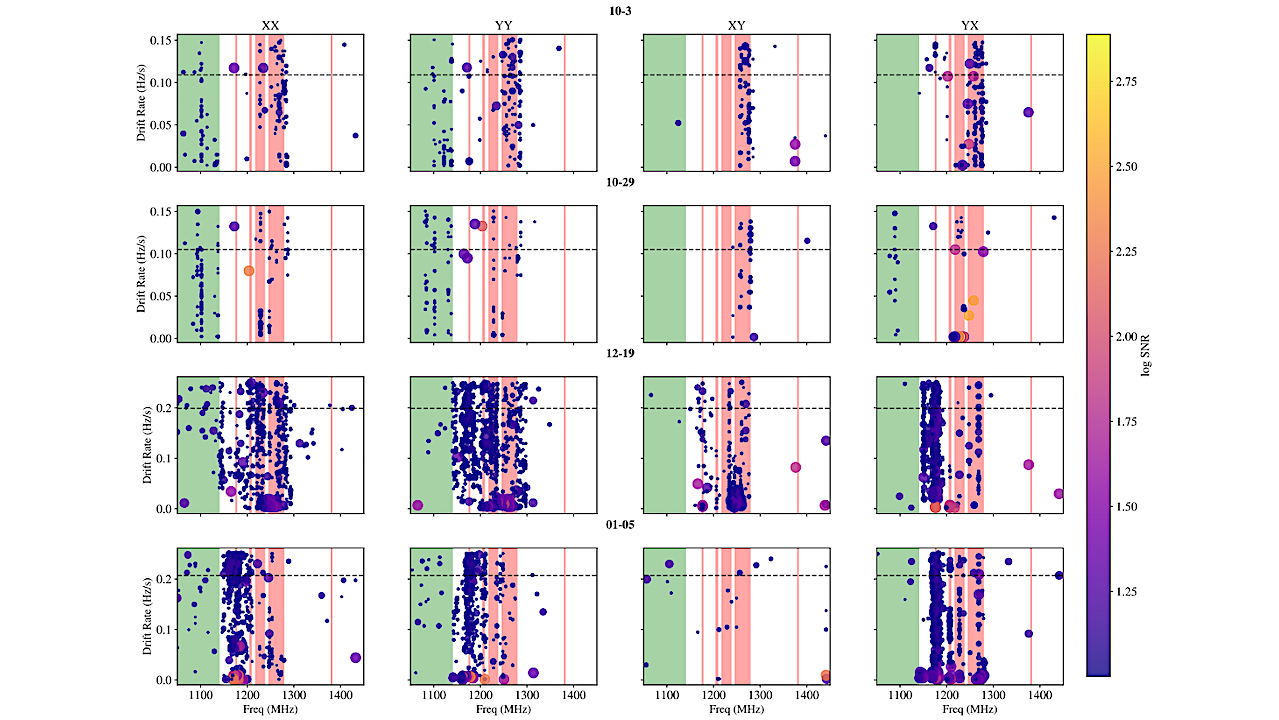
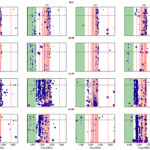
Scatter plots of potential candidate in frequency, drift rate and signal-to-noise ratio for each polarization channel. The color and the size for each point represent the value of SNR in log space. The green and red color bar is the frequency ranges of civil aviation and navigation satellites, respectively. The black dashed lines represent the expected drift rates for each observation date. — astro-ph.IM
3I/ATLAS is the third confirmed interstellar object passing through the Solar System. In this work, we conduct narrowband radio technosignature search toward 3I/ATLAS using the Five-hundred-meter Aperture Spherical Telescope (FAST) L-band multibeam receiver from October 2025 to January 2026 on 4 separate dates (i.e. Mars closest, perihelion, Earth closest and flew away from Earth, respectively).
We carry out frequency-drifting signal searching with signal-to-noise ratio (SNR) over 10 within 1.05-1.45 GHz via bliss pipeline. These signal hits are grouping into event by beam, frequency and drift rate matching, the events are then filtered by cluster analysis and drift rate cut-off.
We also characterized the events by their significance in SNR, structure tensor as well as principal component analysis (PCA). No credible narrowband radio technosignature are detected from 3I/ATLAS after visual inspections. The null results place constraints on the presence of transmitters above 2.862×10⁻³ W. We further introduce a Bayesian inference framework to constraints on the existence probability and characteristic power of hypothetical transmitters using physically motivated priors to bracket plausible transmitter scenarios.
Jian-Kang Li, Zhen-Zhao Tao, Tong-Jie Zhang
Comments: 26 pages, 15 figures, 6 tables. Submitted to AAS Journals
Subjects: Instrumentation and Methods for Astrophysics (astro-ph.IM)
Cite as: arXiv:2603.19023 [astro-ph.IM](or arXiv:2603.19023v1 [astro-ph.IM] for this version)
https://doi.org/10.48550/arXiv.2603.19023
Focus to learn more
Submission history
From: Jiankang Li
[v1] Thu, 19 Mar 2026 15:24:06 UTC (29,187 KB)
https://arxiv.org/abs/2603.19023
Astrobiology, SETI,











Related Posts
Stay Informed With the Latest & Most Important News
Previous Post
Next Post
Advertisement
-
 01Two Black Holes Observed Circling Each Other for the First Time
 -
 02From Polymerization-Enabled Folding and Assembly to Chemical Evolution: Key Processes for Emergence of Functional Polymers in the Origin of Life
 -
 03Astronomy 101: From the Sun and Moon to Wormholes and Warp Drive, Key Theories, Discoveries, and Facts about the Universe (The Adams 101 Series)
 -
 04True Anomaly hires former York Space executive as chief operating officer
 -
 05Φsat-2 begins science phase for AI Earth images
 -
 06Hurricane forecasters are losing 3 key satellites ahead of peak storm season − a meteorologist explains why it matters
 -
 07Binary star systems are complex astronomical objects − a new AI approach could pin down their properties quickly