
Now Reading: Analysis Of Io’s tidal Response As A Function Of The Properties Of The Partially Molten Layer
-
01
Analysis Of Io’s tidal Response As A Function Of The Properties Of The Partially Molten Layer

Analysis Of Io’s tidal Response As A Function Of The Properties Of The Partially Molten Layer

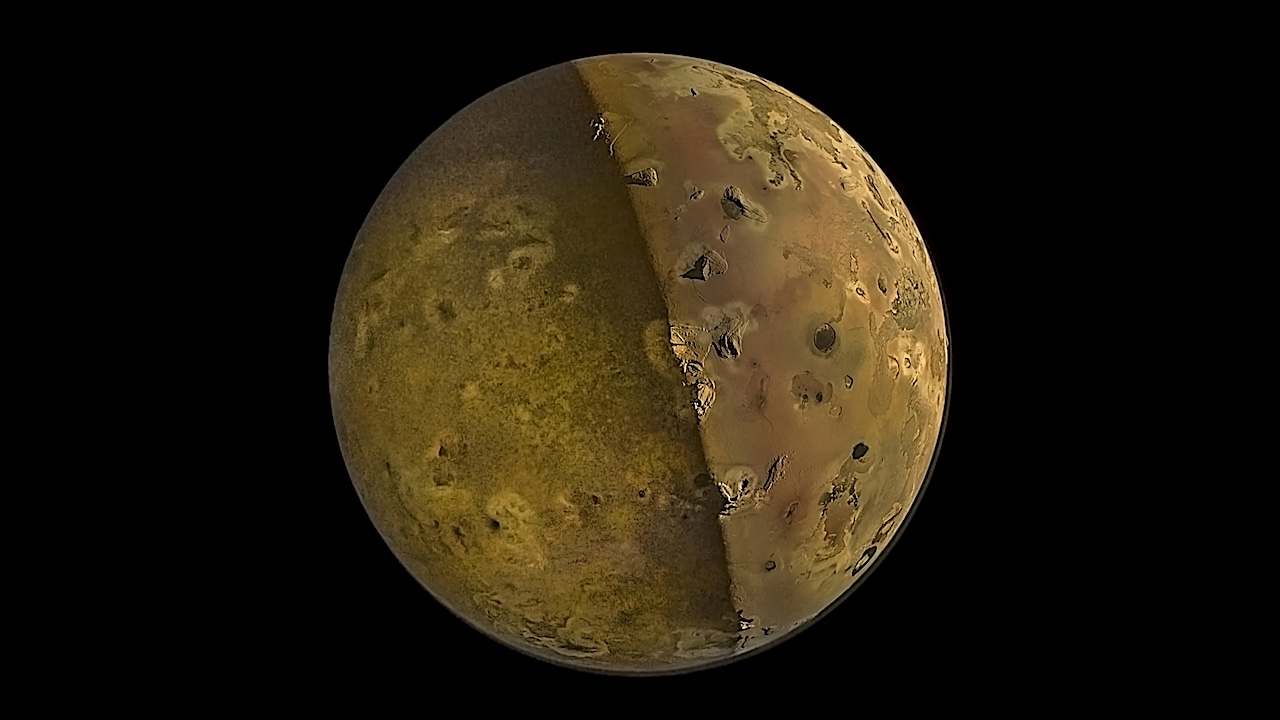

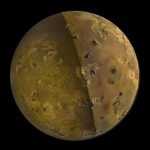
Io – NASA
Io’s internal heat is generated by Jupiter-driven tidal dissipation and Laplace resonance. This energy partially melts the mantle, but the melt fraction, depth, and spatial distribution of dissipation remain poorly constrained.
Tidal deformation is linked to the mantle’s physical state via a parametric approach accounting for melting onset depth and latent heat of fusion. Io is modeled as a three-layer body comprising a fluid core, a viscoelastic mantle, and an elastic lithosphere.
The degree-2 potential Love number k2 is computed by solving spheroidal oscillation equations with an adapted California Planetary Geophysics Code (CPGC). Mantle properties (viscosity, shear modulus, Andrade parameter beta) are iteratively updated based on the local melt fraction, and mantle compressibility is explicitly incorporated. Results show a self-consistent shallow-mantle enhancement of tidal heating.
Melt presence decreases effective viscosity and increases anelasticity, amplifying upper-mantle dissipation. Reproducing the observed real part of k2 in 1D models requires melt fractions below the rheologically critical threshold. Compressibility yields higher values for the real part of k2, reinforcing this upper bound.
Mass flux analysis confirms melt percolation capacity exceeds thermodynamic production, implying efficient drainage. The reference Andrade parameter beta strongly influences the imaginary Love numbers (k2, h2, l2) and the predicted libration amplitude.
These constraints support a heterogeneous mantle characterized by a magmatic sponge structure rather than a global magma ocean, establishing a quantitative framework linking Io’s interior, partial melting, and tidal dissipation to Juno observations.
M. Paris, A. Mura, F. Zambon, A. Genova, F. Tosi, A. Consorzi, G. Mitri, A. Cicchetti, S. Bolton, R. Noschese, G. Piccioni, C. Plainaki, G. Sindoni, R. Sordini
Comments: 18 pages, 23 figures
Subjects: Earth and Planetary Astrophysics (astro-ph.EP)
Cite as: arXiv:2603.19095 [astro-ph.EP] (or arXiv:2603.19095v1 [astro-ph.EP] for this version)
https://doi.org/10.48550/arXiv.2603.19095
Focus to learn more
Submission history
From: Matteo Paris
[v1] Thu, 19 Mar 2026 16:20:31 UTC (12,171 KB)
https://arxiv.org/abs/2603.19095
Astrobiology, Astrogeology,










Related Posts
Stay Informed With the Latest & Most Important News
Previous Post
Next Post


Advertisement
-
 01Two Black Holes Observed Circling Each Other for the First Time
 -
 02From Polymerization-Enabled Folding and Assembly to Chemical Evolution: Key Processes for Emergence of Functional Polymers in the Origin of Life
 -
 03Astronomy 101: From the Sun and Moon to Wormholes and Warp Drive, Key Theories, Discoveries, and Facts about the Universe (The Adams 101 Series)
 -
 04True Anomaly hires former York Space executive as chief operating officer
 -
 05Φsat-2 begins science phase for AI Earth images
 -
 06Hurricane forecasters are losing 3 key satellites ahead of peak storm season − a meteorologist explains why it matters
 -
 07Binary star systems are complex astronomical objects − a new AI approach could pin down their properties quickly