
Now Reading: Sovereign demand and institutional capital reshape space economy
-
01
Sovereign demand and institutional capital reshape space economy



TAMPA, Fla. — Large infrastructure funds are “carefully looking” into entering the space sector, Seraphim Space CEO Mark Boggett said March 23, giving early-stage investors more confidence to back ambitious startups that may later need billions of dollars to scale.
Speaking at the Satellite Conference in Washington D.C., Boggett said growing interest from institutional investors is creating a new floor of capital for the maturing industry, which SpaceX’s potential IPO this year could accelerate.
“Space tech has now broken through this glass ceiling and is now becoming a permanent institutional allocation,” he said.
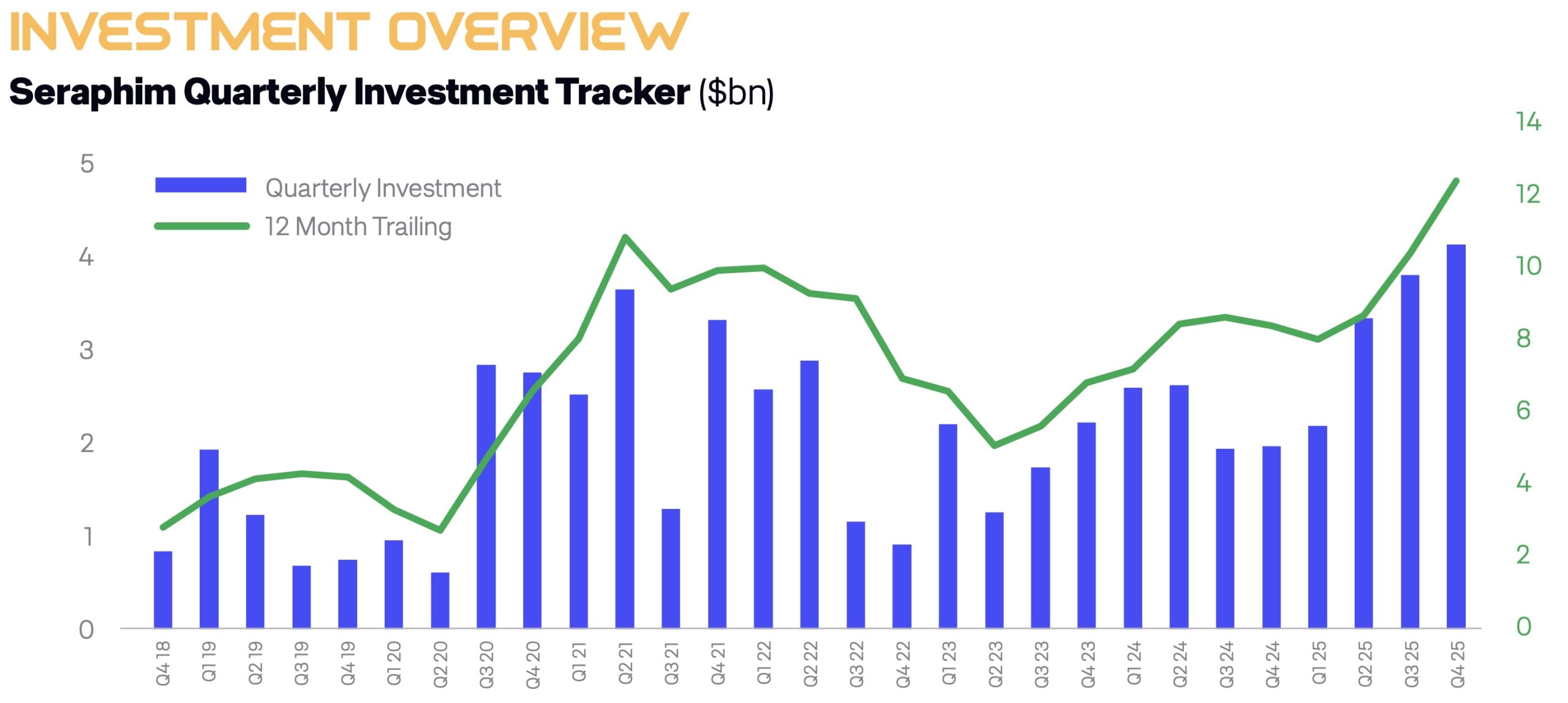
Private investment in the sector soared 48% year-on-year to about $12.4 billion in 2025, according to Seraphim analysis covering companies across the value chain, including space-enabled applications such as ride-hailing service Uber.
The total surpasses the previous peak in 2021 in a rebound Boggett said reflects a broader and more durable funding base as capital increasingly flows into infrastructure-heavy segments.
A potential public listing this year that could value SpaceX at more than $1.5 trillion would further validate the sector, he added, possibly lifting valuations across the industry.
Even with the hefty valuation Elon Musk is aiming for, he pointed to “considerable upside” for SpaceX as it pushes into orbital data centers and other infrastructure tied to artificial intelligence.
Boggett also argued that there remains plenty of room to compete with SpaceX, even in launch.
“We’ve got a single player that’s dominating the market that is increasing the cost of launch,” he said, “so there needs to be more competition to continue driving that price downwards.”
Sovereign push
Virtually every country wants its own launch capability so it can rapidly replace satellites lost in a war environment, Boggett continued, and nowhere is a shift toward sovereign capabilities more visible than in Europe.
“We’ve never seen anything like this before,” he said, “It’s a new period of time in Europe, and there is this very significant opportunity for earlier stage companies” that can deliver reliable, low-cost space capabilities quickly using regionally sourced components.
“I think, particularly with what’s going on in the Middle East at the moment, that the attention is being turned to other regions wanting their own Golden Domes,” Boggett added, referring tothe Pentagon’s $185 billion missile defense initiative.
He also said the increasing reliance of governments on commercial providers will help drive the emergence of a new generation of “neo-primes” similar to those seen in the United States.
“We’re going to see more Palantirs and more Andurils effectively being created as governments get themselves comfortable with individual names,” he added, pointing to how Indian startup Pixxel recently secured a contract to develop and operate an Earth observation constellation for the country’s government.










Related Posts
Stay Informed With the Latest & Most Important News
Previous Post
Next Post




Advertisement
-
 01Two Black Holes Observed Circling Each Other for the First Time
 -
 02From Polymerization-Enabled Folding and Assembly to Chemical Evolution: Key Processes for Emergence of Functional Polymers in the Origin of Life
 -
 03Astronomy 101: From the Sun and Moon to Wormholes and Warp Drive, Key Theories, Discoveries, and Facts about the Universe (The Adams 101 Series)
 -
 04True Anomaly hires former York Space executive as chief operating officer
 -
 05Φsat-2 begins science phase for AI Earth images
 -
 06Hurricane forecasters are losing 3 key satellites ahead of peak storm season − a meteorologist explains why it matters
 -
 07Binary star systems are complex astronomical objects − a new AI approach could pin down their properties quickly