
Now Reading: XRISM solves gamma-Cas’s 50-year X-ray mystery
-
01
XRISM solves gamma-Cas’s 50-year X-ray mystery


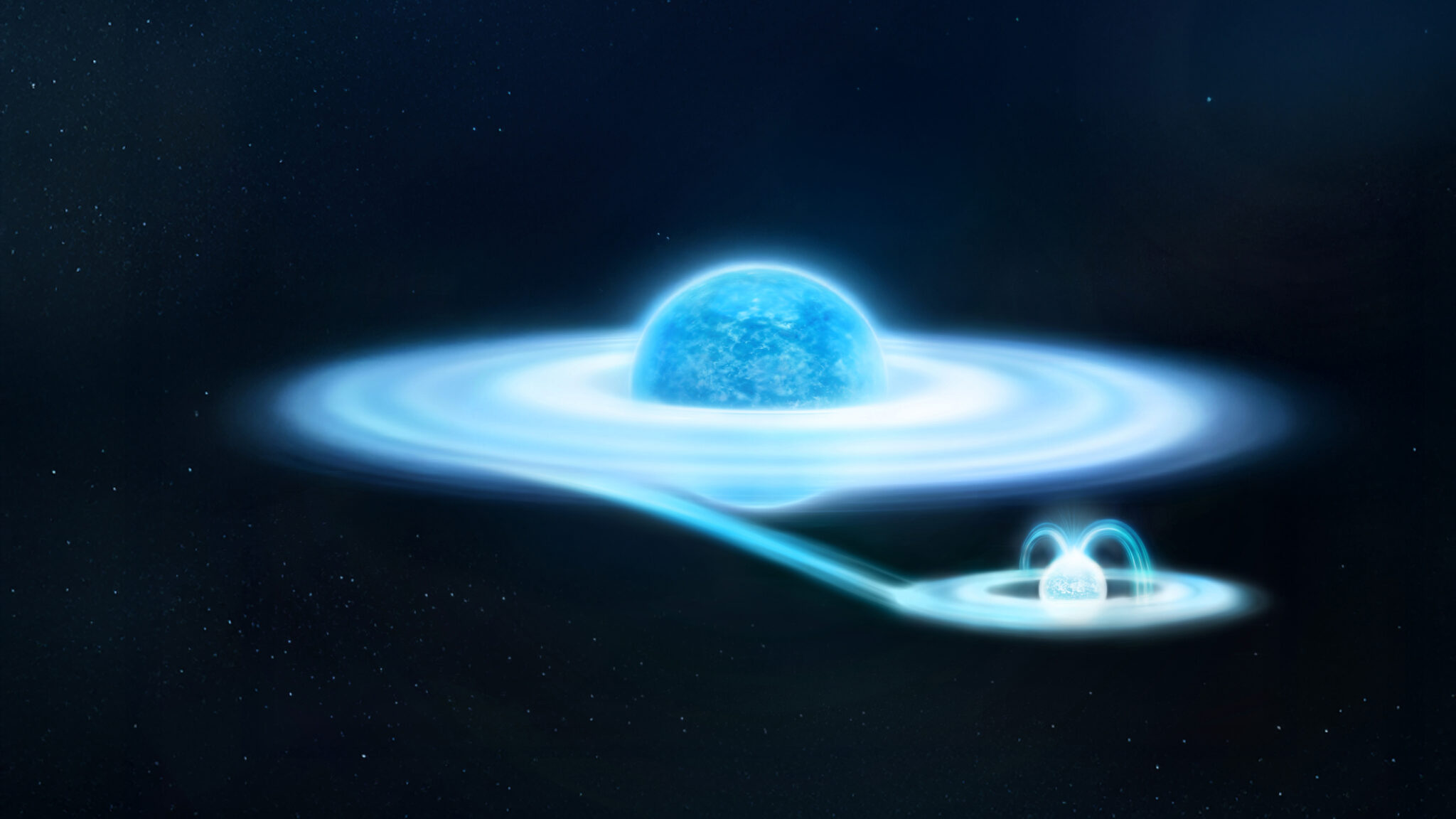
Strange X-rays from the naked eye star gamma-Cas have been confirmed to come from matter falling onto a hidden white dwarf companion, resolving a fifty-year astronomical mystery.
Gamma-Cas, the central star in the familiar W-shape of Cassiopeia, has puzzled astronomers since the 1970s, when it was found to emit unusually strong high-energy X-rays. For decades two competing explanations have been considered. Either the X-rays arose from magnetic interaction between the star and its surrounding disc of gas, or they were produced as material from that disc fell onto a compact, unseen companion.
The debate has now ended thanks to decisive evidence from the X-Ray Imaging and Spectroscopy Mission (XRISM), led by JAXA in collaboration with ESA and NASA. Using its high-resolution Resolve spectrometer, astronomers were able to track the motion of the hot, X-ray-emitting gas in unprecedented detail.
The observations show that the plasma’s motion follows the orbit of gamma-Cas’s invisible companion. This provides clear evidence that the X-rays are generated as a white dwarf star orbits gamma-Cas, pulling material onto itself, rather than through magnetic processes in the star itself.
“There has been an intense effort to solve the mystery of gamma-Cas across many research groups for many decades. And now, thanks to the high-precision observations of XRISM, we have finally done it,” says Yaël Nazé of the University of Liège, Belgium, who led the new study.
The result resolves a long-standing disagreement over the nature of so-called gamma-Cas stars. These are a small class of similar stars that all show the unusual X-ray behaviour. Around two dozen such objects are now known, having been found with X-ray space telescopes including ESA’s XMM-Newton, NASA’s Chandra and the Germany-led eROSITA, but until now their underlying mechanism remained uncertain.
“The previous work using XMM-Newton really cleared the way for XRISM, enabling us to eliminate numerous theories and prove which of the last two competing theories was correct,” Nazé said. “It is extremely satisfying to have direct evidence to solve this mystery at long last!”
Such stellar pairings were long expected to be common, mainly among low‑mass stars. However, new research shows they are rarer than predicted and instead tend to occur in high‑mass Be stars. “We think the key is in understanding how exactly the interactions take place between the two stars,” says Yaël. “Now that we know the true nature of gamma-Cas, we can create models specifically for this class of stellar systems, and update our understanding of binary evolution accordingly.”
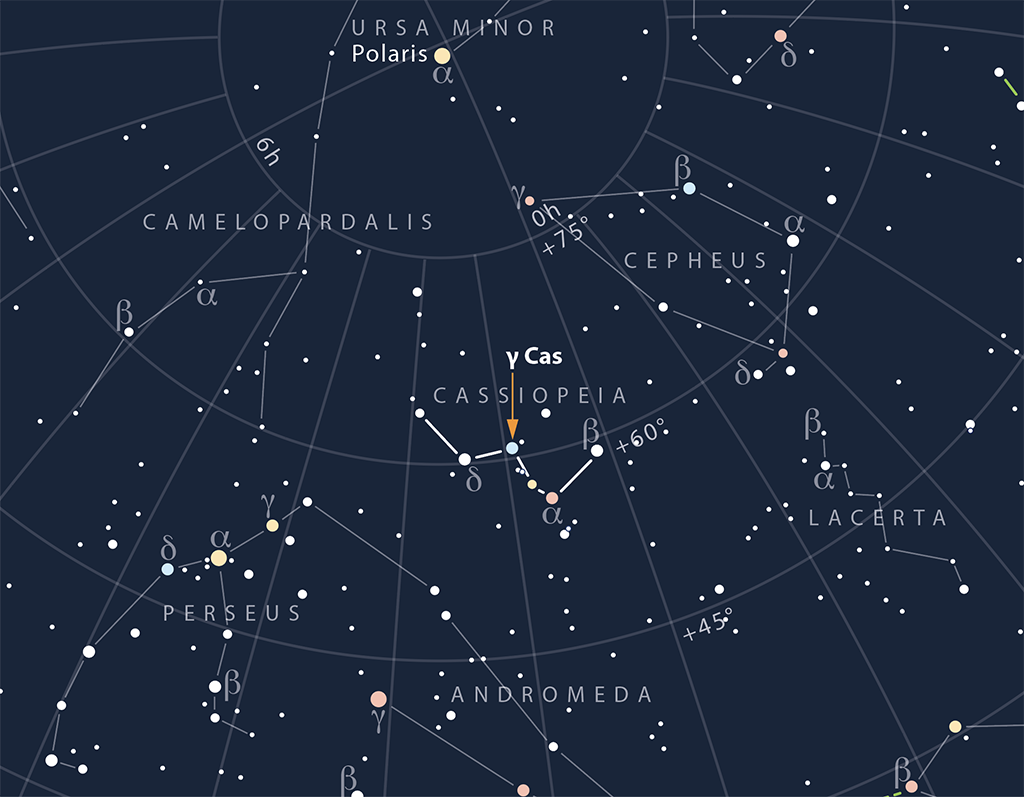
This story , including our Astronomy Now finder chart, was originally published by the European Space Agency.
For more on the gamma-Cas results, see Orbital motion detected in γ Cas Fe K emission lines, published today in the journal Astronomy & Astrophysics.
For more on how astronomers are realising that binary star evolution is much more complicated than we originally thought, see our cover story from March 2026, Stars that shouldn’t exist.










Related Posts

Stay Informed With the Latest & Most Important News
Previous Post
Next Post




Advertisement
-
 01Two Black Holes Observed Circling Each Other for the First Time
 -
 02From Polymerization-Enabled Folding and Assembly to Chemical Evolution: Key Processes for Emergence of Functional Polymers in the Origin of Life
 -
 03Astronomy 101: From the Sun and Moon to Wormholes and Warp Drive, Key Theories, Discoveries, and Facts about the Universe (The Adams 101 Series)
 -
 04True Anomaly hires former York Space executive as chief operating officer
 -
 05Φsat-2 begins science phase for AI Earth images
 -
 06Hurricane forecasters are losing 3 key satellites ahead of peak storm season − a meteorologist explains why it matters
 -
 07Binary star systems are complex astronomical objects − a new AI approach could pin down their properties quickly