
Now Reading: NASA to test nuclear electric propulsion with 2028 mission to Mars
-
01
NASA to test nuclear electric propulsion with 2028 mission to Mars


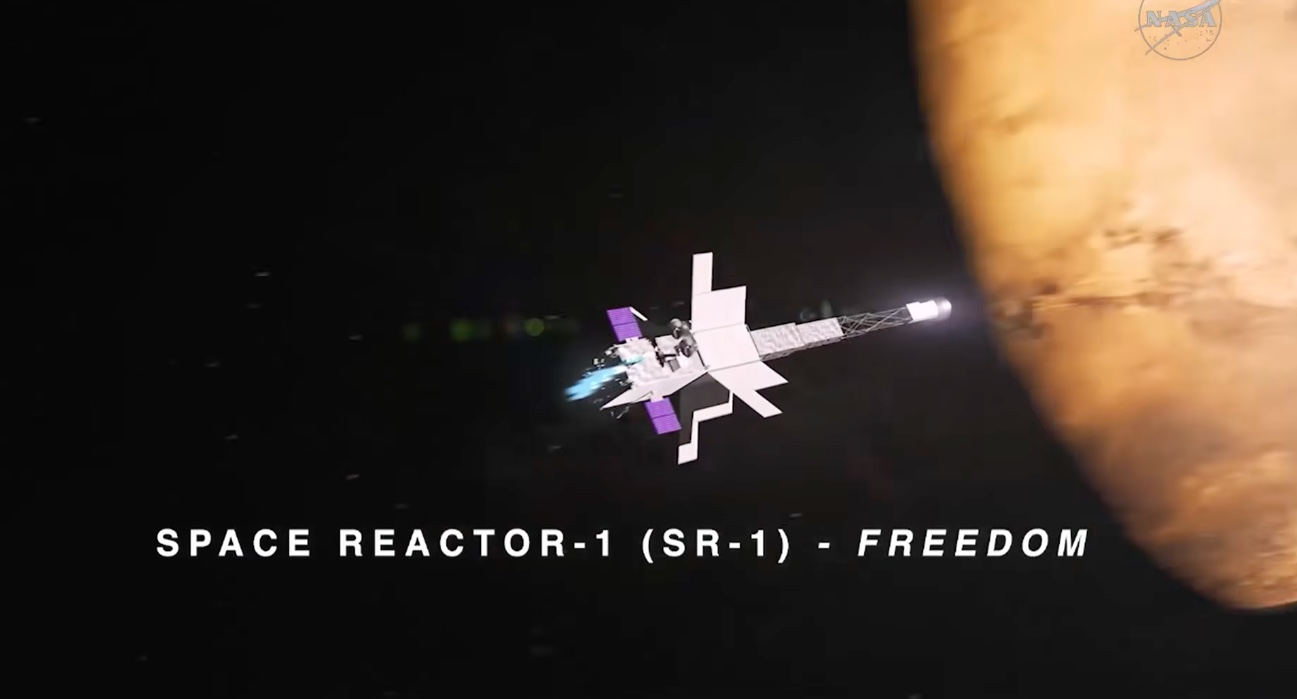

WASHINGTON — NASA’s new exploration strategy includes the rapid development of a nuclear-powered mission to Mars in 2028, leveraging hardware originally built for the lunar Gateway.
As part of the agency’s “Ignition” event March 24, NASA announced a mission called Space Reactor 1 (SR-1) Freedom. That spacecraft, launching at the end of 2028, would use a nuclear electric propulsion system to go to Mars.
“After decades of study and millions spent on concepts that have never left Earth, America will finally get underway on nuclear power in space,” NASA Administrator Jared Isaacman said at the event.
SR-1 Freedom will use a nuclear reactor that NASA plans to develop, generating 20 kilowatts of electrical power using high-assay low-enriched uranium, or HALEU. The reactor will be placed at one end of a truss to protect spacecraft electronics from the radiation it produces.
At the other end of the truss will be the Power and Propulsion Element, or PPE, that NASA had planned to use on the Gateway. During the event, NASA announced it no longer planned to develop the Gateway, directing funding and capabilities from the Gateway to a lunar base.
PPE, being built by Lanteris Space Systems, was originally designed to provide both power and electric propulsion for the Gateway. It will be adapted to become the electric propulsion system for SR-1 Freedom, using power from the reactor.
“PPE gives us a huge leg up. That’s the only thing that makes this achievable,” Steve Sinacore, program executive for NASA’s Fission Surface Power program, said in an interview. “That’s a very capable spacecraft bus that is going to be adaptable.”
Between the reactor and the PPE will be radiators for heat rejection from the reactor. The spacecraft will have some solar arrays to provide additional power, particularly immediately after launch, before the reactor is activated.
In his presentation at Ignition, Sinacore described SR-1 as a “pathfinder” for space nuclear power and propulsion, an effort that has made little progress for decades despite multiple efforts that have spent a combined $20 billion.
“The lack of an operational space nuclear reactor is not a technology problem. It’s an execution problem,” he said. He cited four “failure modes” for past projects, including a lack of sustained mission pull for the technology, overly ambitious projects, unrealistic timelines and fragmented leadership. Those factors mirror an assessment published by the Idaho National Laboratory (INL) last summer.
“SR-1 Freedom is designed to break every one of those patterns,” he said, with the demand for the technology for a Mars mission, a reactor that is relatively small, a firm timeline to meet the Mars launch window and clear leadership by NASA.
NASA’s initial response to the INL report was to pursue development of a nuclear reactor for the moon through the Fission Surface Power program, which would have used a reactor developed by industry. However, that effort appeared to stall after two draft requests for proposals.
SR-1 Freedom will take a different development approach. “We’re going to bring this in-house, with NASA as the prime. We’re going to leverage the expertise of the Department of Energy to design and assemble the reactor,” he said in the interview.
“We realized that when we went out and said, ‘Industry, you do it all,’ that was a big ask,” he said of the earlier Fission Surface Power plans, with challenges that went beyond technology to topics like launch authority and indemnification. “This really is a NASA near-impossible thing. Let’s trailblaze, let’s be the pathfinder, and then hand off to them.”
He said that NASA planned to share the reactor design for SR-1 Freedom with industry. “No one owns proprietary rights to it. It will be to the benefit of all the reactor companies.”
The reactor design is intended to be extensible to future missions. That includes Lunar Reactor 1, a reactor to generate power on the surface of the moon that would launch in 2030. “In the 2030s we will scale up and move into production,” he said at the briefing, including systems capable of producing hundreds of kilowatts to megawatts of power.
SR-1 Freedom will do more than simply test nuclear electric propulsion. Upon arriving at Mars a year after launch, it will deploy a science payload called SkyFall, featuring three helicopters based on the Ingenuity helicopter that accompanied the Perseverance rover.
The helicopters will study a potential future human landing site on Mars, Sinacore said, including looking for subsurface water ice.
“They’re going to be very, very similar in capabilities to Ingenuity,” Nicky Fox, NASA associate administrator for science, said at a press conference at the end of the daylong event. “They’re going to have cameras on them to be able to take images, but they’re not going to be full-up heavy science birds.”
The agency is still studying what to do with SR-1 Freedom once it reaches Mars and deploys SkyFall.
“We have not decided where the mission will end,” Sinacore said, including options to enter orbit around Mars or fly by it to another destination that could further test the nuclear electric propulsion system. “We do want to push the bounds with this demonstrator.”










Related Posts

Stay Informed With the Latest & Most Important News

Advertisement
-
 01Two Black Holes Observed Circling Each Other for the First Time
 -
 02From Polymerization-Enabled Folding and Assembly to Chemical Evolution: Key Processes for Emergence of Functional Polymers in the Origin of Life
 -
 03Astronomy 101: From the Sun and Moon to Wormholes and Warp Drive, Key Theories, Discoveries, and Facts about the Universe (The Adams 101 Series)
 -
 04True Anomaly hires former York Space executive as chief operating officer
 -
 05Φsat-2 begins science phase for AI Earth images
 -
 06Hurricane forecasters are losing 3 key satellites ahead of peak storm season − a meteorologist explains why it matters
 -
 07Binary star systems are complex astronomical objects − a new AI approach could pin down their properties quickly