
Now Reading: New portrait of the oldest-known supernova | Space photo of the day for March 27, 2026
-
01
New portrait of the oldest-known supernova | Space photo of the day for March 27, 2026

New portrait of the oldest-known supernova | Space photo of the day for March 27, 2026

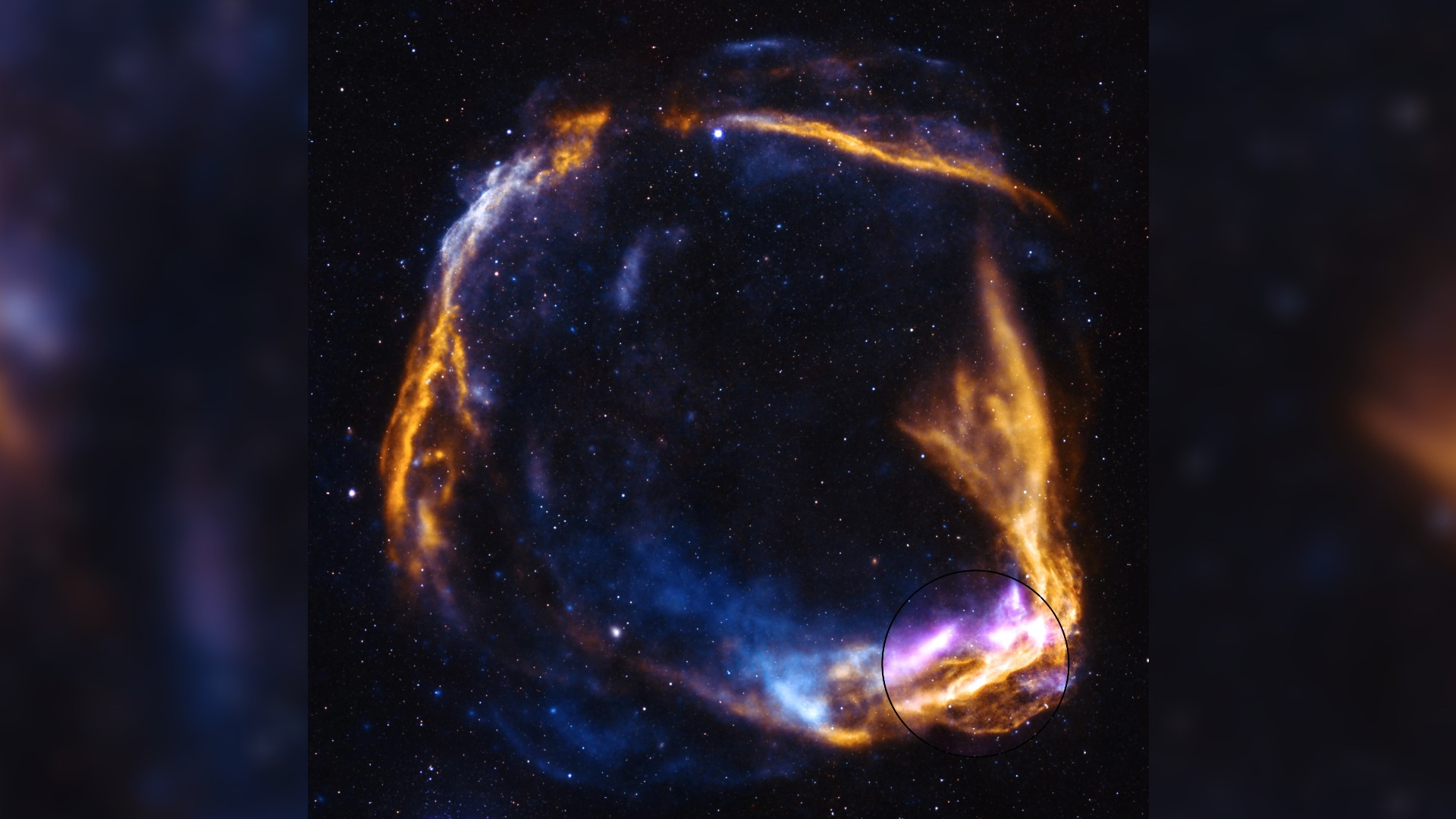

A NASA X-ray telescope has captured a breathtaking portrait of a supernova remnant, revealing unseen features of the exploded star.
What is it?
This image depicts the supernova remnant SN 185, found some 8,000 light-years away from Earth in the direction of the sun’s closest sibling, the triple star Alpha Centauri. Based on historical records made by Chinese astronomers, scientists believe the star exploded in the year AD 185. It may have been visible in the sky for as many as eight months.
In this new image, NASA’s Imaging X-ray Polarimetry Explorer (IXPE) observatory helped astronomers study the outer rim of this object (also known as RCW 86) and discover that the expansion of the remnant’s gases appears to have stopped in the region NASA has highlighted by a purple ring in the image.
Article continues below
Astronomers have previously found that a large low-density “cavity” in the center of the supernova caused it to expand more rapidly than they would normally expect, and now IXPE’s new observation of this outer rim helps “fill in a fuller picture of what other telescopes have observed,” NASA wrote in a statement accompanying the image.
Why is it amazing?
IXPE captured the image using its unique ability to study the polarization of X-rays, or how waves of X-ray light oscillate relative to their direction.
By studying this polarization, IXPE can help astronomers probe some of the deepest mysteries of the cosmos, such as why black holes spin, what powers the extreme jets blasting from supermassive black holes, or why pulsars glow so brightly in X-ray light.
IXPE launched on Dec. 9, 2021, from NASA’s Kennedy Space Center in Florida atop a SpaceX Falcon 9 rocket. In its first four years of operation, it has studied a black hole’s “heartbeat”, observed supernova remnants, and peered into the magnetic fields of neutron stars.










Related Posts
Stay Informed With the Latest & Most Important News

Advertisement
-
 01Two Black Holes Observed Circling Each Other for the First Time
 -
 02From Polymerization-Enabled Folding and Assembly to Chemical Evolution: Key Processes for Emergence of Functional Polymers in the Origin of Life
 -
 03Astronomy 101: From the Sun and Moon to Wormholes and Warp Drive, Key Theories, Discoveries, and Facts about the Universe (The Adams 101 Series)
 -
 04True Anomaly hires former York Space executive as chief operating officer
 -
 05Φsat-2 begins science phase for AI Earth images
 -
 06Hurricane forecasters are losing 3 key satellites ahead of peak storm season − a meteorologist explains why it matters
 -
 07Binary star systems are complex astronomical objects − a new AI approach could pin down their properties quickly