
Now Reading: A Planetary Illusion’s Funeral: Non-detection of a Gaia DR3 Exoplanet Candidate, and the Role of Intermediate-precision Radial Velocities in Gaia Exoplanet Follow-up
-
01
A Planetary Illusion’s Funeral: Non-detection of a Gaia DR3 Exoplanet Candidate, and the Role of Intermediate-precision Radial Velocities in Gaia Exoplanet Follow-up

A Planetary Illusion’s Funeral: Non-detection of a Gaia DR3 Exoplanet Candidate, and the Role of Intermediate-precision Radial Velocities in Gaia Exoplanet Follow-up

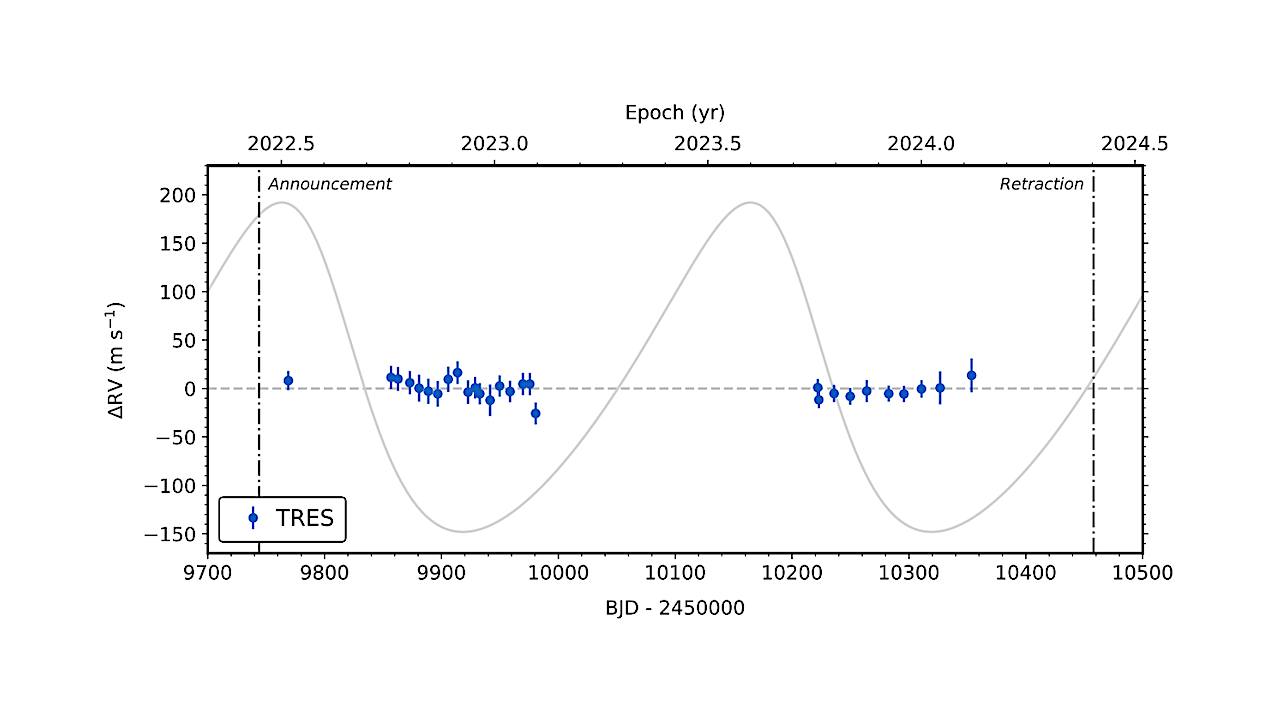

TRES RV observations of HD 12800. We mark the dates of announcement (2022-06-13) and official retraction (2024-05-27) for the Gaia DR3 planet candidate. Our observations would have easily detected the RV signal expected from the Gaia DR3 orbital solution, and independently verify that the companion does not exist. While in this case the ultimate result is a non-detection, this nonetheless serves to demonstrate the value of intermediate-precision (≈10 m s−1 ) RV observations for the follow-up of Gaia astrometric exoplanet candidates. — astro-ph.EP)
The detection of exoplanets using astrometry has long been an area of interest, but is fraught with challenges. The Gaia mission is fundamentally reshaping this field thanks to its unprecedentedly precise all-sky astrometric observations. The 2022 release of Gaia DR3 brought the first exoplanets discovered from the Gaia astrometry, including a new candidate around the bright (V=6.6) solar-type star HD 12800.
However, two years after announcement, the Gaia exoplanet candidate was retracted. In this work we report radial velocity observations of HD 12800 acquired with the TRES spectrograph, which we began immediately after the release of Gaia DR3. Our observations failed to detect the planet candidate; nonetheless, we emphasise that the originally proposed companion would have been easily detected in our radial velocity observations.
We conclude with a discussion on the role of intermediate-precision (≈10 m s−1) RV spectrographs in the follow-up of Gaia astrometric exoplanet candidates, relevant to the forthcoming release of Gaia DR4. We argue that such observations may play an important role in planet confirmation for stars between approximately 8<G<12, likely to represent a significant fraction of Gaia exoplanet discoveries.
Alexander Venner, Chelsea X. Huang, David W. Latham, Samuel N. Quinn, Allyson Bieryla, Andrew Vanderburg, Robert A. Wittenmyer
Comments: 8 pages, 2 tables, 1 figure. Accepted to AJ
Subjects: Earth and Planetary Astrophysics (astro-ph.EP); Astrophysics of Galaxies (astro-ph.GA); Instrumentation and Methods for Astrophysics (astro-ph.IM)
Cite as: arXiv:2603.19402 [astro-ph.EP] (or arXiv:2603.19402v1 [astro-ph.EP] for this version)
https://doi.org/10.48550/arXiv.2603.19402
Focus to learn more
Submission history
From: Alexander Venner
[v1] Thu, 19 Mar 2026 18:50:21 UTC (96 KB)
https://arxiv.org/abs/2603.19402
Astrobiology,











Related Posts

Stay Informed With the Latest & Most Important News
Previous Post
Next Post

Advertisement
-
 01Two Black Holes Observed Circling Each Other for the First Time
 -
 02From Polymerization-Enabled Folding and Assembly to Chemical Evolution: Key Processes for Emergence of Functional Polymers in the Origin of Life
 -
 03Astronomy 101: From the Sun and Moon to Wormholes and Warp Drive, Key Theories, Discoveries, and Facts about the Universe (The Adams 101 Series)
 -
 04True Anomaly hires former York Space executive as chief operating officer
 -
 05Φsat-2 begins science phase for AI Earth images
 -
 06Hurricane forecasters are losing 3 key satellites ahead of peak storm season − a meteorologist explains why it matters
 -
 07Binary star systems are complex astronomical objects − a new AI approach could pin down their properties quickly